Driving Success Factors of LINE Micro-App Architecture: A Technical Assessment of Information System Quality and Empirical Value
DOI:
https://doi.org/10.65205/jcct.2026.e3285Keywords:
Information System, LIFF, User Satisfaction Evaluation, Business PerformanceAbstract
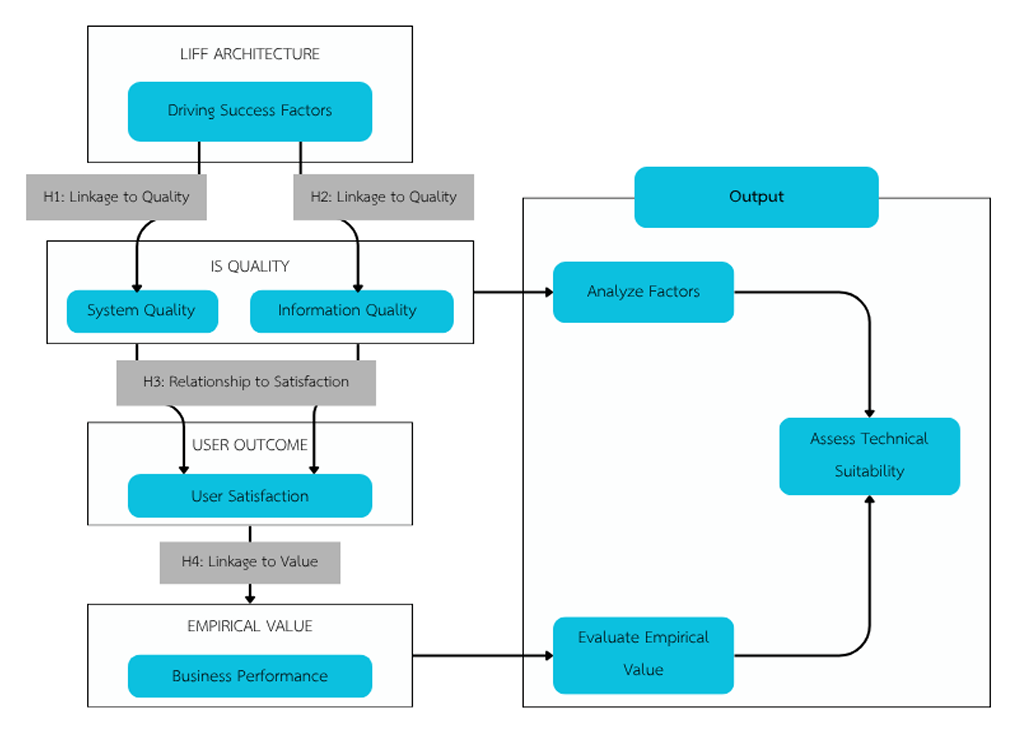
This research aimed to (1) study the success drivers of the LINE Front-end Framework (LIFF) architecture that affect information system quality, (2) evaluate the effect of information system quality on user satisfaction, and (3) examine the influence of user satisfaction on the performance of community enterprises by applying the Extended IS Success Model framework. The sample comprised 175 community members from Surin Province, drawn using stratified random sampling. The research instrument used was an online questionnaire. Data were analyzed using multiple regression, path analysis, and mediation analysis. The results showed that the success factors of the LIFF architecture, including ease of use, Integration with platforms, and data security, had a statistically significant positive impact on the information system's quality (p < 0.001). In addition, information quality influenced user satisfaction (β = 0.547, p < 0.001), and user satisfaction directly impacted the business performance of community enterprises (β = 0.654, R² = 0.428, p < 0.001). The study results show that the Extended IS Success Model appropriately describes the success of using micro-applications on the LINE platform and reflects LIFF's potential to support community enterprise operations in a real-world context.
Downloads
References
Alshibly, H. H. (2015). Investigating Decision Support System (DSS) Success: A Partial Least Squares Structural Equation Modeling Approach. Journal of Business Studies Quarterly, 6(4), 56-77.
Amornkitvikai, Y., Tham, S. Y., Harvie, C., & Buachoom, W. W. (2022). Barriers and Factors Affecting the E-Commerce Sustainability of Thai Micro-, Small- and Medium-Sized Enterprises (MSMEs). Sustainability, 14(14), 8476. https://doi.org/10.3390/su14148476
Baron, R. M., & Kenny, D. A. (1986). The Moderator–Mediator Variable Distinction in Social Psychological Research: Conceptual, Strategic, and Statistical Considerations. Journal of Personality and Social Psychology, 51(6), 1173-1182. https://doi.org/10.1037/0022-3514.51.6.1173
Cipher. (2025). LINE Mini App: Build LINE Apps Effortlessly for Every Type of Business. https://www.cipher.co.th/blogs/line-mini-app (In Thai)
Davis, F. D. (1989). Perceived Usefulness, Perceived Ease of Use, and User Acceptance of Information Technology. MIS Quarterly, 13(3), 319-340. https://doi.org/10.2307/249008
DeLone, W. H., & McLean, E. R. (2003). The DeLone and McLean Model of Information Systems Success: A Ten-Year Update. Journal of Management Information Systems, 19(4), 9-30. https://doi.org/10.1080/07421222.2003.11045748
Foxbith. (2025). 5 Key LINE LIFF Features Businesses Shouldn’t Overlook. https://www.foxbith.com/blog/top-5-line-liff-features (In Thai)
Iivari, J. (2005). An Empirical Test of the DeLone-McLean Model of Information System Success. The Data Base for Advances in Information Systems, 36(2), 8-27. https://doi.org/10.1145/1066149.1066152
Jongwanich, J., & Kohpaiboon, A. (2025). Digital Technology Adoption and the Financial Performance of SMEs: Evidence from Thailand. Asian Economic Papers. https://doi.org/10.1162/asep_a_00922
Krejcie, R. V., & Morgan, D. W. (1970). Determining Sample Size for Research Activities. Educational and Psychological Measurement, 30(3), 607-610. https://doi.org/10.1177/001316447003000308
Lertwongsatien, C., & Wongpinunwatana, N. (2003). E-Commerce Adoption in Thailand: An Empirical Study of Small and Medium Enterprises (SMEs). Journal of Global Information Technology Management, 6(3), 67-83. https://doi.org/10.1080/1097198X.2003.10856356
LINE Developers. (n.d.). LINE Front-end Framework (LIFF). https://developers.line.biz/en/docs/liff/overview
Martínez-Plumed, F., Gómez, E., & Hernández-Orallo, J. (2021). Futures of Artificial Intelligence through Technology Readiness Levels. Telematics and Informatics, 58, 101525. https://doi.org/10.1016/j.tele.2020.101525
Mason, M. C., Zamparo, G., Marini, A., & Ameen, N. (2022). Glued to Your Phone? Generation Z’s Smartphone Addiction and Online Compulsive Buying. Computers in Human Behavior, 136, 107404. https://doi.org/10.1016/j.chb.2022.107404
Nunnally, J. C. (1978). Psychometric Theory (2nd ed.). McGraw-Hill.
Petter, S., DeLone, W., & McLean, E. (2008). Measuring Information Systems Success: Models, Dimensions, Measures, and Interrelationships. European Journal of Information Systems, 17(3), 236-263. https://doi.org/10.1057/ejis.2008.15
Sagala, G. H., & Őri, D. (2024). Exploring Digital Transformation Strategy to Achieve SMEs Resilience and Antifragility: A Systematic Literature Review. Journal of Small Business & Entrepreneurship. https://doi.org/10.1080/08276331.2024.2392080
Tasuntia, J., Chaiwachirakhampon, A., Hiranrat, W., & Silachot, K. (2024). Modern Marketing Platform for Surin Farmer Group. Information Technology Journal KMUTNB, 20(2), 14-24. https://doi.org/10.14416/j.it/2024.v2.002
The Digital Tips. (2023). What is LINE LIFF (LINE Front-end Framework), and How Does It Benefit Businesses? https://thedigitaltips.com/blog/line/line-liff (In Thai)
Tongdaeng, W., & Mahakanjana, C.-N. (2022). Thai SMEs’ Response in the Digital Economy Age: A Case Study of Community-Based Tourism Policy Implementation. Social Sciences, 11(4), 180. https://doi.org/10.3390/socsci11040180
Downloads
Published
How to Cite
Issue
Section
License
Copyright (c) 2026 Journal of Computer and Creative Technology

This work is licensed under a Creative Commons Attribution-NonCommercial-NoDerivatives 4.0 International License.