Design and Implementation of a Low-Code Geofencing Architecture for Location-Based Attendance Management in Local Government Organizations
DOI:
https://doi.org/10.65205/jcct.2026.e3674Keywords:
Geofencing, Low-Code Architecture, Workforce Mobility, Location-Based Services, Digital TransformationAbstract
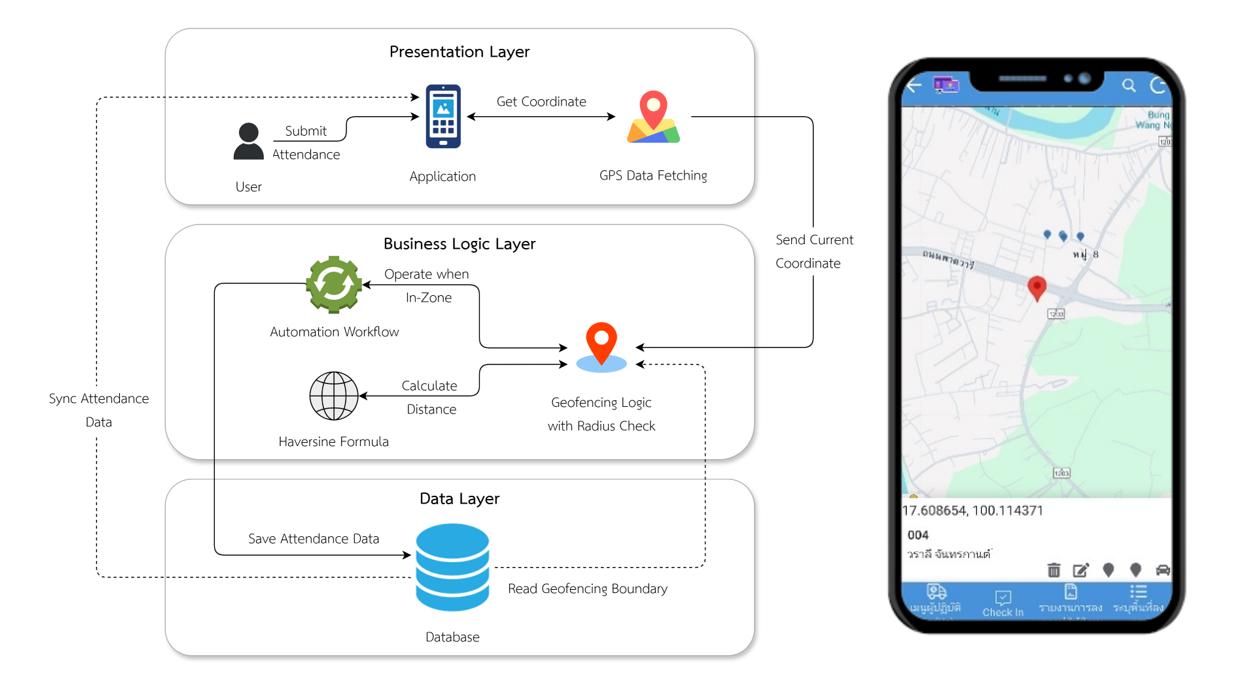
As public organizations undergo digital transformation, efficient workforce mobility management is imperative. This study addresses a critical gap in the integration of spatial tracking capabilities within low-code platforms by designing and implementing a low-code geofencing architecture at Thasao Subdistrict Municipality, Thailand. The proposed three-tier architecture facilitates real-time data processing using Google AppSheet and Google Sheets. The system's business logic implements the Haversine formula for geodesic distance calculation and incorporates error-handling mechanisms to mitigate intermittent GPS signal instability. Performance evaluation via black-box testing demonstrated a 100% success rate across predefined functional test cases under controlled conditions, rather than absolute system accuracy. Field observations further revealed that real-world performance may vary depending on network latency and GPS signal quality. Empirical data collected through purposive sampling from 20 off-site personnel indicated a high level of satisfaction (Mean = 4.39, S.D. = 0.57), with the evaluation instrument reaching high reliability (Cronbach's Alpha = 0.85). This research contributes a scalable and resource-efficient architectural framework that reduces administrative workload and supports practical digital transformation in local government contexts, while also highlighting implementation constraints relevant to real-world deployment.
Downloads
References
Al Farisi, S., Fauziah, & Tamara Aldisa, R. (2023, February 16). A Combination of the Haversine Formula Algorithm and the Sequential Searching Algorithm in Web Based Online Attendance. 2023 International Conference on Computer Science, Information Technology and Engineering, 450–455. Institute of Electrical and Electronics Engineers. https://doi.org/10.1109/iccosite57641.2023.10127681
Brünninghaus, M., & Röcker, C. (2022, July 25-28). Low-Code Development in Worker Assistance Systems: Improving Flexibility and Adaptability. 2022 IEEE 20th International Conference on Industrial Informatics, 366–373. Institute of Electrical and Electronics Engineers. https://doi.org/10.1109/indin51773.2022.9976178
Chauhan, V., Singh, H., Dewari, K., & Kumar, I. (2024, July 10-12). Efficient Employee Tracking with Smart Attendance System Using Advanced Face Recognition and Geofencing. 2024 2nd International Conference on Sustainable Computing and Smart Systems, 750–755. Institute of Electrical and Electronics Engineers. https://doi.org/10.1109/icscss60660.2024.10625038
Doodala, A. N. K. (2023). Offline-First Android Architecture for Waste Management in Low Connectivity Zones. International Journal of Emerging Trends in Computer Science and Information Technology, 4(1), 201–209. https://doi.org/10.63282/3050-9246.ijetcsit-v4i1p121
Gupta, S. K., Yadav, N., Pandey, A., Sharma, R., & Chauhan, A. (2025, April 4-6). Geolocation-Based Attendance Tracking System: A Comprehensive Review. 2025 3rd International Conference on Communication, Security, and Artificial Intelligence, 932–935. Institute of Electrical and Electronics Engineers. https://doi.org/10.1109/iccsai64074.2025.11064660
Hair, J. F., Black, W. C., Babin, B. J., & Anderson, R. E. (2019). Multivariate Data Analysis (8th ed.). Cengage Learning.
Merry, K., & Bettinger, P. (2019). Smartphone GPS Accuracy Study in an Urban Environment. PLOS ONE, 14(7), e0219890. https://doi.org/10.1371/journal.pone.0219890
Ngamsong, S., Lerk-U-Suke, S., & Wongyai, S. (2021). Building of Mobile Application with No-Code Development for Field Data Collection in Tax Administration of Local Administrative Organization. The Journal of Spatial Innovation Development, 2(3), 55–69. (In Thai)
O-In, S. (2024). Development of a Geo-Informatics Database System to Support Urban Conservation and Rehabilitation: A Case Study of Mueang Ratchaburi District, Thailand. Humanities, Arts and Social Sciences Studies, 24(1), 33–42. https://doi.org/10.69598/hasss.24.1.260631
Patil, H., Darekar, O., Thorbole, B., Kindre, P., & Dekate, V. (2025). Tick Mark: Geofencing Attendance System. International Journal for Research in Applied Science and Engineering Technology, 13(4), 1269–1274. https://doi.org/10.22214/ijraset.2025.68524
Pressman, R. S., & Maxim, B. R. (2020). Software Engineering: A Practitioner's Approach (9th ed.). McGraw-Hill Education.
Rokis, K., & Kirikova, M. (2023). Exploring Low-Code Development: A Comprehensive Literature Review. Complex Systems Informatics and Modeling Quarterly, 36, 68–86. https://doi.org/10.7250/csimq.2023-36.04
Sarawan, K., Sarnthong, A., Khumla, P., & Nasinprom, N. (2023). Improvement of Time Attendance Online System: Case Study in the University. Journal of Advanced Development in Engineering and Science, 11(30), 16–31. (In Thai)
Shevchenko, Y., & Reips, U. D. (2024). Geofencing in Location-Based Behavioral Research: Methodology, Challenges, and Implementation. Behavior Research Methods, 56, 6411–6439. https://doi.org/10.3758/s13428-023-02213-2
Tang, Y., Li, T., Zhu, R., Du, F., Wang, J., & Ma, Z. (2021). A Discovery Method for Hierarchical Software Execution Behavior Models Based on Components. Scientific Programming, 2021, 1–22. https://doi.org/10.1155/2021/4788357
Downloads
Published
How to Cite
Issue
Section
Categories
License
Copyright (c) 2026 Journal of Computer and Creative Technology

This work is licensed under a Creative Commons Attribution-NonCommercial-NoDerivatives 4.0 International License.