
Editorial Process

The Journal of Computer and Creative Technology (JCCT) employs a double-blind peer review process, involving at least three independent reviewers. The Editor-in-Chief make a final decision on whether to accept/reject the submission. The Editor-in-Chief is responsible for the academic quality of the editorial process based on the publication ethics in line with the ethical standards of the Committee on Publication Ethics (COPE) and the announcement of the Thai-Journal Citation Index Center, regarding the evaluation of the ethics and principles in Thai academic journals.

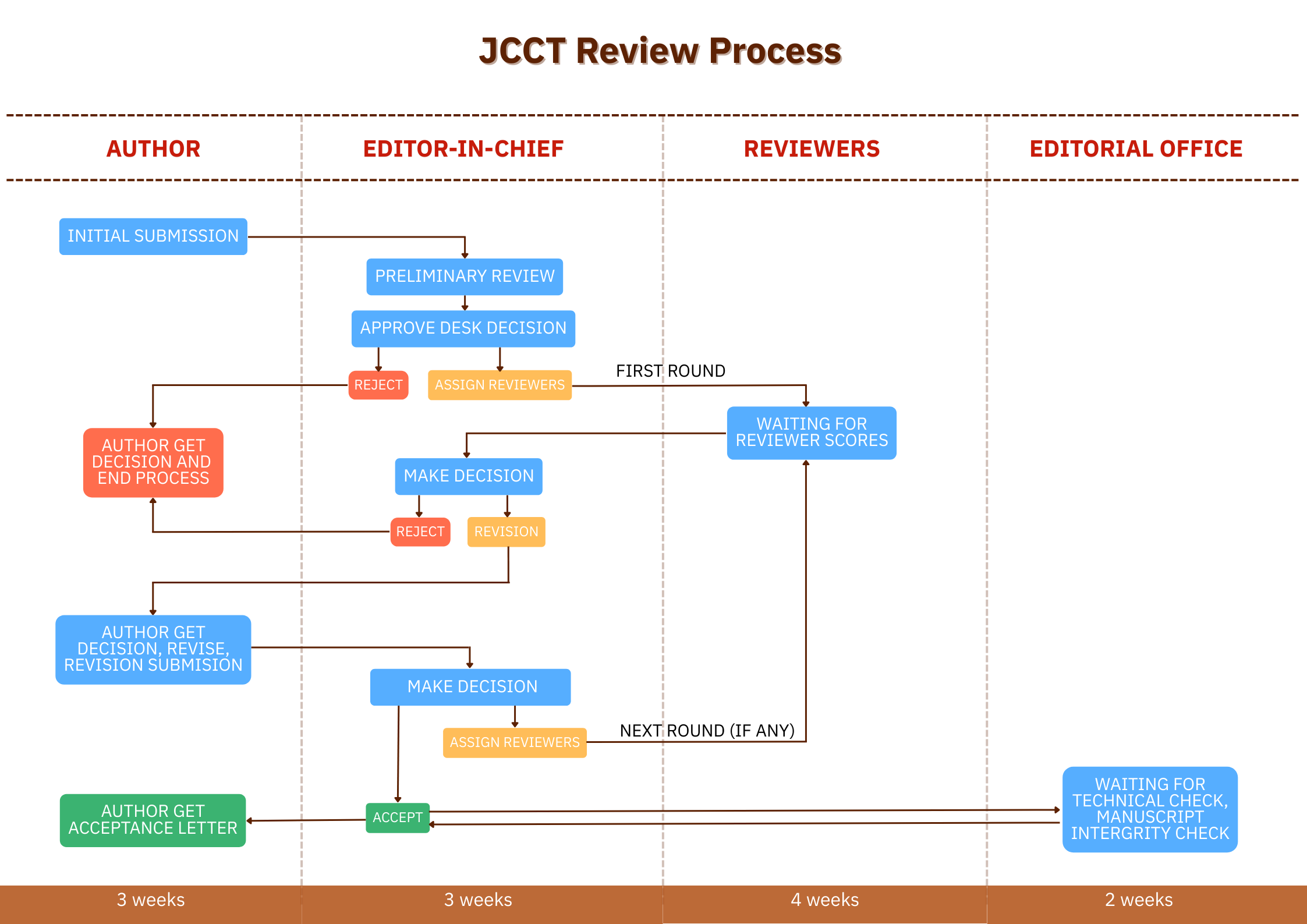
A flow chart of the review process is given below:

Preliminary Review

All submitted manuscripts will undergo a preliminary review by the Editorial-in-Chief to determine whether they are appropriately focused, fall within the journal’s scope, are properly formatted, and meet the article processing charge (APC) requirements. Manuscripts must also adhere to the journal's publication ethics and AI policies. Submissions that do not comply with these policies, fail to meet the required standards, or fall outside the journal’s scope will be rejected through a desk decision. Manuscripts that are inadequately prepared will be returned to the author(s) for revision and resubmission. After the preliminary review, qualified manuscripts will be forwarded for peer review by the Editorial-in-Chief.

Peer Review

All manuscripts considered for publication undergo a rigorous and thorough peer-review process. Following a preliminary review, each manuscript is assigned to qualified reviewers for evaluation. Reviewers may provide one of the following recommendations: Accept the manuscript for publication without revisions (Accept Submission), Request revisions, then submit the revised manuscript to the Editor-in-Chief for a final decision (Revisions Required), Request revisions and a resubmission for further review by the same reviewer(s) (Resubmit for Review), or Reject the manuscript (Decline Submission).

At least three independent experts, who are neither the Editor-in-Chief nor affiliated with the authors, participate in the peer-review process. The journal follows a double-blind peer-review system, meaning that the reviewers are unaware of the authors’ identities, and the authors do not know the reviewers’ identities.

The Editor-in-Chief is responsible for assigning manuscripts to reviewers with no conflicts of interest, ensuring they have relevant expertise in the manuscript's subject area.

Reviewers’ Responsibilities

Reviewers are expected to adhere to the journal’s publication ethics. Their responsibilities include checking for duplication, similarities, plagiarism, self-plagiarism, and incorrect citations; evaluating the academic and research quality of the manuscript in accordance with scholarly standards; reviewing the formatting; and providing constructive suggestions for both authors and readers. Reviewers are also expected to complete their evaluations and submit the results within the designated timeframe.

Editorial Decisions

After receiving recommendations and comments from the three reviewers, the Editor-in-Chief will make a decision, which may take one of the following four forms.

Accept

Acceptance of the manuscript is based on the reviewers’ evaluations. The publication decision considers not only the quality of the work but also the overall significance and contribution of the article.

Revise

The manuscript will be accepted upon satisfactory completion of the revisions as specified by the reviewers. Authors are allotted fourteen days to respond to the reviewers’ comments via the revision form and to revise the manuscript accordingly.

Revise and resubmit to reviewers in the next round

The manuscript will be accepted upon thorough revision as specified by the reviewers. Authors are given fourteen days to respond to the reviewers’ comments using the revision form and to revise the manuscript accordingly. The revised version will then be sent back to the same reviewers for further evaluation in the next round.

Reject

Any manuscript must be recommended by at least three external reviewers before it can be accepted for final publication. The Editor-in-Chief reserves the right to reject any manuscript if its subject matter is deemed inappropriate, the quality is insufficient, or the results are found to be inaccurate. Furthermore, even after revision, articles may still be rejected if they exhibit significant weaknesses or fail to provide a meaningful and original contribution to the field.

Online First (status 'In Progress')

Most articles accepted and ready for publication in JCCT are published Online First (status 'In Progress') of the current issue. Articles published Online First are copyedited and proofed by the author(s) before being published. Online First articles already have the Digital Object Identifier (DOI). However, a DOI will always be discovered after a complete issue is published.