Development of a Learning Management Model Based on Engineering Design Processes Integrated with Artificial Intelligence Technology to Enhance Creative Thinking and Problem-Solving Abilities of Grade 8 Students
DOI:
https://doi.org/10.65205/jcct.2026.e4205Keywords:
SUTLUM Learning Management Model, Engineering Design Process, Artificial Intelligence, Creativity, Problem-Solving AbilityAbstract
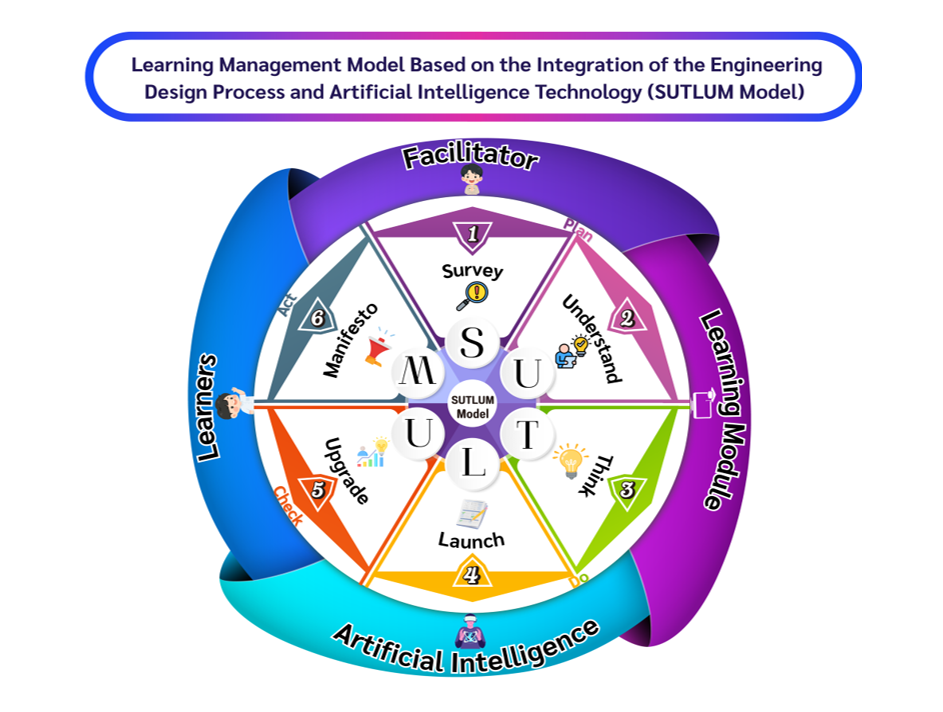
This research aimed to (1) investigate guidelines for developing a learning management model based on the engineering design process integrated with artificial intelligence technology, (2) develop the learning management model, and (3) examine the effects of implementing the model. The sample consisted of 30 Grade 8 students, selected through purposive sampling. The research instruments included an expert interview form, lesson plans, a learning management model, learning support tools, a creativity assessment form, a problem-solving ability assessment form, a learning achievement test, and a satisfaction questionnaire. Data were analyzed using mean, standard deviation, reliability coefficients, and t-tests. The findings indicated that (1) the development of the learning management model should integrate the engineering design process with artificial intelligence to support students’ thinking, analysis, design, and product development through project-based learning and authentic problem-solving situations with ethical considerations. (2) The developed SUTLUM Model comprised six stages: Survey, Understand, Think, Launch, Upgrade, and Manifesto, along with four key components: teachers, learners, AI tools, and learning modules. The model demonstrated a very high level of Quality (M = 4.65, S.D. = 0.47). (3) The implementation results showed that students’ creativity was at a very high level (M = 31.90 out of 36), and their problem-solving ability was also at a very high level (M = 21.60 out of 24). In addition, students’ post-test achievement scores were significantly higher than their pre-test scores at the .05 level, and their satisfaction with the learning management was at the highest level (M = 4.68, S.D. = 0.46).
Downloads
References
Amabile, T. M. (1996). Creativity in Context. Westview Press. https://archive.org/details/creativityincont0000amab/page/n9/mode/2up
Arends, R. I. (2012). Learning to Teach (9th ed.). McGraw-Hill.
Autthawuttikul, S., Laisema, S., & Rodkroh, P. (2024). Enhancing Critical Learning through an Adaptive Web Application: A Case Study of Lower Secondary School Students Studying Artificial Intelligence Technology. Humanities, Arts and Social Sciences Studies, 24(1), 55–67. https://doi.org/10.69598/hasss.24.1.263101 DOI: https://doi.org/10.69598/hasss.24.1.263101
Battelle for Kids. (2019). Framework for 21st Century Learning Definitions. https://static.battelleforkids.org/documents/p21/P21_Framework_DefinitionsBFK.pdf
Bostrom, N. (2014). Superintelligence: Paths, Dangers, Strategies. Oxford University Press.
Chandrasekera, T., Hosseini, Z., & Perera, U. (2025). Can Artificial Intelligence Support Creativity in Early Design Processes? International Journal of Architectural Computing, 23(1), 122–136. https://doi.org/10.1177/14780771241254637 DOI: https://doi.org/10.1177/14780771241254637
Cross, N. (2008). Engineering Design Methods: Strategies for Product Design (4th ed.). John Wiley & Sons.
Dewey, J. (1938). Experience and Education. Macmillan.
Dym, C. L., Agogino, A. M., Eris, O., Frey, D. D., & Leifer, L. J. (2005). Engineering Design Thinking, Teaching, and Learning. Journal of Engineering Education, 94(1), 103–120. https://doi.org/10.1002/j.2168-9830.2005.tb00832.x DOI: https://doi.org/10.1002/j.2168-9830.2005.tb00832.x
Guilford, J. P. (1950). Creativity. American Psychologist, 5(9), 444–454. https://doi.org/10.1037/h0063487 DOI: https://doi.org/10.1037/h0063487
Guilford, J. P. (1967). Creativity: Yesterday, Today and Tomorrow. The Journal of Creative Behavior, 1(1), 3–14. https://doi.org/10.1002/j.2162-6057.1967.tb00002.x DOI: https://doi.org/10.1002/j.2162-6057.1967.tb00002.x
Holmes, W., Bialik, M., & Fadel, C. (2019). Artificial Intelligence in Education Promises and Implications for Teaching and Learning. Center for Curriculum Redesign.
Johnson, D. W., & Johnson, R. T. (1999). Learning Together and Alone: Cooperative, Competitive, and Individualistic Learning (5th ed.). Allyn and Bacon.
Jonassen, D. H. (2011). Learning to Solve Problems: A Handbook for Designing Problem-Solving Learning Environments. Routledge.
Joyce, B., Weil, M., & Calhoun, E. (2004). Models of Teaching (9th ed.). Pearson Education.
Karimi, S. (2022). Using the Engineering Design Process to Enhance Creativity and Problem-Solving Skills: Part 1. https://www.scimath.org/article-science/item/12485-1-2 (In Thai)
Khammani, T. (2010). Teaching Science: Knowledge for Effective Learning Management. Chulalongkorn University Press. (In Thai)
Kiatsarutsakuln, N., Wiwanthamongkon, K., Aphinatkhunakorn, P., & Kitroongrueng, P. (2025). Guidelines for Learning Management Based on STEM Education in the BANI World Era for Elementary School Students. Panya, 32(1), 167–180. (In Thai)
Ministry of Higher Education, Science, Research and Innovation, & Ministry of Digital Economy and Society. (2022). National Artificial Intelligence Action Plan for the Development of Thailand (2022–2027). https://pub.nstda.or.th/gov-dx/wp-content/uploads/2022/12/20220726-AI.pdf (In Thai)
Mishra, P., & Koehler, M. J. (2006). Technological Pedagogical Content Knowledge: A Framework for Teacher Knowledge. Teachers College Record: The Voice of Scholarship in Education, 108(6), 1017–1054. https://doi.org/10.1111/j.1467-9620.2006.00684.x DOI: https://doi.org/10.1177/016146810610800610
Piaget, J., & Inhelder, B. (1972). The Psychology of the Child. Basic Books.
Polya, G. (1957). How to Solve It: A New Aspect of Mathematical Method (2nd ed.). Princeton University Press.
Russell, S., & Norvig, P. (2010). Artificial Intelligence: A Modern Approach (3rd ed.). Prentice Hall.
Saritepeci, M., & Durak, H. Y. (2024). Effectiveness of Artificial Intelligence Integration in Design-Based Learning on Design Thinking Mindset, Creative and Reflective Thinking Skills: An Experimental Study. Education and Information Technologies, 29(18), 25175–25209. https://doi.org/10.1007/s10639-024-12829-2 DOI: https://doi.org/10.1007/s10639-024-12829-2
Saylor, J. G., Alexander, W. M., & Lewis, A. J. (1981). Curriculum Planning for Better Teaching and Learning. Holt, Rinehart and Winston.
Sheppard, S. D., Macatangay, K., Colby, A., & Sullivan, W. M. (2008). Educating Engineers: Designing for the Future of the Field. Jossey-Bass.
Siripangpa, T., & Ketprom, C. (2025). General Administration in the BANI World Era of the Schools under Saraburi Primary Educational Service Area Office 2. Phimoldhamma Research Institute Journal, 12(2), 193–206. (In Thai)
The Institute for the Promotion of Teaching Science and Technology. (n.d.). STEM Education and Engineering Design. https://designtechnology.ipst.ac.th/?page_id=1082
Torrance, E. P. (1966). Torrance Tests of Creative Thinking: Norms-Technical Manual. Personnel Press.
Torrance, E. P. (1974). Torrance Tests of Creative Thinking: Directions Manual and Scoring Guide. Ginn and Company.
Trilling, B., & Fadel, C. (2009). 21st Century Skills: Learning for Life in Our Times. Jossey-Bass.
Vygotsky, L. S. (1978). Mind in Society: The Development of Higher Psychological Processes. Harvard University Press.
Wongyai, V., & Patphol, M. (2019). Creative and Productive Learning. Curriculum and Learning Innovation Leadership Center. (In Thai)
Wonsiri, N., Pantapalangkoor, B., & Ketsing, J. (2022). Developing Ninth Graders’ Complex Problem-Solving Competency via Engineering Design Problem-Based Learning. Journal of Education Naresuan University, 24(3), 147–157. (In Thai)
Downloads
Published
How to Cite
Issue
Section
Categories
License
Copyright (c) 2026 Journal of Computer and Creative Technology

This work is licensed under a Creative Commons Attribution-NonCommercial-NoDerivatives 4.0 International License.