การพัฒนารูปแบบการจัดการเรียนรู้ตามแนวคิดกระบวนการออกแบบเชิงวิศวกรรม ร่วมกับเทคโนโลยีปัญญาประดิษฐ์เพื่อส่งเสริมความคิดสร้างสรรค์และความสามารถในการแก้ปัญหาของนักเรียนชั้นมัธยมศึกษาปีที่ 2
DOI:
https://doi.org/10.65205/jcct.2026.e4205คำสำคัญ:
รูปแบบการจัดการเรียนรู้ SUTLUM, กระบวนการออกแบบเชิงวิศวกรรม, เทคโนโลยีปัญญาประดิษฐ์, ความคิดสร้างสรรค์, ความสามารถในการแก้ปัญหาบทคัดย่อ
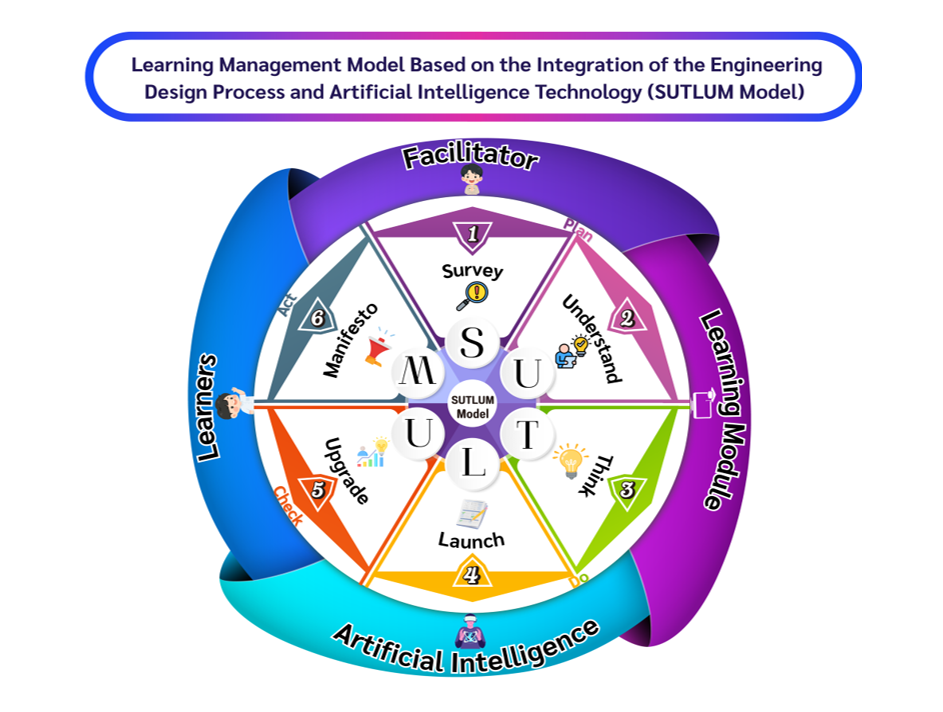
การวิจัยครั้งนี้มีวัตถุประสงค์เพื่อ (1) ศึกษาแนวทางการพัฒนารูปแบบการจัดการเรียนรู้ตามแนวคิดกระบวนการออกแบบเชิงวิศวกรรมร่วมกับเทคโนโลยีปัญญาประดิษฐ์ (2) พัฒนารูปแบบการจัดการเรียนรู้ และ (3) ศึกษาผลการใช้รูปแบบการจัดการเรียนรู้ กลุ่มตัวอย่างเป็นนักเรียนชั้นมัธยมศึกษาปีที่ 2 จำนวน 30 คน ซึ่งได้มาโดยการเลือกแบบเจาะจง เครื่องมือที่ใช้ในการวิจัยประกอบด้วยแบบสัมภาษณ์ผู้เชี่ยวชาญ แผนการจัดการเรียนรู้ รูปแบบการจัดการเรียนรู้ เครื่องมือสนับสนุนการเรียนรู้ แบบประเมินความคิดสร้างสรรค์ แบบประเมินความสามารถในการแก้ปัญหา แบบทดสอบผลสัมฤทธิ์ และแบบประเมินความพึงพอใจ สถิติที่ใช้ในการวิเคราะห์ข้อมูล ได้แก่ ค่าเฉลี่ย ส่วนเบี่ยงเบนมาตรฐาน ค่าความเชื่อมั่น และการทดสอบค่าที ผลการวิจัยพบว่า (1) การพัฒนารูปแบบ การจัดการเรียนรู้ควรบูรณาการกระบวนการออกแบบเชิงวิศวกรรมร่วมกับปัญญาประดิษฐ์ เพื่อสนับสนุนการคิด วิเคราะห์ ออกแบบ และพัฒนาผลงาน ของผู้เรียน ผ่านการเรียนรู้แบบโครงงานและการแก้ปัญหาจากสถานการณ์จริงอย่างมีจริยธรรม (2) รูปแบบการจัดการเรียนรู้ SUTLUM Model ที่พัฒนาขึ้น มีกระบวนการจัดการเรียนรู้ 6 ขั้นตอน ได้แก่ การสำรวจและระบุปัญหา การทำความเข้าใจและวิเคราะห์ปัญหา การคิดและออกแบบแนวทางแก้ปัญหา การดำเนินการและลงมือปฏิบัติ การปรับปรุงผลงานและประเมินผล และการนำเสนอผลงานและสะท้อนการเรียนรู้ รูปแบบมี 4 องค์ประกอบสำคัญ ได้แก่ ผู้สอน ผู้เรียน เครื่องมือปัญญาประดิษฐ์ และโมดูลการเรียนรู้ รูปแบบมีคุณภาพอยู่ในระดับดีมาก (M = 4.65, S.D. = 0.47) (3) ผลการใช้รูปแบบการจัดการเรียนรู้ พบว่า 3.1) นักเรียน มีความคิดสร้างสรรค์อยู่ในระดับดีมาก (M = 31.90 จาก 36 คะแนน) 3.2) นักเรียน มีความสามารถในการแก้ปัญหาอยู่ในระดับดีมาก (M = 21.60 จาก 24 คะแนน) 3.3) นักเรียนมีผลสัมฤทธิ์ทางการเรียนหลังเรียนสูงกว่าก่อนเรียนอย่างมีนัยสำคัญทางสถิติ ที่ระดับ .05 และ 3.4) นักเรียน มีความพึงพอใจต่อการจัดการเรียนรู้ อยู่ในระดับมากที่สุด (M = 4.68, S.D. = 0.46)
Downloads
เอกสารอ้างอิง
Amabile, T. M. (1996). Creativity in Context. Westview Press. https://archive.org/details/creativityincont0000amab/page/n9/mode/2up
Arends, R. I. (2012). Learning to Teach (9th ed.). McGraw-Hill.
Autthawuttikul, S., Laisema, S., & Rodkroh, P. (2024). Enhancing Critical Learning through an Adaptive Web Application: A Case Study of Lower Secondary School Students Studying Artificial Intelligence Technology. Humanities, Arts and Social Sciences Studies, 24(1), 55–67. https://doi.org/10.69598/hasss.24.1.263101 DOI: https://doi.org/10.69598/hasss.24.1.263101
Battelle for Kids. (2019). Framework for 21st Century Learning Definitions. https://static.battelleforkids.org/documents/p21/P21_Framework_DefinitionsBFK.pdf
Bostrom, N. (2014). Superintelligence: Paths, Dangers, Strategies. Oxford University Press.
Chandrasekera, T., Hosseini, Z., & Perera, U. (2025). Can Artificial Intelligence Support Creativity in Early Design Processes? International Journal of Architectural Computing, 23(1), 122–136. https://doi.org/10.1177/14780771241254637 DOI: https://doi.org/10.1177/14780771241254637
Cross, N. (2008). Engineering Design Methods: Strategies for Product Design (4th ed.). John Wiley & Sons.
Dewey, J. (1938). Experience and Education. Macmillan.
Dym, C. L., Agogino, A. M., Eris, O., Frey, D. D., & Leifer, L. J. (2005). Engineering Design Thinking, Teaching, and Learning. Journal of Engineering Education, 94(1), 103–120. https://doi.org/10.1002/j.2168-9830.2005.tb00832.x DOI: https://doi.org/10.1002/j.2168-9830.2005.tb00832.x
Guilford, J. P. (1950). Creativity. American Psychologist, 5(9), 444–454. https://doi.org/10.1037/h0063487 DOI: https://doi.org/10.1037/h0063487
Guilford, J. P. (1967). Creativity: Yesterday, Today and Tomorrow. The Journal of Creative Behavior, 1(1), 3–14. https://doi.org/10.1002/j.2162-6057.1967.tb00002.x DOI: https://doi.org/10.1002/j.2162-6057.1967.tb00002.x
Holmes, W., Bialik, M., & Fadel, C. (2019). Artificial Intelligence in Education Promises and Implications for Teaching and Learning. Center for Curriculum Redesign.
Johnson, D. W., & Johnson, R. T. (1999). Learning Together and Alone: Cooperative, Competitive, and Individualistic Learning (5th ed.). Allyn and Bacon.
Jonassen, D. H. (2011). Learning to Solve Problems: A Handbook for Designing Problem-Solving Learning Environments. Routledge.
Joyce, B., Weil, M., & Calhoun, E. (2004). Models of Teaching (9th ed.). Pearson Education.
Karimi, S. (2022). Using the Engineering Design Process to Enhance Creativity and Problem-Solving Skills: Part 1. https://www.scimath.org/article-science/item/12485-1-2 (In Thai)
Khammani, T. (2010). Teaching Science: Knowledge for Effective Learning Management. Chulalongkorn University Press. (In Thai)
Kiatsarutsakuln, N., Wiwanthamongkon, K., Aphinatkhunakorn, P., & Kitroongrueng, P. (2025). Guidelines for Learning Management Based on STEM Education in the BANI World Era for Elementary School Students. Panya, 32(1), 167–180. (In Thai)
Ministry of Higher Education, Science, Research and Innovation, & Ministry of Digital Economy and Society. (2022). National Artificial Intelligence Action Plan for the Development of Thailand (2022–2027). https://pub.nstda.or.th/gov-dx/wp-content/uploads/2022/12/20220726-AI.pdf (In Thai)
Mishra, P., & Koehler, M. J. (2006). Technological Pedagogical Content Knowledge: A Framework for Teacher Knowledge. Teachers College Record: The Voice of Scholarship in Education, 108(6), 1017–1054. https://doi.org/10.1111/j.1467-9620.2006.00684.x DOI: https://doi.org/10.1177/016146810610800610
Piaget, J., & Inhelder, B. (1972). The Psychology of the Child. Basic Books.
Polya, G. (1957). How to Solve It: A New Aspect of Mathematical Method (2nd ed.). Princeton University Press.
Russell, S., & Norvig, P. (2010). Artificial Intelligence: A Modern Approach (3rd ed.). Prentice Hall.
Saritepeci, M., & Durak, H. Y. (2024). Effectiveness of Artificial Intelligence Integration in Design-Based Learning on Design Thinking Mindset, Creative and Reflective Thinking Skills: An Experimental Study. Education and Information Technologies, 29(18), 25175–25209. https://doi.org/10.1007/s10639-024-12829-2 DOI: https://doi.org/10.1007/s10639-024-12829-2
Saylor, J. G., Alexander, W. M., & Lewis, A. J. (1981). Curriculum Planning for Better Teaching and Learning. Holt, Rinehart and Winston.
Sheppard, S. D., Macatangay, K., Colby, A., & Sullivan, W. M. (2008). Educating Engineers: Designing for the Future of the Field. Jossey-Bass.
Siripangpa, T., & Ketprom, C. (2025). General Administration in the BANI World Era of the Schools under Saraburi Primary Educational Service Area Office 2. Phimoldhamma Research Institute Journal, 12(2), 193–206. (In Thai)
The Institute for the Promotion of Teaching Science and Technology. (n.d.). STEM Education and Engineering Design. https://designtechnology.ipst.ac.th/?page_id=1082
Torrance, E. P. (1966). Torrance Tests of Creative Thinking: Norms-Technical Manual. Personnel Press.
Torrance, E. P. (1974). Torrance Tests of Creative Thinking: Directions Manual and Scoring Guide. Ginn and Company.
Trilling, B., & Fadel, C. (2009). 21st Century Skills: Learning for Life in Our Times. Jossey-Bass.
Vygotsky, L. S. (1978). Mind in Society: The Development of Higher Psychological Processes. Harvard University Press.
Wongyai, V., & Patphol, M. (2019). Creative and Productive Learning. Curriculum and Learning Innovation Leadership Center. (In Thai)
Wonsiri, N., Pantapalangkoor, B., & Ketsing, J. (2022). Developing Ninth Graders’ Complex Problem-Solving Competency via Engineering Design Problem-Based Learning. Journal of Education Naresuan University, 24(3), 147–157. (In Thai)
ดาวน์โหลด
เผยแพร่แล้ว
รูปแบบการอ้างอิง
ฉบับ
ประเภทบทความ
หมวดหมู่
สัญญาอนุญาต
ลิขสิทธิ์ (c) 2026 วารสารคอมพิวเตอร์และเทคโนโลยีสร้างสรรค์

อนุญาตภายใต้เงื่อนไข Creative Commons Attribution-NonCommercial-NoDerivatives 4.0 International License.