การใช้ปัญญาประดิษฐ์เชิงสร้างสรรค์ร่วมกับกิจกรรมสะท้อนคิดเพื่อส่งเสริมการคิดเชิงวิพากษ์ของนักศึกษาระดับปริญญาตรี
DOI:
https://doi.org/10.65205/jcct.2026.e4324คำสำคัญ:
ปัญญาประดิษฐ์เชิงสร้างสรรค์, กิจกรรมสะท้อนคิด, การคิดเชิงวิพากษ์, การเรียนรู้ในระดับอุดมศึกษาบทคัดย่อ
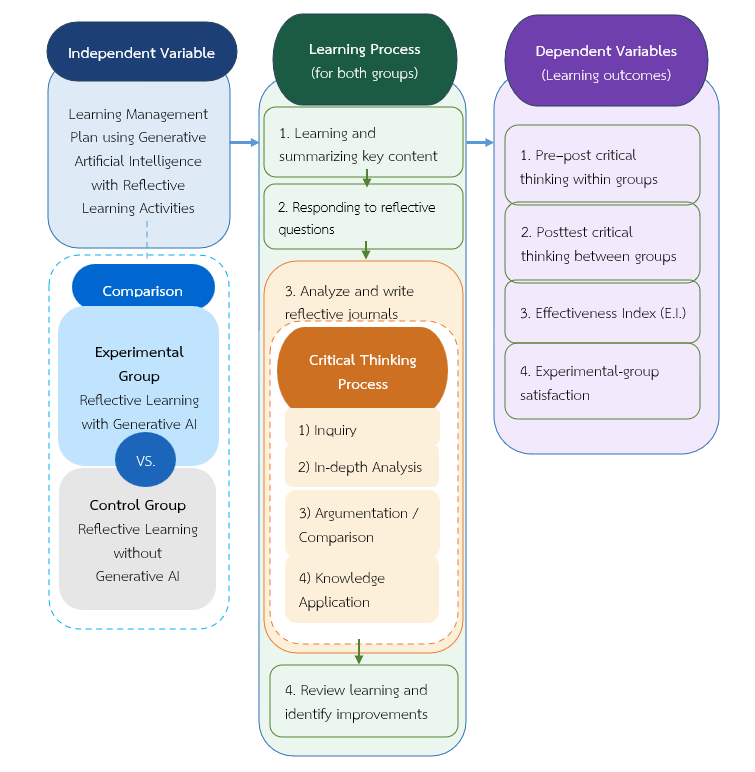
การวิจัยครั้งนี้มีวัตถุประสงค์เพื่อ (1) เพื่อเปรียบเทียบการคิดเชิงวิพากษ์ของนักศึกษาก่อนและหลังภายในของแต่ละกลุ่ม (2) เปรียบเทียบการคิดเชิงวิพากษ์ระหว่างกลุ่มทดลองและกลุ่มควบคุมหลังการทดลอง (3) ศึกษาประสิทธิผลของการจัดกิจกรรมการเรียนรู้ และ (4) ศึกษาความพึงพอใจของนักศึกษาที่มีต่อการจัดกิจกรรมการเรียนรู้ของกลุ่มทดลอง กลุ่มตัวอย่างเป็นนักศึกษาระดับปริญญาตรี จำนวน 42 คน การสุ่มตัวอย่างเป็นการสุ่มแบบแบ่งกลุ่มสองขั้นตอน โดยแบ่งเป็นสาขาวิชาที่มี 2 หมู่เรียน ได้จำนวน 8 สาขา แล้วเลือกสุ่ม 1 สาขาวิชา เพื่อเป็นกลุ่มทดลองและกลุ่มควบคุม ได้กลุ่มทดลอง จำนวน 22 คน และกลุ่มควบคุม จำนวน 20 คน เครื่องมือวิจัยประกอบด้วย แผนการจัดกิจกรรมการเรียนรู้ แบบวัดการคิดเชิงวิพากษ์ และแบบประเมินการสะท้อนคิด วิเคราะห์ข้อมูลด้วยค่าเฉลี่ย ส่วนเบี่ยงเบนมาตรฐาน การทดสอบค่าที และดัชนีประสิทธิผล ผลการวิจัยพบว่า (1) นักศึกษากลุ่มทดลองมีคะแนนการคิดเชิงวิพากษ์หลังเรียน ( = 26.32, S.D. = 1.36) สูงกว่าก่อนเรียน (
= 12.59, S.D. = 1.44) อย่างมีนัยสำคัญทางสถิติที่ระดับ .05 (t = 31.04, df = 21, p < .05 (2) การคิดเชิงวิพากษ์หลังเรียนของกลุ่มทดลองเฉลี่ย (
= 26.32, S.D. = 1.36) สูงกว่านักศึกษากลุ่มควบคุมที่เรียนด้วยวิธีปกติ (
= 17.65, S.D. = 2.28) อย่างมีนัยสำคัญทางสถิติที่ระดับ .05 (t = 15.14, df = 40, p < .05) และ (3) การจัดกิจกรรมการเรียนรู้ของกลุ่มทดลองมีค่าดัชนีประสิทธิผลเท่ากับ 0.5008 สูงกว่ากลุ่มควบคุมที่มีค่าดัชนีประสิทธิผล 0.1722 แสดงให้เห็นว่าการใช้ปัญญาประดิษฐ์เชิงสร้างสรรค์ร่วมกับกิจกรรมสะท้อนคิดสามารถส่งเสริมการคิดเชิงวิพากษ์ของนักศึกษาได้อย่างมีประสิทธิผล (4) นักศึกษากลุ่มทดลองมีความพึงพอใจต่อการจัดกิจกรรมการเรียนรู้โดยรวมอยู่ในระดับมากที่สุด (
= 4.60, S.D. = 0.62) ผลการวิจัยแสดงให้เห็นว่าการประยุกต์ใช้ Generative AI ร่วมกับกิจกรรมสะท้อนคิด ในฐานะเครื่องมือสนับสนุนการสะท้อนคิดสามารถช่วยยกระดับคุณภาพการเรียนรู้ และเป็นแนวทางที่เหมาะสมสำหรับการจัดกิจกรรมการเรียนรู้ในระดับอุดมศึกษายุคดิจิทัล
Downloads
เอกสารอ้างอิง
Al-Fattal, A. (2026). You Do It, AI Does It, You Compare and Reflect: Exploring Reflective Learning With Generative AI in Principles of Marketing. Journal of Marketing Education, 48(2), 201–217. https://doi.org/10.1177/02734753251356691 DOI: https://doi.org/10.1177/02734753251356691
Boonsouykhwan, S., Suthasinobon, K., & Wansudon, S. (2026). The Development of Critical Thinking in the Digital Age. Patanasilpa Journal, 10(1), 1-18. (In Thai)
Busabong, C. (2025). A Study of Artificial Intelligence (AI) Usage Behavior for Learning Among Graduate Students at Sisaket Rajabhat University. Journal of Association of Professional Development of Educational Administration of Thailand, 7(4), 91–105. (In Thai)
Darwin, Rusdin, D., Mukminatien, N., Suryati, N., Laksmi, E. D., & Marzuki. (2024). Critical Thinking in the AI Era: An Exploration of EFL Students’ Perceptions, Benefits, and Limitations. Cogent Education, 11(1), 2290342. https://doi.org/10.1080/2331186X.2023.2290342 DOI: https://doi.org/10.1080/2331186X.2023.2290342
Dewey, J. (1933). How We Think: A Restatement of the Relation of Reflective Thinking to the Educative Process. D. C. Heath.
Facione, P. A. (1990). Critical Thinking: A Statement of Expert Consensus for Purposes of Educational Assessment and Instruction. American Philosophical Association.
Guo, L. (2022). How Should Reflection be Supported in Higher Education? - A Meta-Analysis of Reflection Interventions. Reflective Practice, 23(1), 118–146. https://doi.org/10.1080/14623943.2021.1995856 DOI: https://doi.org/10.1080/14623943.2021.1995856
Kanthong, S. (2021). Development of Learning Management for Enhancing Reflective Thinking of Student Teachers in Peace Education for Teachers Course, Princess of Naradhiwas University. Princess of Naradhiwas University Journal of Humanities and Social Sciences, 8(2), 180–197. (In Thai)
Lee, H.-Y., Chen, P.-H., Lin, C.-J., Huang, Y.-M., & Wu, T.-T. (2025). Leveraging ChatGPT for Personalized Reflective Learning in Programming Education: Effects on Self-Efficacy, Higher-Order Thinking, and Project Implementation Skills. Education and Information Technologies, 30(17), 24815–24854. https://doi.org/10.1007/s10639-025-13733-z DOI: https://doi.org/10.1007/s10639-025-13733-z
Mezirow, J. (1991). Transformative Dimensions of Adult Learning. Jossey-Bass.
Mingsiritham, K. (2023). ChatGPT and Education in the Digital Age. Silpakorn Educational Research Journal, 15(2), 1-10. (In Thai)
Nakbure, N., & Leknoi, U. (2025). Ethical Use of Generative AI in Research and Academic Writing for Publication of Graduate Students in Bangkok based on AI Literacy Concept The Journal of Research and Academics, 8(5), 319–340. (In Thai)
Nasr, N. R., Tu, C.-H., Werner, J., Bauer, T., Yen, C.-J., & Sujo-Montes, L. (2025). Exploring the Impact of Generative AI ChatGPT on Critical Thinking in Higher Education: Passive AI-Directed Use or Human–AI Supported Collaboration? Education Sciences, 15(9), 1198. https://doi.org/10.3390/educsci15091198 DOI: https://doi.org/10.3390/educsci15091198
Paul, R., & Elder, L. (2021). Critical Thinking: Tools for Taking Charge of Your Learning and Your Life (4th ed.). Rowman & Littlefield.
Phumkeaw, P. (2019). Development of a Model of Organizing for Learning For Enhancement of Reflective Thinking Ability of Student Teachers. Journal of Educational Measurement Mahasarakham University, 25(1), 188-205. (In Thai)
Saengngam, J., & Veepion, S. (2026). A Study of the Relationship between the Use of Peer Assessment and Critical Thinking Skills among Undergraduate Students in the Faculty of Education. Nakkhabut Paritat Journal, 18(1), 89-100. (In Thai)
Sangnarin, T., Diteeyont, W., & Chaivisit, S. (2025). A Study on the Effects of Integrating Generative AI with Reflective Thinking to Enhance Advanced Essay Writing Achievement of Grade 8 Students. Journal of Educational Technology and Communications Faculty of Education Mahasarakham University, 8(26), 141–151. (In Thai)
Schön, D. A. (1992). The Reflective Practitioner: How Professionals Think in Action. Routledge. https://doi.org/10.4324/9781315237473 DOI: https://doi.org/10.4324/9781315237473
Suriano, R., Plebe, A., Acciai, A., & Fabio, R. A. (2025). Student Interaction with ChatGPT Can Promote Complex Critical Thinking Skills. Learning and Instruction, 95, 102011. https://doi.org/10.1016/j.learninstruc.2024.102011 DOI: https://doi.org/10.1016/j.learninstruc.2024.102011
Tredashe, I. (2025). Using Artificial Intelligence Technology to Develop Office Technology Skills of Pre-Service Teachers: A Classroom Action Research. Journal of Learning Innovation and Technology, 5(2), 159-169. (In Thai)
Xu, X., Qiao, L., Cheng, N., Liu, H., & Zhao, W. (2025). Enhancing Self‐Regulated Learning and Learning Experience in Generative AI Environments: The Critical Role of Metacognitive Support. British Journal of Educational Technology, 56(5), 1842–1863. https://doi.org/10.1111/bjet.13599 DOI: https://doi.org/10.1111/bjet.13599
Zhai, N., Huang, Y., Ma, X., & Chen, J. (2023). Can Reflective Interventions Improve Students’ Academic Achievement? A Meta-Analysis. Thinking Skills and Creativity, 49, 101373. https://doi.org/10.1016/j.tsc.2023.101373 DOI: https://doi.org/10.1016/j.tsc.2023.101373
ดาวน์โหลด
เผยแพร่แล้ว
รูปแบบการอ้างอิง
ฉบับ
ประเภทบทความ
หมวดหมู่
สัญญาอนุญาต
ลิขสิทธิ์ (c) 2026 วารสารคอมพิวเตอร์และเทคโนโลยีสร้างสรรค์

อนุญาตภายใต้เงื่อนไข Creative Commons Attribution-NonCommercial-NoDerivatives 4.0 International License.