Using Generative Artificial Intelligence with Reflective Activities to Enhance Critical Thinking among Undergraduate Students
DOI:
https://doi.org/10.65205/jcct.2026.e4324Keywords:
Generative Artificial Intelligence, Reflective Activities, Critical Thinking, Higher EducationAbstract
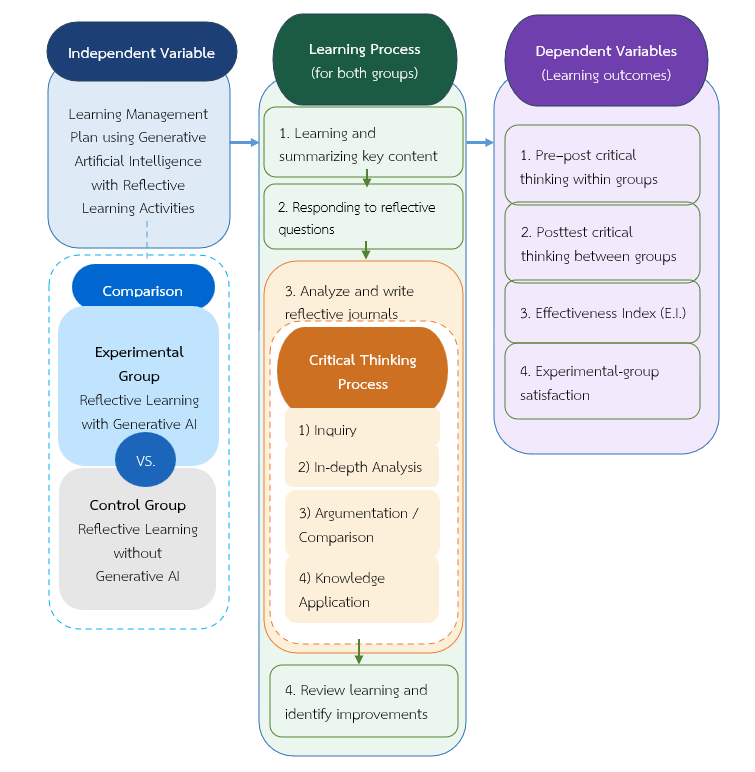
This research aimed to (1) to compare students' critical thinking before and after the intervention within each group; (2) to compare critical thinking between the experimental group and the control group after the intervention; (3) to examine the effectiveness of the learning activities; and (4) to examine students' satisfaction with the learning activities in the experimental group. The sample comprised 42 undergraduate students obtained through two-stage cluster random sampling. In the first stage, eight academic programs each offering two parallel class sections were identified; in the second stage, one program was randomly selected, and its two intact sections were randomly assigned as the experimental group (n = 22) and the control group (n = 20). The research instruments consisted of lesson plans, a critical thinking test, and a reflective thinking assessment form. Data were analyzed using mean, standard deviation, t-test, and the effectiveness index (E.I.). The findings revealed that (1) the posttest critical thinking scores of the experimental group ( = 26.32, SD = 1.36) were significantly higher than their pretest scores (
= 12.59, SD = 1.44) at the .05 level (t = 31.04, df = 21, p < .05); (2) the posttest critical thinking scores of the experimental group (
= 26.32, SD = 1.36) were significantly higher than those of the control group taught through conventional instruction (
= 17.65, SD = 2.28) at the .05 level (t = 15.14, df = 40, p < .05); (3) the learning activities implemented with the experimental group yielded an effectiveness index of 0.5008, higher than that of the control group (0.1722), indicating that GenAI combined with reflective thinking activities effectively promotes students' critical thinking; and (4) students in the experimental group reported overall satisfaction with the learning activities at the highest level (
= 4.60, SD = 0.62). These results demonstrate that applying Generative AI together with reflective thinking activities, as a tool supporting reflection, can enhance the quality of learning and constitutes an appropriate approach to instructional design in higher education in the digital era.
Downloads
References
Al-Fattal, A. (2026). You Do It, AI Does It, You Compare and Reflect: Exploring Reflective Learning With Generative AI in Principles of Marketing. Journal of Marketing Education, 48(2), 201–217. https://doi.org/10.1177/02734753251356691 DOI: https://doi.org/10.1177/02734753251356691
Boonsouykhwan, S., Suthasinobon, K., & Wansudon, S. (2026). The Development of Critical Thinking in the Digital Age. Patanasilpa Journal, 10(1), 1-18. (In Thai)
Busabong, C. (2025). A Study of Artificial Intelligence (AI) Usage Behavior for Learning Among Graduate Students at Sisaket Rajabhat University. Journal of Association of Professional Development of Educational Administration of Thailand, 7(4), 91–105. (In Thai)
Darwin, Rusdin, D., Mukminatien, N., Suryati, N., Laksmi, E. D., & Marzuki. (2024). Critical Thinking in the AI Era: An Exploration of EFL Students’ Perceptions, Benefits, and Limitations. Cogent Education, 11(1), 2290342. https://doi.org/10.1080/2331186X.2023.2290342 DOI: https://doi.org/10.1080/2331186X.2023.2290342
Dewey, J. (1933). How We Think: A Restatement of the Relation of Reflective Thinking to the Educative Process. D. C. Heath.
Facione, P. A. (1990). Critical Thinking: A Statement of Expert Consensus for Purposes of Educational Assessment and Instruction. American Philosophical Association.
Guo, L. (2022). How Should Reflection be Supported in Higher Education? - A Meta-Analysis of Reflection Interventions. Reflective Practice, 23(1), 118–146. https://doi.org/10.1080/14623943.2021.1995856 DOI: https://doi.org/10.1080/14623943.2021.1995856
Kanthong, S. (2021). Development of Learning Management for Enhancing Reflective Thinking of Student Teachers in Peace Education for Teachers Course, Princess of Naradhiwas University. Princess of Naradhiwas University Journal of Humanities and Social Sciences, 8(2), 180–197. (In Thai)
Lee, H.-Y., Chen, P.-H., Lin, C.-J., Huang, Y.-M., & Wu, T.-T. (2025). Leveraging ChatGPT for Personalized Reflective Learning in Programming Education: Effects on Self-Efficacy, Higher-Order Thinking, and Project Implementation Skills. Education and Information Technologies, 30(17), 24815–24854. https://doi.org/10.1007/s10639-025-13733-z DOI: https://doi.org/10.1007/s10639-025-13733-z
Mezirow, J. (1991). Transformative Dimensions of Adult Learning. Jossey-Bass.
Mingsiritham, K. (2023). ChatGPT and Education in the Digital Age. Silpakorn Educational Research Journal, 15(2), 1-10. (In Thai)
Nakbure, N., & Leknoi, U. (2025). Ethical Use of Generative AI in Research and Academic Writing for Publication of Graduate Students in Bangkok based on AI Literacy Concept The Journal of Research and Academics, 8(5), 319–340. (In Thai)
Nasr, N. R., Tu, C.-H., Werner, J., Bauer, T., Yen, C.-J., & Sujo-Montes, L. (2025). Exploring the Impact of Generative AI ChatGPT on Critical Thinking in Higher Education: Passive AI-Directed Use or Human–AI Supported Collaboration? Education Sciences, 15(9), 1198. https://doi.org/10.3390/educsci15091198 DOI: https://doi.org/10.3390/educsci15091198
Paul, R., & Elder, L. (2021). Critical Thinking: Tools for Taking Charge of Your Learning and Your Life (4th ed.). Rowman & Littlefield.
Phumkeaw, P. (2019). Development of a Model of Organizing for Learning For Enhancement of Reflective Thinking Ability of Student Teachers. Journal of Educational Measurement Mahasarakham University, 25(1), 188-205. (In Thai)
Saengngam, J., & Veepion, S. (2026). A Study of the Relationship between the Use of Peer Assessment and Critical Thinking Skills among Undergraduate Students in the Faculty of Education. Nakkhabut Paritat Journal, 18(1), 89-100. (In Thai)
Sangnarin, T., Diteeyont, W., & Chaivisit, S. (2025). A Study on the Effects of Integrating Generative AI with Reflective Thinking to Enhance Advanced Essay Writing Achievement of Grade 8 Students. Journal of Educational Technology and Communications Faculty of Education Mahasarakham University, 8(26), 141–151. (In Thai)
Schön, D. A. (1992). The Reflective Practitioner: How Professionals Think in Action. Routledge. https://doi.org/10.4324/9781315237473 DOI: https://doi.org/10.4324/9781315237473
Suriano, R., Plebe, A., Acciai, A., & Fabio, R. A. (2025). Student Interaction with ChatGPT Can Promote Complex Critical Thinking Skills. Learning and Instruction, 95, 102011. https://doi.org/10.1016/j.learninstruc.2024.102011 DOI: https://doi.org/10.1016/j.learninstruc.2024.102011
Tredashe, I. (2025). Using Artificial Intelligence Technology to Develop Office Technology Skills of Pre-Service Teachers: A Classroom Action Research. Journal of Learning Innovation and Technology, 5(2), 159-169. (In Thai)
Xu, X., Qiao, L., Cheng, N., Liu, H., & Zhao, W. (2025). Enhancing Self‐Regulated Learning and Learning Experience in Generative AI Environments: The Critical Role of Metacognitive Support. British Journal of Educational Technology, 56(5), 1842–1863. https://doi.org/10.1111/bjet.13599 DOI: https://doi.org/10.1111/bjet.13599
Zhai, N., Huang, Y., Ma, X., & Chen, J. (2023). Can Reflective Interventions Improve Students’ Academic Achievement? A Meta-Analysis. Thinking Skills and Creativity, 49, 101373. https://doi.org/10.1016/j.tsc.2023.101373 DOI: https://doi.org/10.1016/j.tsc.2023.101373
Downloads
Published
How to Cite
Issue
Section
Categories
License
Copyright (c) 2026 Journal of Computer and Creative Technology

This work is licensed under a Creative Commons Attribution-NonCommercial-NoDerivatives 4.0 International License.