ปัญญาประดิษฐ์กับการสอนวิชาศิลปะ
DOI:
https://doi.org/10.14456/jcct.2023.15คำสำคัญ:
ปัญญาประดิษฐ์, การสอนศิลปะ, ความคิดสร้างสรรค์, ปัญหาและอุปสรรคบทคัดย่อ
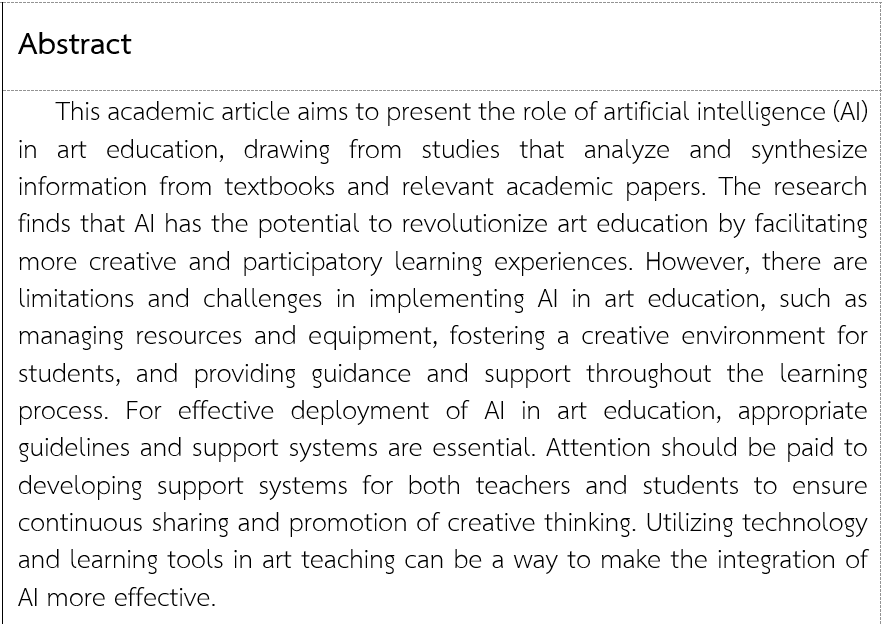
บทความวิชาการนี้ มีวัตถุประสงค์เพื่อนำเสนอ ปัญญาประดิษฐ์กับการสอนวิชาศิลปะ โดยใช้การศึกษาจากการวิเคราะห์ สังเคราะห์ข้อมูลจากตำรา เอกสารวิชาการที่เกี่ยวข้อง ผลการศึกษาพบว่า ปัญญาประดิษฐ์ (AI) เป็นเทคโนโลยีที่มีศักยภาพในการปฏิวัติการสอนศิลปะ โดยสามารถช่วยสร้างประสบการณ์การเรียนรู้ที่สร้างสรรค์และมีส่วนร่วมมากขึ้น อย่างไรก็ตาม การนำ AI มาใช้ในการเรียนการสอนศิลปะยังมีข้อจำกัดและอุปสรรค เช่น การจัดการทรัพยากรและอุปกรณ์ที่จำเป็น การสร้างสภาพแวดล้อมที่กระตุ้นความคิดสร้างสรรค์ของนักเรียน และการให้คำแนะนำและสนับสนุนในกระบวนการเรียนรู้ การพัฒนาการนำ AI มาใช้ในการเรียนการสอนศิลปะอย่างมีประสิทธิภาพ จำเป็นต้องมีแนวทางและระบบสนับสนุนที่เหมาะสม โดยควรให้ความสำคัญกับการสร้างระบบการสนับสนุนสำหรับครูและนักเรียน เพื่อให้มีการแบ่งปันและส่งเสริมความคิดสร้างสรรค์อย่างต่อเนื่อง การใช้เทคโนโลยีและเครื่องมือการเรียนรู้ในการสอนศิลปะก็เป็นวิธีที่สามารถช่วยให้การนำ AI เป็นไปอย่างมีประสิทธิภาพ
Downloads
เอกสารอ้างอิง
1. Mikalonytė ES and Kneer M. Can Artificial Intelligence Make Art?: Folk Intuitions as to Whether AI-Driven Robots Can be Viewed as Artists and Produce Art. ACM Transactions on Human-Robot Interaction (THRI). 2022;11(4):1-19.
2. Wogu IAP, Misra S, Olu-Owolabi EF, Assibong PA, Udoh OD, Ogiri SO, Damasevicius R. Artificial Intelligence, Artificial Teachers and the Fate of Learners in the 21st Century Education Sector: Implications for Theory and Practice. International Journal of Pure and Applied Mathematics. 2018;119(16):2245-2259.
3. Chen L, Chen P, Lin Z. Artificial Intelligence in Education: A Review. IEEE Access. 2020;8:75264-75278.
4. Miller AI. The Artist in the Machine: The World of AI-Powered Creativity. Mit Press. 2019.
5. Fathoni AFCA. Leveraging Generative AI Solutions in Art and Design Education: Bridging Sustainable Creativity and Fostering Academic Integrity for Innovative Society. E3S Web of Conferences 426. 2023;01102 (2023):1-5. doi: 10.1051/e3sconf/202342601102.
6. Pedró F, Subosa M, Rivas A, Valverde P. Artificial Intelligence in Education: Challenges and Opportunities for Sustainable Development. France : United Nations Educational, Scientific and Cultural Organization. 2019.
7. Mazzone M and Elgammal A. Art, Creativity, and the Potential of Artificial Intelligence. Arts. 2019;8(1):26. doi: 10.3390/arts8010026.
8. Fan X and Zhong X. Artificial Intelligence-Based Creative Thinking Skill Analysis Model using Human–Computer Interaction in Art Design Teaching. Computers and Electrical Engineering. 2022;100:107957. doi: 10.1016/j.compeleceng.2022.107957.
9. Andriessen J and Sandberg J. Where is Education Heading and How About AI. International Journal of Artificial Intelligence in Education. 1999;10(2):130-150.
ดาวน์โหลด
เผยแพร่แล้ว
รูปแบบการอ้างอิง
ฉบับ
ประเภทบทความ
หมวดหมู่
สัญญาอนุญาต
ลิขสิทธิ์ (c) 2023 วารสารคอมพิวเตอร์และเทคโนโลยีสร้างสรรค์

อนุญาตภายใต้เงื่อนไข Creative Commons Attribution-NonCommercial-NoDerivatives 4.0 International License.