การออกแบบและพัฒนาสถาปัตยกรรมจีโอเฟนซิงแบบโลว์โค้ดสำหรับการบริหารจัดการการลงเวลาปฏิบัติงานเชิงพื้นที่ในองค์กรปกครองส่วนท้องถิ่น
DOI:
https://doi.org/10.65205/jcct.2026.e3674คำสำคัญ:
จีโอเฟนซิง, สถาปัตยกรรมโลว์โค้ด, ความคล่องตัวของบุคลากร, บริการอิงตำแหน่งที่ตั้ง, การเปลี่ยนผ่านสู่ดิจิทัลบทคัดย่อ
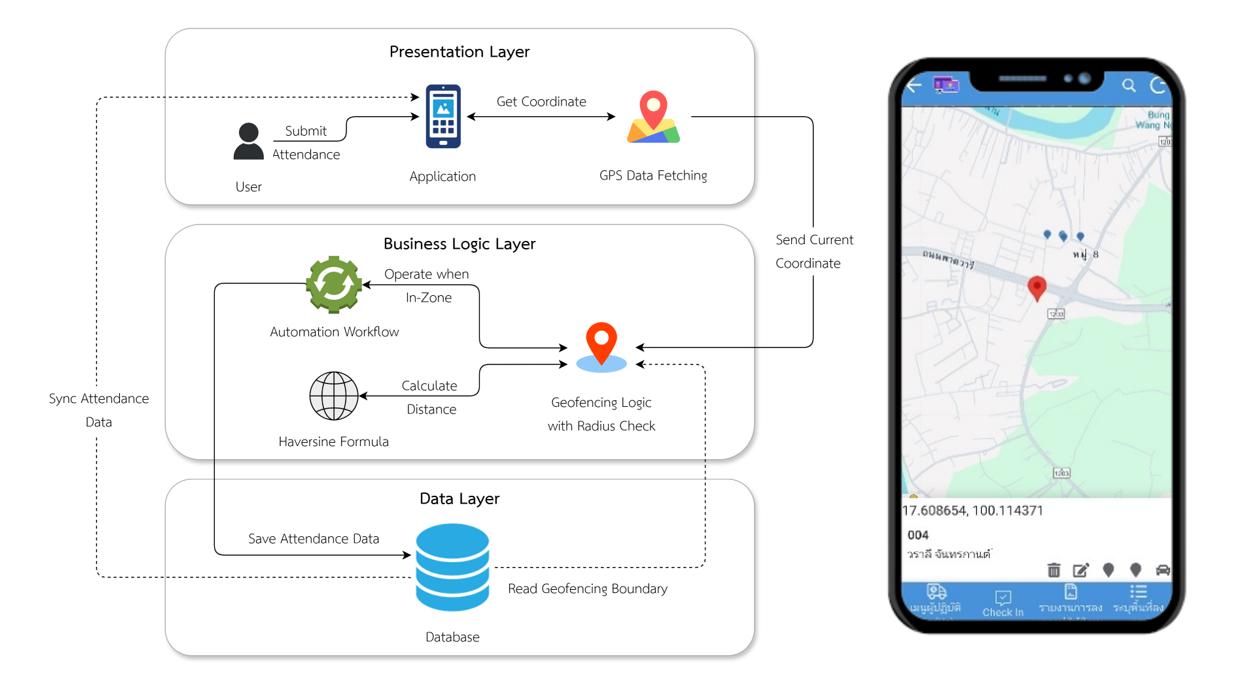
ในขณะที่องค์กรภาครัฐเข้าสู่การเปลี่ยนผ่านสู่ดิจิทัล การบริหารจัดการความคล่องตัวของบุคลากรอย่างมีประสิทธิภาพจึงเป็นสิ่งจำเป็น งานวิจัยนี้ มุ่งแก้ไขช่องว่างเชิงวิชาการด้านการบูรณาการความสามารถในการติดตามเชิงพื้นที่บนแพลตฟอร์มโลว์โค้ด โดยการออกแบบและพัฒนาสถาปัตยกรรมจีโอเฟนซิงแบบโลว์โค้ด กรณีศึกษาเทศบาลตำบลท่าเสา จังหวัดอุตรดิตถ์ ระบบใช้สถาปัตยกรรมสามระดับ เพื่อการประมวลผลข้อมูลแบบเรียลไทม์ผ่าน Google AppSheet และ Google Sheets ตรรกะทางธุรกิจประยุกต์ใช้อัลกอริทึมสูตร Haversine เพื่อคำนวณระยะทางเชิงภูมิศาสตร์พร้อม กลไกจัดการข้อผิดพลาดเพื่อรองรับความไม่เสถียรของสัญญาณ GPS ผลการประเมินประสิทธิภาพผ่านการทดสอบแบบกล่องดำ พบว่า ระบบมี อัตราความสำเร็จของกรณีทดสอบตามเงื่อนไขที่กำหนดร้อยละ 100 ภายใต้สภาพแวดล้อมที่ควบคุมได้ ทั้งนี้ ประสิทธิภาพในการใช้งานจริงอาจแปรผันตามความหน่วงของเครือข่ายและคุณภาพสัญญาณ GPS ในแต่ละพื้นที่ ข้อมูลเชิงประจักษ์จากการเลือกตัวอย่างแบบเจาะจงในกลุ่มบุคลากรนอกสถานที่ 20 ราย พบว่ามีความพึงพอใจในระดับมาก (Mean = 4.39, S.D. = 0.57) โดยเครื่องมือประเมินมีค่าความเชื่อมั่น (Cronbach's Alpha = 0.85) คุณูปการสำคัญของงานวิจัยนี้คือการนำเสนอ กรอบสถาปัตยกรรมที่สามารถขยายผลได้และใช้ทรัพยากรอย่างมีประสิทธิภาพ ซึ่ง ช่วยลดภาระงานธุรการและสนับสนุนการเปลี่ยนผ่านสู่ดิจิทัลในบริบทขององค์กรปกครองส่วนท้องถิ่น พร้อมทั้ง สะท้อนข้อจำกัดเชิงปฏิบัติที่เกิดขึ้นในการใช้งานจริง
Downloads
เอกสารอ้างอิง
Al Farisi, S., Fauziah, & Tamara Aldisa, R. (2023, February 16). A Combination of the Haversine Formula Algorithm and the Sequential Searching Algorithm in Web Based Online Attendance. 2023 International Conference on Computer Science, Information Technology and Engineering, 450–455. Institute of Electrical and Electronics Engineers. https://doi.org/10.1109/iccosite57641.2023.10127681
Brünninghaus, M., & Röcker, C. (2022, July 25-28). Low-Code Development in Worker Assistance Systems: Improving Flexibility and Adaptability. 2022 IEEE 20th International Conference on Industrial Informatics, 366–373. Institute of Electrical and Electronics Engineers. https://doi.org/10.1109/indin51773.2022.9976178
Chauhan, V., Singh, H., Dewari, K., & Kumar, I. (2024, July 10-12). Efficient Employee Tracking with Smart Attendance System Using Advanced Face Recognition and Geofencing. 2024 2nd International Conference on Sustainable Computing and Smart Systems, 750–755. Institute of Electrical and Electronics Engineers. https://doi.org/10.1109/icscss60660.2024.10625038
Doodala, A. N. K. (2023). Offline-First Android Architecture for Waste Management in Low Connectivity Zones. International Journal of Emerging Trends in Computer Science and Information Technology, 4(1), 201–209. https://doi.org/10.63282/3050-9246.ijetcsit-v4i1p121
Gupta, S. K., Yadav, N., Pandey, A., Sharma, R., & Chauhan, A. (2025, April 4-6). Geolocation-Based Attendance Tracking System: A Comprehensive Review. 2025 3rd International Conference on Communication, Security, and Artificial Intelligence, 932–935. Institute of Electrical and Electronics Engineers. https://doi.org/10.1109/iccsai64074.2025.11064660
Hair, J. F., Black, W. C., Babin, B. J., & Anderson, R. E. (2019). Multivariate Data Analysis (8th ed.). Cengage Learning.
Merry, K., & Bettinger, P. (2019). Smartphone GPS Accuracy Study in an Urban Environment. PLOS ONE, 14(7), e0219890. https://doi.org/10.1371/journal.pone.0219890
Ngamsong, S., Lerk-U-Suke, S., & Wongyai, S. (2021). Building of Mobile Application with No-Code Development for Field Data Collection in Tax Administration of Local Administrative Organization. The Journal of Spatial Innovation Development, 2(3), 55–69. (In Thai)
O-In, S. (2024). Development of a Geo-Informatics Database System to Support Urban Conservation and Rehabilitation: A Case Study of Mueang Ratchaburi District, Thailand. Humanities, Arts and Social Sciences Studies, 24(1), 33–42. https://doi.org/10.69598/hasss.24.1.260631
Patil, H., Darekar, O., Thorbole, B., Kindre, P., & Dekate, V. (2025). Tick Mark: Geofencing Attendance System. International Journal for Research in Applied Science and Engineering Technology, 13(4), 1269–1274. https://doi.org/10.22214/ijraset.2025.68524
Pressman, R. S., & Maxim, B. R. (2020). Software Engineering: A Practitioner's Approach (9th ed.). McGraw-Hill Education.
Rokis, K., & Kirikova, M. (2023). Exploring Low-Code Development: A Comprehensive Literature Review. Complex Systems Informatics and Modeling Quarterly, 36, 68–86. https://doi.org/10.7250/csimq.2023-36.04
Sarawan, K., Sarnthong, A., Khumla, P., & Nasinprom, N. (2023). Improvement of Time Attendance Online System: Case Study in the University. Journal of Advanced Development in Engineering and Science, 11(30), 16–31. (In Thai)
Shevchenko, Y., & Reips, U. D. (2024). Geofencing in Location-Based Behavioral Research: Methodology, Challenges, and Implementation. Behavior Research Methods, 56, 6411–6439. https://doi.org/10.3758/s13428-023-02213-2
Tang, Y., Li, T., Zhu, R., Du, F., Wang, J., & Ma, Z. (2021). A Discovery Method for Hierarchical Software Execution Behavior Models Based on Components. Scientific Programming, 2021, 1–22. https://doi.org/10.1155/2021/4788357
ดาวน์โหลด
เผยแพร่แล้ว
รูปแบบการอ้างอิง
ฉบับ
ประเภทบทความ
หมวดหมู่
สัญญาอนุญาต
ลิขสิทธิ์ (c) 2026 วารสารคอมพิวเตอร์และเทคโนโลยีสร้างสรรค์

อนุญาตภายใต้เงื่อนไข Creative Commons Attribution-NonCommercial-NoDerivatives 4.0 International License.