Enhancing Silkworm Feeding Efficiency at Each Larval Stage Using Chatbot Technology to Improve Silk Production Capacity in Surin Province
DOI:
https://doi.org/10.65205/jcct.2026.e3896Keywords:
Retrieval-Augmented Generation, Agricultural Chatbot, Silkworm Feeding Management, Technology Acceptance Model, Surin ProvinceAbstract
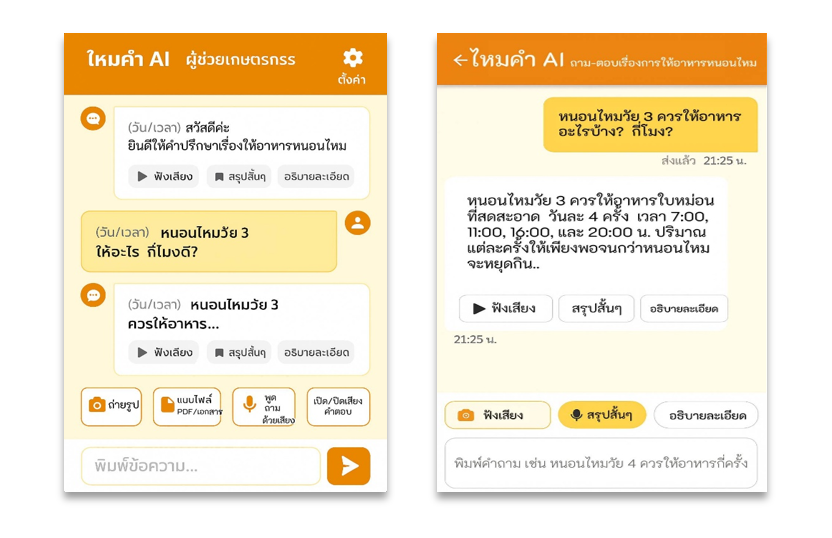
In Surin Province, silkworm farming runs on memory. Feeding recommendations vary by larval stage, yet most rely on memory and informal knowledge passed between generations. This study developed and evaluated MaiKham AI, a domain-specific chatbot built on a Retrieval-Augmented Generation (RAG) architecture, designed to deliver stage-specific feeding guidance through text, voice, and image. The study had two objectives: assessing technical performance of the chatbot, and measuring its effect on sericulture productivity and technology acceptance. A quasi-experimental design was used. Fifty silkworm farmers in Surin Province were purposively selected 25 used the chatbot, 25 continued conventional practice. The RAG system drew on a 52-week silkworm rearing manual loaded into Google AI Studio’s Knowledge Base, with Gemini 1.5 Pro generating responses grounded in that domain knowledge. Expert panels rated the system 4.58 out of 5.00 (S.D. = 0.24). Chatbot users harvested heavier cocoons and higher-grade silk than the control group (p < 0.001), with yield gains of 70–90% across rearing cycles. On the Technology Acceptance Model, farmers scored Perceived Usefulness at 4.38 (S.D. = 0.78) and Perceived Ease of Use at 4.46 (S.D. = 0.87); elderly farmers who had initially resisted the phone adapted more quickly once they could speak their questions aloud. After a single structured training session, 94% used the system without assistance. RAG based chatbots appear capable of filling the knowledge gap in smallholder sericulture, even where farmers are older and digitally inexperienced.
Downloads
References
Adamopoulou, E., & Moussiades, L. (2020). An Overview of Chatbot Technology. In Maglogiannis, I., Iliadis, L., & Pimenidis, E. (Eds), Artificial Intelligence Applications and Innovations (584, 373–383). Springer International Publishing. https://doi.org/10.1007/978-3-030-49186-4_31 DOI: https://doi.org/10.1007/978-3-030-49186-4_31
Asolo, E., Gil-Ozoudeh, I., & Ejimuda, C. (2024). AI-Powered Decision Support Systems for Sustainable Agriculture using AI-Chatbot Solution. Journal of Digital Food, Energy & Water Systems, 5(1), 1-10. https://doi.org/10.36615/2ar4w994 DOI: https://doi.org/10.36615/2ar4w994
Beck, K., Beedle, M., Bennekum, A. V., Cockburn, A., Cunningham, W., Fowler, M., Grenning, J., Highsmith, J., Hunt, A., Jeffries, R., Kern, J., Marick, B., Martin, R. C., Mellor, S., Schwaber, K., Sutherland, J., & Thomas, D. (2001). Manifesto for Agile Software Development. https://agilemanifesto.org
Davis, F. D. (1989). Perceived Usefulness, Perceived Ease of Use, and User Acceptance of Information Technology. MIS Quarterly, 13(3), 319–340. https://doi.org/10.2307/249008 DOI: https://doi.org/10.2307/249008
Ekanayake, J., & Saputhanthri, L. (2020). E-AGRO: Intelligent Chat-Bot. IoT and Artificial Intelligence to Enhance Farming Industry. AGRIS On-Line Papers in Economics and Informatics, 12(1), 15–21. https://doi.org/10.7160/aol.2020.120102 DOI: https://doi.org/10.7160/aol.2020.120102
Jantavongso, S. (2022). Toward Global Digital Literate Citizens: A Case of Thailand ’s Aging Generation. The Electronic Journal of Information Systems in Developing Countries, 88(2), e12207. https://doi.org/10.1002/isd2.12207 DOI: https://doi.org/10.1002/isd2.12207
Kamilaris, A., & Prenafeta-Boldú, F. X. (2018). Deep Learning in Agriculture: A Survey. Computers and Electronics in Agriculture, 147, 70–90. https://doi.org/10.1016/j.compag.2018.02.016 DOI: https://doi.org/10.1016/j.compag.2018.02.016
Lewis, P., Perez, E., Piktus, A., Petroni, F., Karpukhin, V., Goyal, N., Küttler, H., Lewis, M., Yih, W. -T., Rocktäschel, T., Riedel, S., Kiela, D. (2020, December 6-12). Retrieval-Augmented Generation for Knowledge-Intensive NLP Tasks. 34th Conference on Neural Information Processing Systems, 9459-9474. Curran Associates.
Sawangloke, W., Chanthes, S., & Nuttee, S. (2023). Measuring the Labour Productivity of Sericultural Farmers in Mahasarakham Province, Thailand. African Journal of Food, Agriculture, Nutrition and Development, 23(8), 24383–24405. https://doi.org/10.22004/ag.econ.340749 DOI: https://doi.org/10.18697/ajfand.123.23330
Schwaber, K., & Sutherland, J. (2020). The Scrum Guide. https://scrumguides.org/docs/scrumguide/v2020/2020-Scrum-Guide-US.pdf
Shoaib, M., Sadeghi-Niaraki, A., Ali, F., Hussain, I., & Khalid, S. (2025). Leveraging Deep Learning for Plant Disease and Pest Detection: A Comprehensive Review and Future Directions. Frontiers in Plant Science, 16, 1538163. https://doi.org/10.3389/fpls.2025.1538163 DOI: https://doi.org/10.3389/fpls.2025.1538163
Thar, S. P., Ramilan, T., Farquharson, R. J., Pang, A., & Chen, D. (2021). An Empirical Analysis of the Use of Agricultural Mobile Applications among Smallholder Farmers in Myanmar. The Electronic Journal of Information Systems in Developing Countries, 87(2), e12159. https://doi.org/10.1002/isd2.12159 DOI: https://doi.org/10.1002/isd2.12159
Vaportzis, E., Giatsi Clausen, M., & Gow, A. J. (2017). Older Adults Perceptions of Technology and Barriers to Interacting with Tablet Computers: A Focus Group Study. Frontiers in Psychology, 8, 1687. https://doi.org/10.3389/fpsyg.2017.01687 DOI: https://doi.org/10.3389/fpsyg.2017.01687
Yu, H., Gan, A., Zhang, K., Tong, S., Liu, Q., & Liu, Z. (2025). Evaluation of Retrieval-Augmented Generation: A Survey. In Zhu, W., Xiong, H., Cheng, X., Cui, L., Dou, Z., Dong, J., Pang, S., Wang, L., Kong, L., & Chen, Z. (Eds), Big Data (2301, 102–120). Springer Nature Singapore. https://doi.org/10.1007/978-981-96-1024-2_8 DOI: https://doi.org/10.1007/978-981-96-1024-2_8
Downloads
Published
How to Cite
Issue
Section
Categories
License
Copyright (c) 2026 Journal of Computer and Creative Technology

This work is licensed under a Creative Commons Attribution-NonCommercial-NoDerivatives 4.0 International License.