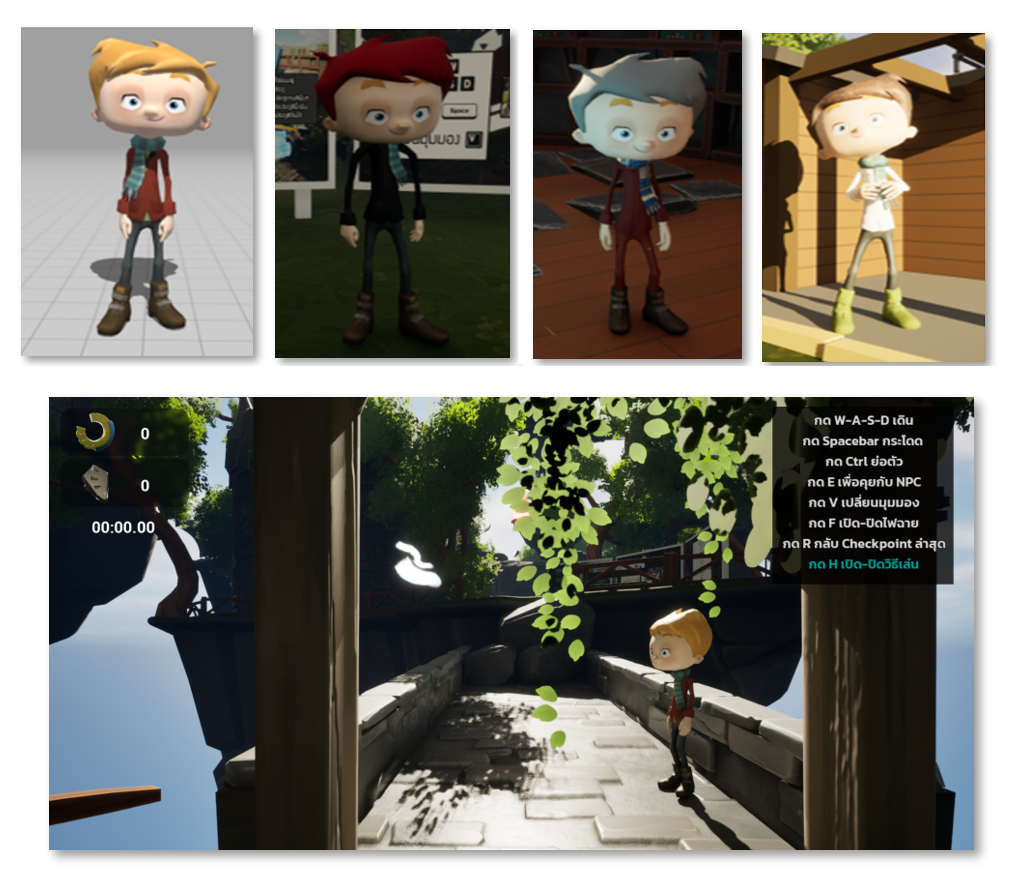
การพัฒนาเกมสามมิติ เรื่อง ตามล่าหาสมบัติบนเกาะลอยฟ้า
DOI:
https://doi.org/10.65205/jcct.2025.3048คำสำคัญ:
เกมสามมิติ, การออกแบบเกมด้วยกรอบเอ็มดีเอ, อันเรียลเอนจิน รุ่น 5, ประสบการณ์ผู้ใช้, การประเมินความพึงพอใจบทคัดย่อ
การวิจัยครั้งนี้มีวัตถุประสงค์ 1. เพื่อพัฒนาเกมสามมิติ “ตามล่าหาสมบัติบนเกาะลอยฟ้า” โดยประยุกต์แนวคิดการออกแบบเกมจาก Only Up! และ Subway Surfers ภายใต้กรอบแนวคิดเอ็มดีเอ (MDA) เพื่อใช้เป็นแนวทางในการพัฒนาระบบด้วยโปรแกรมอันเรียลเอนจิน รุ่น 5 และ 2. เพื่อประเมินระดับความพึงพอใจของผู้ใช้ที่เข้าร่วมการทดลองเล่นเกมที่พัฒนาขึ้น กลุ่มตัวอย่างประกอบด้วยนักศึกษาชั้นปีที่ 1 - 3 คณะวิทยาศาสตร์และเทคโนโลยี มหาวิทยาลัยราชภัฏสุรินทร์ ปีการศึกษา 2567 จำนวน 60 คน แบ่งเป็นสาขาวิชาคอมพิวเตอร์ 30 คน และสาขาวิชาวิทยาการคอมพิวเตอร์ 30 คน โดยคัดเลือกด้วยวิธีการเลือกแบบเจาะจง ผู้เข้าร่วมแต่ละรายทำการทดลองเล่นเกมเป็นเวลา 30 นาที และตอบแบบประเมินความพึงพอใจ การวิเคราะห์ข้อมูลใช้สถิติทดสอบความแตกต่างของค่าเฉลี่ยระหว่างกลุ่มตัวอย่างทั้งสอง เพื่อประเมินระดับความพึงพอใจของผู้ใช้ ผลการวิจัยพบว่าค่า p-value เท่ากับ 0.95 ซึ่งสูงกว่าระดับนัยสำคัญทางสถิติที่กำหนด สะท้อนว่า ไม่พบความแตกต่างอย่างมีนัยสำคัญทางสถิติในระดับความพึงพอใจระหว่างกลุ่มผู้เข้าร่วมทั้งสองสาขา อันแสดงถึงประสิทธิภาพของเกมที่พัฒนาขึ้นในการให้ประสบการณ์การเล่นที่สอดคล้องกันในทุกกลุ่มตัวอย่าง ผลการศึกษาครั้งนี้ชี้ให้เห็นว่า การประยุกต์ใช้กรอบแนวคิด MDA ร่วมกับเทคโนโลยีการพัฒนาเกมสมัยใหม่ สามารถส่งเสริมคุณภาพของประสบการณ์ผู้เล่นได้อย่างมีประสิทธิผล และเหมาะสมต่อการนำไปประยุกต์ใช้ในการพัฒนาเกมในบริบทอื่นต่อไป
Downloads
เอกสารอ้างอิง
Adams, E. (2014). Fundamentals of Adventure Game Design. Peachpit Press.
Beatty, I. D. (2014). Gaming the System: Video Games as a Theoretical Framework for Instructional Design. arXiv. https://doi.org/10.48550/arXiv.1401.6716.
Deterding, S., Dixon, D., Khaled, R., & Nacke, L. (2011, September 28 - 30). From Game Design Elements to Gamefulness: Defining “Gamification”. The 15th International Academic MindTrek Conference: Envisioning Future Media Environments, 9 - 15. Tampere. https://doi.org/10.1145/2181037.2181040
Epic Games. (n.d.). Unreal Engine 5.7 Documentation. https://dev.epicgames.com/documentation/en-us/unreal-engine/unreal-engine-5-7-documentation.
Fullerton, T. (2018). Game Design Workshop: A Playcentric Approach to Creating Innovative Games (4th ed.). CRC Press.
Hunicke, R., LeBlanc, M., & Zubek, R. (2004). MDA: A Formal Approach to Game Design and Game Research. Association for the Advancement of Artificial Intelligence. https://cdn.aaai.org/Workshops/2004/WS-04-04/WS04-04-001.pdf.
Juul, J. (2005). Half-Real: Video Games Between Real Rules and Fictional Worlds. MIT Press.
Kanchana, C. (2022). Development of Mathematical Basic Skills and Computational Thinking Skills of Early Childhood Through Educational Game. [Master’s thesis, University of Phayao]. University of Phayao Digital Collections. https://updc.up.ac.th/handle/123456789/221. (In Thai)
Lan, Y. (2023). Development and Application of 3D Modeling in Game. Academic Journal of Science and Technology, 7(2), 94 - 97. https://doi.org/10.54097/ajst.v7i2.11949.
Liem, C. L. C., Sompie, S. R. U. A., & Sugiarso, B. A. (2023). 3D Adventure Game Introduction to South Minahasa Historical Buildings. Jurnal Teknik Elektro Dan Komputer, 12(2), 75 - 84. https://doi.org/10.35793/jtek.v12i2.47311. (In Bahasa Indonesia)
Meepain, P., & Ua-apisitwong, U. (2023). Developing 3D Games for English Learning for Anubunpracharat Samakkee School. Academic Journal of Science and Technology, Dhonburi Rajabhat University, 1(1), 13 - 26. (In Thai)
Ovrick, J. (2017). 3D Modeling Best Practices. Artella. https://www.artella.com/index.php/2017/10/18/pro-tips-3d-modeling-best-practices.
Panyarotjananon, K., Mitmoolpitak, K., Yindeechai, N., Yuenying, W., & Yasaka, P. (2023). Game Development Promoted the Proper Sorting of Solid Waste . Journal of Computer and Creative Technology, 1(2), 15 - 22. https://doi.org/10.14456/jcct.2023.8. (In Thai)
Plum, F., Bulla, R., Beck, H. K., Imirzian, N., & Labonte, D. (2023). replicAnt: A Pipeline for Generating Annotated Images of Animals in Complex Environments Using Unreal Engine. Nature Communications, 14, 7195. https://doi.org/10.1038/s41467-023-42898-9.
Putra, S. D., & Yasin, V. (2021). MDA Framework Approach for Gamification-Based Elementary Mathematics Learning Design. International Journal of Engineering, Science & Information Technology, 1(3), 35 - 39.
Sicart, M. (2008). Defining Game Mechanics. Game studies. https://gamestudies.org/0802/articles/sicart.
Srisaard, B. (2000). Preliminary Research (6th ed.). Suwiriyasan. (In Thai)
Tekinbas, K. S., & Zimmerman, E. (2004). Rules of Play: Game Design Fundamentals. MIT Press.
Thanyasiri, D., & Uparimakul, A. (2024). Developing a 3D game titled “Learning Reading and Writing Skills in Thai Language” for Matthayom 1 Level. Research and Development Journal Suan Sunandha Rajabhat University, 16(2), 55 - 67. (In Thai)
Zainol Abidin, M. K., & Ismail, A. (2021). Developing A 3D Action-Adventure Game Called “Code - E” for Learning C++ Function Codes. Journal of ICT in Education, 8(3), 13 - 26. https://doi.org/10.37134/jictie.vol8.sp.1.2.2021.
ดาวน์โหลด
เผยแพร่แล้ว
รูปแบบการอ้างอิง
ฉบับ
ประเภทบทความ
หมวดหมู่
สัญญาอนุญาต
ลิขสิทธิ์ (c) 2025 วารสารคอมพิวเตอร์และเทคโนโลยีสร้างสรรค์

อนุญาตภายใต้เงื่อนไข Creative Commons Attribution-NonCommercial-NoDerivatives 4.0 International License.