การวิเคราะห์และเปรียบเทียบผลกระทบของการลดขนาดคุณลักษณะเชิงสถิติสำหรับการจำแนกด้วยการเรียนรู้ของเครื่อง
DOI:
https://doi.org/10.65205/jcct.2026.e3002คำสำคัญ:
การจำแนกภาวะทางการแพทย์, การคัดเลือกคุณลักษณะ, ไฮเปอร์พารามิเตอร์, การเรียนรู้ของเครื่องบทคัดย่อ
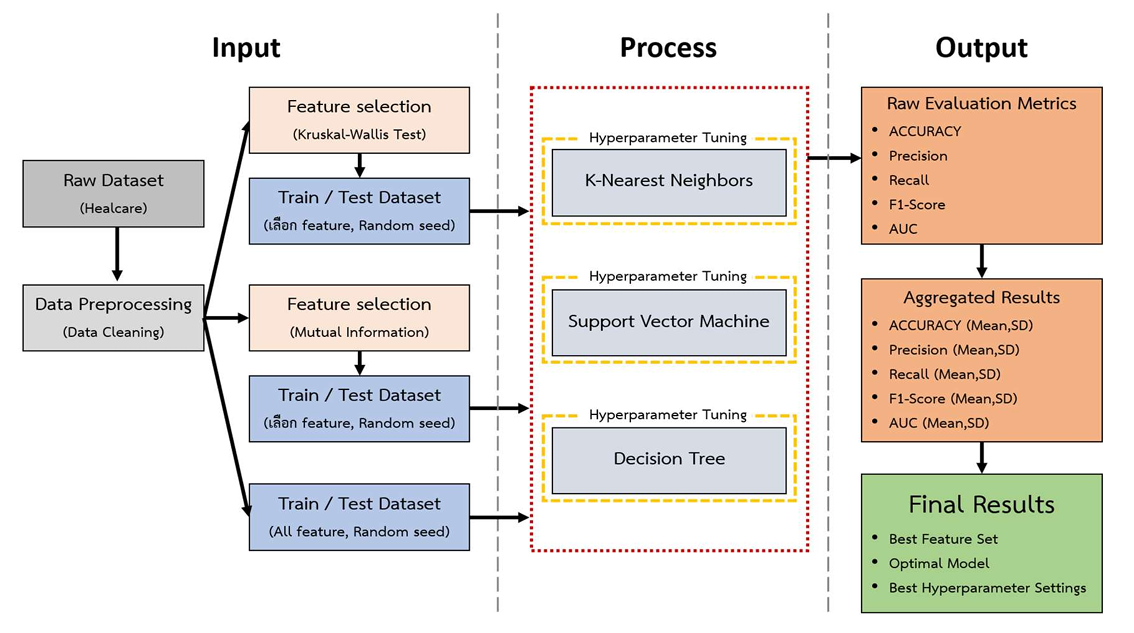
การศึกษานี้มีวัตถุประสงค์เพื่อวิเคราะห์ผลกระทบของการลดขนาดคุณลักษณะเชิงสถิติต่อประสิทธิภาพการจำแนกประเภทและค้นหาชุดค่าพารามิเตอร์ที่เหมาะสมที่สุดในการทำนายภาวะทางการแพทย์ โดยเปรียบเทียบอัลกอริทึมการเรียนรู้ของเครื่อง 3 รูปแบบ ได้แก่ Support Vector Machine (SVM) Decision Tree (DT) และ K-Nearest Neighbors (KNN) และใช้ชุดข้อมูล Healthcare Risk Factors ร่วมกับวิธีการคัดเลือกคุณลักษณะแบบตัวกรอง 2 วิธี คือ Kruskal–Wallis test (KW) และ Mutual Information (MI) เพื่อสร้างชุดข้อมูลที่มีคุณลักษณะครบถ้วนและชุดข้อมูลย่อยที่ระดับเปอร์เซ็นไทล์ที่ 25, 50 และ 75 ประเมินประสิทธิภาพด้วยวิธี 5 repeats of 5-fold Stratified K-Fold Cross-Validation ที่ร่วมกับการปรับจูนไฮเปอร์พารามิเตอร์อย่างเป็นระบบ ผลการทดลอง พบว่า SVM ให้ประสิทธิภาพสูงสุดเมื่อใช้คุณลักษณะครบถ้วน (C = 300) โดยมีค่าความถูกต้อง (Accuracy) 0.9214 ± 0.0005 ค่าความเที่ยงตรง (Precision) 0.9212 ± 0.0005 ค่าความระลึก (Recall) 0.9214 ± 0.0005 และค่าเอฟวันสกอร์ (F1-Score) 0.9210 ± 0.0005 ซึ่งค่าความถูกต้องสูงกว่า DT (0.8752 ± 0.0028) และ KNN (0.7916 ± 0.0015) อย่างมีนัยสำคัญ นอกจากนี้การลดจำนวนคุณลักษณะลงเหลือร้อยละ 75 ด้วยวิธี KW ยังคงรักษาค่าความถูกต้องไว้ได้สูงถึง 0.9165 ± 0.0006 ซึ่งลดลงจากเดิมเพียงร้อยละ 0.49 ผลการวิจัยชี้ให้เห็นว่า SVM มีความเหมาะสมอย่างยิ่งสำหรับการวินิจฉัยโรคในชุดข้อมูลนี้ และการลดขนาดคุณลักษณะเชิงสถิติช่วยลดความซับซ้อนในการประมวลผลได้ โดยไม่สูญเสียความแม่นยำอย่างมีนัยสำคัญ
Downloads
เอกสารอ้างอิง
Ahmed, A. (2025). Healthcare Risk Factors Dataset [Dataset]. Kaggle. https://www.kaggle.com/datasets/abdallaahmed77/healthcare-risk-factors-dataset
Bashir, S., Khattak, I. U., Khan, A., Khan, F. H., Gani, A., & Shiraz, M. (2022). A Novel Feature Selection Method for Classification of Medical Data Using Filters, Wrappers, and Embedded Approaches. Complexity, 2022(1), 8190814. https://doi.org/10.1155/2022/8190814 DOI: https://doi.org/10.1155/2022/8190814
Clarke, R., Ressom, H. W., Wang, A., Xuan, J., Liu, M. C., Gehan, E. A., & Wang, Y. (2008). The Properties of High-Dimensional Data Spaces: Implications for Exploring Gene and Protein Expression Data. Nature Reviews Cancer, 8(1), 37-49. https://doi.org/10.1038/nrc2294 DOI: https://doi.org/10.1038/nrc2294
Guyon, I., & Elisseeff, A. (2003). An Introduction to Variable and Feature Selection. Journal of Machine Learning Research, 3, 1157-1182.
Jothi, N., Syed-Mohamed, S. M., & Rajagopal, H. (2022, July 20-22). Hybrid Feature Selection using Shapley Value and ReliefF for Medical Datasets. 2022 International Conference on Inventive Computation Technologies, 351-355. Institute of Electrical and Electronics Engineers. https://doi.org/10.1109/icict54344.2022.9850833 DOI: https://doi.org/10.1109/ICICT54344.2022.9850833
Kavakiotis, I., Tsave, O., Salifoglou, A., Maglaveras, N., Vlahavas, I., & Chouvarda, I. (2017). Machine Learning and Data Mining Methods in Diabetes Research. Computational and Structural Biotechnology Journal, 15, 104-116. https://doi.org/10.1016/j.csbj.2016.12.005 DOI: https://doi.org/10.1016/j.csbj.2016.12.005
Kruskal, W. H., & Wallis, W. A. (1952). Use of Ranks in One-Criterion Variance Analysis. Journal of the American Statistical Association, 47(260), 583-621. https://doi.org/10.1080/01621459.1952.10483441 DOI: https://doi.org/10.1080/01621459.1952.10483441
Majed, R. J., Al-Heddi, R. M., & Zeki, A. M. (2023, October 25-26). Parkinson’s Disease Detection Using Data Mining Models: A Comparative Study. 2023 4th International Conference on Data Analytics for Business and Industry, 290-294. Institute of Electrical and Electronics Engineers. https://doi.org/10.1109/icdabi60145.2023.10629302 DOI: https://doi.org/10.1109/ICDABI60145.2023.10629302
Narwane, S. V., & Sawarkar, S. D. (2021, August 27-29). Dimensionality Reduction of Unbalanced Datasets: Principal Component Analysis. 2021 Asian Conference on Innovation in Technology, 1-6. Institute of Electrical and Electronics Engineers. https://doi.org/10.1109/asiancon51346.2021.9544971 DOI: https://doi.org/10.1109/ASIANCON51346.2021.9544971
Prusty, S., Patnaik, S., & Dash, S. K. (2022). SKCV: Stratified K-Fold Cross-Validation on ML Classifiers for Predicting Cervical Cancer. Frontiers in Nanotechnology, 4, 972421. https://doi.org/10.3389/fnano.2022.972421 DOI: https://doi.org/10.3389/fnano.2022.972421
Remeseiro, B., & Bolon-Canedo, V. (2019). A Review of Feature Selection Methods in Medical Applications. Computers in Biology and Medicine, 112, 103375. https://doi.org/10.1016/j.compbiomed.2019.103375 DOI: https://doi.org/10.1016/j.compbiomed.2019.103375
Saha, P., Patikar, S., & Neogy, S. (2020, October 2-4). A Correlation-Sequential Forward Selection Based Feature Selection Method for Healthcare Data Analysis. 2020 IEEE International Conference on Computing, Power and Communication Technologies, 69-72. Institute of Electrical and Electronics Engineers. https://doi.org/10.1109/gucon48875.2020.9231205 DOI: https://doi.org/10.1109/GUCON48875.2020.9231205
Salehin, S., Islam, A. J., Iqbal, A. M., Barua, L., Islam, K., & Uddin, A. (2024, December 7-8). A Comparative Analysis of Feature Selection Methods on the Accuracy of Heart Disease Prediction Models. 2024 International Conference on Recent Progresses in Science, Engineering and Technology, 1-6. Institute of Electrical and Electronics Engineers. https://doi.org/10.1109/icrpset64863.2024.10955882 DOI: https://doi.org/10.1109/ICRPSET64863.2024.10955882
Shannon, C. E. (1948). A Mathematical Theory of Communication. Bell System Technical Journal, 27(3), 379-423. https://doi.org/10.1002/j.1538-7305.1948.tb01338.x DOI: https://doi.org/10.1002/j.1538-7305.1948.tb01338.x
Siburian, R. H., Km Nasution, M., & Tarigan, J. T. (2025, January 21). Optimization Of KNN, SVM, And SVM Kernel in Water Potability Prediction with Hyperparameter Approach. 2025 International Conference on Computer Sciences, Engineering, and Technology Innovation, 576-581. Institute of Electrical and Electronics Engineers. https://doi.org/10.1109/icocseti63724.2025.11019055 DOI: https://doi.org/10.1109/ICoCSETI63724.2025.11019055
Uddin, S., Khan, A., Hossain, M. E., & Moni, M. A. (2019). Comparing Different Supervised Machine Learning Algorithms for Disease Prediction. BMC Medical Informatics and Decision Making, 19(1), 281. https://doi.org/10.1186/s12911-019-1004-8 DOI: https://doi.org/10.1186/s12911-019-1004-8
ดาวน์โหลด
เผยแพร่แล้ว
รูปแบบการอ้างอิง
ฉบับ
ประเภทบทความ
หมวดหมู่
สัญญาอนุญาต
ลิขสิทธิ์ (c) 2026 วารสารคอมพิวเตอร์และเทคโนโลยีสร้างสรรค์

อนุญาตภายใต้เงื่อนไข Creative Commons Attribution-NonCommercial-NoDerivatives 4.0 International License.