การยกระดับการศึกษาวิทยาศาสตร์ คณิตศาสตร์ และเทคโนโลยีเชิงพื้นที่จังหวัดสุรินทร์ โดยใช้กระบวนการพัฒนาครูสู่บทบาทผู้อำนวยการเรียนรู้
DOI:
https://doi.org/10.65205/jcct.2025.2970คำสำคัญ:
ความต้องการในการพัฒนาวิชาชีพ, สมรรถนะการจัดการออกแบบการเรียนรู้ Facilitator, ผู้อำนวยการเรียนรู้, มาตรฐานวิชาชีพครูบทคัดย่อ
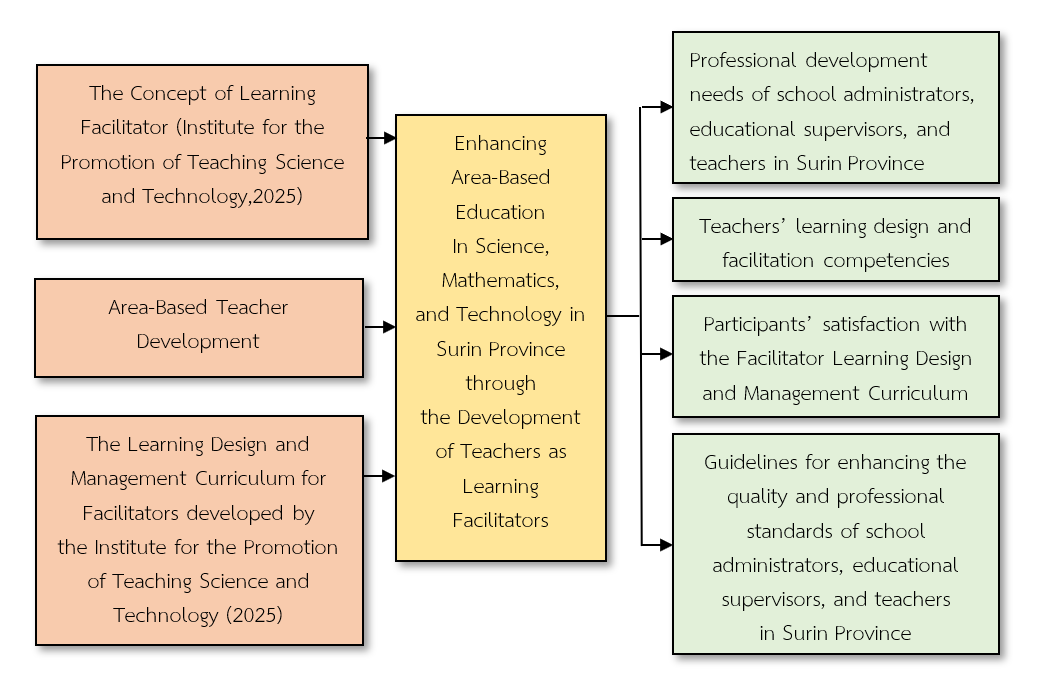
การวิจัยนี้มีวัตถุประสงค์เพื่อ 1. ศึกษาความต้องการในการพัฒนาตนเองของ ผู้บริหารสถานศึกษา ศึกษานิเทศก์ และครูในพื้นที่จังหวัดสุรินทร์ 2. ศึกษาผลการพัฒนาสมรรถนะการจัดการออกแบบการเรียนรู้ Facilitator ให้ครูและบุคลากรทางการศึกษาในพื้นที่จังหวัดสุรินทร์ 3. ศึกษาความพึงพอใจที่มีต่อหลักสูตรการจัดการออกแบบการเรียนรู้ Facilitator ให้ครูและบุคลากรทางการศึกษา และ 4. หาแนวทางในการยกระดับคุณภาพและมาตรฐานวิชาชีพ ประชากรเป็นบุคลากรทางการศึกษาในพื้นที่จังหวัดสุรินทร์ จำนวน 150 คน 70 โรงเรียน โดยเลือกกลุ่มตัวอย่างแบบสุ่มอย่างง่าย จำนวน 69 คน เครื่องมือที่ใช้ในการวิจัย ได้แก่ แผนการพัฒนาครูโดยใช้หลักสูตรของ สสวท. จำนวน 4 หน่วย แบบสอบถามความต้องการในการพัฒนาตนเอง แบบวัดสมรรถนะ แบบสอบถามความพึงพอใจ และแบบสัมภาษณ์ สถิติที่ใช้ในการวิเคราะห์ข้อมูล ได้แก่ ค่าเฉลี่ย ส่วนเบี่ยงเบนมาตรฐาน และ การทดสอบค่าที (T-test) แบบ Dependent ผลการวิจัยพบว่า 1. ความต้องการในการพัฒนาตนเองของผู้เข้าร่วมอยู่ในระดับมากที่สุด โดยเฉพาะด้านทักษะดิจิทัลและการใช้เทคโนโลยี AI เพื่อการศึกษา รองลงมาคือภาวะผู้นำทางวิชาการ และความฉลาดทางอารมณ์และความมั่นคงทางจิตใจ 2. ครูที่ได้รับการหลักสูตรการจัดการออกแบบการเรียนรู้ Facilitator มีสมรรถนะการจัดการออกแบบการเรียนรู้ Facilitator สูงขึ้นหลังได้รับการพัฒนา อย่างมีนัยสำคัญทางสถิติที่ระดับ .05 3. ผลการศึกษาความพึงพอใจต่อหลักสูตรอยู่ในระดับ มาก ทั้งในด้านวิทยากร เนื้อหา และกระบวนการดำเนินงาน 4. แนวทางสำคัญในการยกระดับคุณภาพและมาตรฐานวิชาชีพของครูในพื้นที่จังหวัดสุรินทร์ ได้แก่ การจัดอบรมอย่างต่อเนื่องในรูปแบบชุมชนแห่งการเรียนรู้ทางวิชาชีพ (PLC) การสร้างระบบพี่เลี้ยงเพื่อเสริมพลังครูต้นแบบการประยุกต์ใช้เทคโนโลยีและ AI เพื่อสนับสนุนการนิเทศและสะท้อนคิด และการพัฒนาระบบติดตามผลการพัฒนาอย่างยั่งยืนในระดับเครือข่ายโรงเรียน ซึ่งเป็นแนวทางสำคัญต่อการพัฒนาครูในยุคดิจิทัล
Downloads
เอกสารอ้างอิง
Chai, C.-S., Koh, J. H.-L., & Tsai, C.-C. (2013). A Review of Technological Pedagogical Content Knowledge. Educational Technology & Society, 16(2), 31 - 51.
Darling-Hammond, L., Hyler, M. E., & Gardner, M. (2017). Effective Teacher Professional Development. Learning Policy Institute. https://learningpolicyinstitute.org/product/effective-teacher-professional-development-brief. DOI: https://doi.org/10.54300/122.311
Elen, J., & Bishop, M. J. (2020). Introduction to Research Chapters. In Bishop, M. J., Boling, E., Elen, J., & Svihla, V. (Eds), Handbook of Research in Educational Communications and Technology (3 - 5). Springer International Publishing. https://doi.org/10.1007/978-3-030-36119-8_1. DOI: https://doi.org/10.1007/978-3-030-36119-8
Guskey, T. R. (2000). Evaluating Professional Development. Corwin Press.
Guskey, T. R. (2002). Professional Development and Teacher Change. Teachers and Teaching, 8(3), 381 - 391. https://doi.org/10.1080/135406002100000512. DOI: https://doi.org/10.1080/135406002100000512
Hord, S. M. (2015). Professional Learning Communities: Communities of Continuous Inquiry and Improvement. Southwest Educational Development Laboratory. https://sedl.org/pubs/change34/plc-cha34.pdf.
Institute for the Promotion of Teaching Science and Technology. (2023). Facilitator-based Learning Design Framework for Teachers. Institute for the Promotion of Teaching Science and Technology. (In Thai)
Institute for the Promotion of Teaching Science and Technology. (2025). Facilitator-based Learning Design Training Program for Teachers and Educational Personnel. Institute for the Promotion of Teaching Science and Technology. (In Thai)
King Mongkut’s University of Technology Thonburi. (2021). English Test of KMUTT (ETS - KMUTT): Test Manual and Score Interpretation. King Mongkut’s University of Technology Thonburi. (In Thai)
Kirkpatrick, D. L., & Kirkpatrick, J. D. (2006). Evaluating Training Programs: The Four Levels (3rd ed.). Berrett-Koehler Publishers.
Koehler, M. J., Mishra, P., & Cain, W. (2013). What is Technological Pedagogical Content Knowledge (TPACK)? Journal of Education, 193(3), 13 - 19. https://doi.org/10.1177/002205741319300303. DOI: https://doi.org/10.1177/002205741319300303
Kram, K. E. (1985). Mentoring at Work: Developmental Relationships in Organizational Life. Scott Foresman.
Mishra, P., & Koehler, M. J. (2006). Technological Pedagogical Content Knowledge: A Framework for Teacher Knowledge. Teachers College Record: The Voice of Scholarship in Education, 108(6), 1017 - 1054. https://doi.org/10.1111/j.1467-9620.2006.00684.x. DOI: https://doi.org/10.1177/016146810610800610
Office of the Education Council. (2015). National Education Reform Policy and Strategy (2015 - 2020). Office of the Education Council. (In Thai)
Office of the Education Council. (2023). National Education Development Plan and Policy Directions (2023 - 2027). Office of the Education Council. (In Thai)
Office of the National Economic and Social Development Council. (2018). The Twelfth National Economic and Social Development Plan (2017 - 2021). Office of the Prime Minister. https://www.nesdc.go.th/wordpress/wp-content/uploads/2025/04/article_20191119144322.pdf.
Office of the Teacher Civil Service and Educational Personnel Commission. (2024). Annual Report on Human Resource Management of Teacher Civil Servants and Educational Personnel, Fiscal Year 2024. https://otepc.go.th/th/43-about-otepc/annual-report.html. (In Thai)
Organisation for Economic Co-operation and Development. (2019). Education at a Glance 2019: OECD indicators. https://www.oecd.org/content/dam/oecd/en/publications/reports/2019/09/education-at-a-glance-2019_892e172e/f8d7880d-en.pdf.
Pairojangsuthorn, T. (2018). Learning Facilitator. Run Wisdom. https://www.runwisdom.com/2018/07/learning-facilitator. (In Thai)
Robinson, V. M. J. (2017). Reduce Change to Increase Improvement. Corwin Press.
Spady, W. G. (1994). Outcome-Based Education: Critical Issues and Answers. American Association of School Administrators.
Teachers’ Council of Thailand. (2022). Professional Standards for Teachers (B.E. 2565). Secretariat of the Teachers’ Council of Thailand. (In Thai)
Tomlinson, C. A. (2014). The Differentiated Classroom: Responding to the Needs of All Learners (2nd ed.). Association for Supervision and Curriculum Development.
United Nations Educational, Scientific and Cultural Organization. (2021). AI and Education: Guidance for Policy-Makers. UNESCO. https://unesdoc.unesco.org/ark:/48223/pf0000376709?locale=en.
United Nations Educational, Scientific and Cultural Organization. (2023). Guidance for Generative AI in Education and Research. UNESCO. https://www.unesco.org/en/articles/guidance-generative-ai-education-and-research.
ดาวน์โหลด
เผยแพร่แล้ว
รูปแบบการอ้างอิง
ฉบับ
ประเภทบทความ
หมวดหมู่
สัญญาอนุญาต
ลิขสิทธิ์ (c) 2025 วารสารคอมพิวเตอร์และเทคโนโลยีสร้างสรรค์

อนุญาตภายใต้เงื่อนไข Creative Commons Attribution-NonCommercial-NoDerivatives 4.0 International License.