Enhancing Area-Based Education in Science, Mathematics, and Technology in Surin Province through the Development of Teachers as Learning Facilitators
DOI:
https://doi.org/10.65205/jcct.2025.2970Keywords:
Professional Development Needs, Facilitator-based Learning Design Competency, Learning Facilitator, Teacher Professional StandardsAbstract
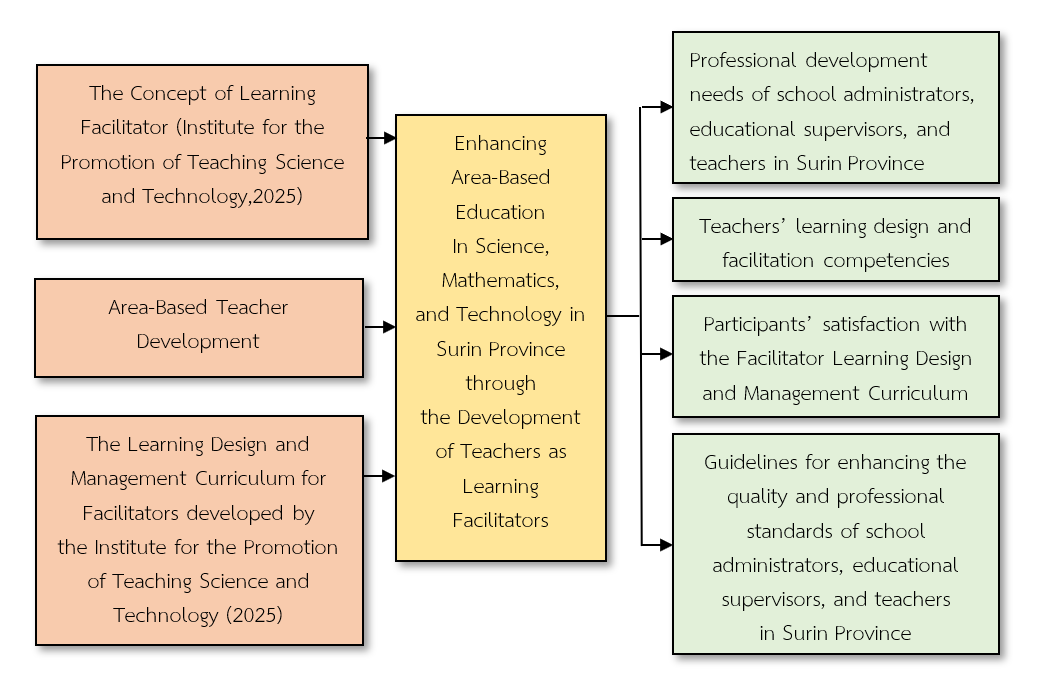
This study aimed to: 1. investigate the professional development needs of school administrators, educational supervisors, and teachers in Surin Province; 2. examine the effects of developing competencies in Facilitator-based learning design management among teachers and educational personnel in Surin Province; 3. explore participants’ satisfaction with the Facilitator-based learning design management program; and 4. identify effective approaches to enhancing professional quality and standards. The population consisted of 150 educational personnel from 70 schools in Surin Province. Using simple random sampling, a sample of 69 participants was selected. The research instruments included a teacher development plan based on four modules of the Institute for the Promotion of Teaching Science and Technology (IPST) curriculum, a professional development needs questionnaire, a competency assessment, a satisfaction questionnaire, and a semi-structured interview. Data were analyzed using mean, standard deviation, and a dependent sample T-test. The findings revealed that: 1. participants’ professional development needs were at the highest level, particularly in digital skills and the use of artificial intelligence (AI) for educational purposes, followed by academic leadership and emotional intelligence and psychological resilience; 2. teachers who participated in the Facilitator-based learning design management program demonstrated significantly higher competencies after the intervention at the .05 level; 3. overall satisfaction with the program was high across the dimensions of instructors, content, and implementation processes; and 4. key approaches to enhancing the professional quality and standards of teachers in Surin Province include continuous professional development through Professional Learning Communities (PLC), the establishment of a mentoring system to empower exemplary teachers, the integration of technology and AI to support supervision and reflective practices, and the development of a sustainable monitoring system at the school-network level. These approaches are essential for teacher development in the digital era.
Downloads
References
Chai, C.-S., Koh, J. H.-L., & Tsai, C.-C. (2013). A Review of Technological Pedagogical Content Knowledge. Educational Technology & Society, 16(2), 31 - 51.
Darling-Hammond, L., Hyler, M. E., & Gardner, M. (2017). Effective Teacher Professional Development. Learning Policy Institute. https://learningpolicyinstitute.org/product/effective-teacher-professional-development-brief. DOI: https://doi.org/10.54300/122.311
Elen, J., & Bishop, M. J. (2020). Introduction to Research Chapters. In Bishop, M. J., Boling, E., Elen, J., & Svihla, V. (Eds), Handbook of Research in Educational Communications and Technology (3 - 5). Springer International Publishing. https://doi.org/10.1007/978-3-030-36119-8_1. DOI: https://doi.org/10.1007/978-3-030-36119-8
Guskey, T. R. (2000). Evaluating Professional Development. Corwin Press.
Guskey, T. R. (2002). Professional Development and Teacher Change. Teachers and Teaching, 8(3), 381 - 391. https://doi.org/10.1080/135406002100000512. DOI: https://doi.org/10.1080/135406002100000512
Hord, S. M. (2015). Professional Learning Communities: Communities of Continuous Inquiry and Improvement. Southwest Educational Development Laboratory. https://sedl.org/pubs/change34/plc-cha34.pdf.
Institute for the Promotion of Teaching Science and Technology. (2023). Facilitator-based Learning Design Framework for Teachers. Institute for the Promotion of Teaching Science and Technology. (In Thai)
Institute for the Promotion of Teaching Science and Technology. (2025). Facilitator-based Learning Design Training Program for Teachers and Educational Personnel. Institute for the Promotion of Teaching Science and Technology. (In Thai)
King Mongkut’s University of Technology Thonburi. (2021). English Test of KMUTT (ETS - KMUTT): Test Manual and Score Interpretation. King Mongkut’s University of Technology Thonburi. (In Thai)
Kirkpatrick, D. L., & Kirkpatrick, J. D. (2006). Evaluating Training Programs: The Four Levels (3rd ed.). Berrett-Koehler Publishers.
Koehler, M. J., Mishra, P., & Cain, W. (2013). What is Technological Pedagogical Content Knowledge (TPACK)? Journal of Education, 193(3), 13 - 19. https://doi.org/10.1177/002205741319300303. DOI: https://doi.org/10.1177/002205741319300303
Kram, K. E. (1985). Mentoring at Work: Developmental Relationships in Organizational Life. Scott Foresman.
Mishra, P., & Koehler, M. J. (2006). Technological Pedagogical Content Knowledge: A Framework for Teacher Knowledge. Teachers College Record: The Voice of Scholarship in Education, 108(6), 1017 - 1054. https://doi.org/10.1111/j.1467-9620.2006.00684.x. DOI: https://doi.org/10.1177/016146810610800610
Office of the Education Council. (2015). National Education Reform Policy and Strategy (2015 - 2020). Office of the Education Council. (In Thai)
Office of the Education Council. (2023). National Education Development Plan and Policy Directions (2023 - 2027). Office of the Education Council. (In Thai)
Office of the National Economic and Social Development Council. (2018). The Twelfth National Economic and Social Development Plan (2017 - 2021). Office of the Prime Minister. https://www.nesdc.go.th/wordpress/wp-content/uploads/2025/04/article_20191119144322.pdf.
Office of the Teacher Civil Service and Educational Personnel Commission. (2024). Annual Report on Human Resource Management of Teacher Civil Servants and Educational Personnel, Fiscal Year 2024. https://otepc.go.th/th/43-about-otepc/annual-report.html. (In Thai)
Organisation for Economic Co-operation and Development. (2019). Education at a Glance 2019: OECD indicators. https://www.oecd.org/content/dam/oecd/en/publications/reports/2019/09/education-at-a-glance-2019_892e172e/f8d7880d-en.pdf.
Pairojangsuthorn, T. (2018). Learning Facilitator. Run Wisdom. https://www.runwisdom.com/2018/07/learning-facilitator. (In Thai)
Robinson, V. M. J. (2017). Reduce Change to Increase Improvement. Corwin Press.
Spady, W. G. (1994). Outcome-Based Education: Critical Issues and Answers. American Association of School Administrators.
Teachers’ Council of Thailand. (2022). Professional Standards for Teachers (B.E. 2565). Secretariat of the Teachers’ Council of Thailand. (In Thai)
Tomlinson, C. A. (2014). The Differentiated Classroom: Responding to the Needs of All Learners (2nd ed.). Association for Supervision and Curriculum Development.
United Nations Educational, Scientific and Cultural Organization. (2021). AI and Education: Guidance for Policy-Makers. UNESCO. https://unesdoc.unesco.org/ark:/48223/pf0000376709?locale=en.
United Nations Educational, Scientific and Cultural Organization. (2023). Guidance for Generative AI in Education and Research. UNESCO. https://www.unesco.org/en/articles/guidance-generative-ai-education-and-research.
Downloads
Published
How to Cite
Issue
Section
Categories
License
Copyright (c) 2025 Journal of Computer and Creative Technology

This work is licensed under a Creative Commons Attribution-NonCommercial-NoDerivatives 4.0 International License.