การพัฒนาบทเรียนออนไลน์ภาษาอังกฤษเพื่อการเรียนรู้ท้องถิ่นสำหรับผู้เรียนที่เรียนรู้ด้วยตนเองจากแหล่งเรียนรู้ทางธรรมชาติ วัฒนธรรมและภูมิปัญญาท้องถิ่นในจังหวัดชัยภูมิ
DOI:
https://doi.org/10.65205/jcct.2025.2857คำสำคัญ:
บทเรียนออนไลน์ภาษาอังกฤษ, การเรียนรู้ด้วยตนเอง, แหล่งเรียนรู้ทางธรรมชาติ, วัฒนธรรม, ภูมิปัญญาท้องถิ่นบทคัดย่อ
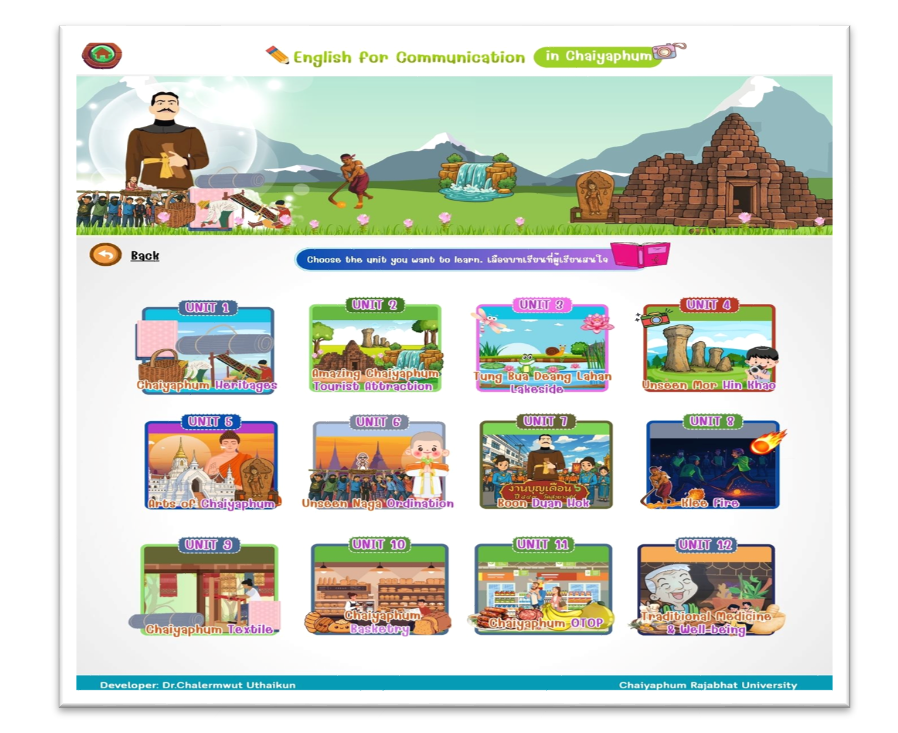
การวิจัยครั้งนี้มีวัตถุประสงค์ คือ 1) เพื่อสำรวจความต้องการในการผลิตสื่อการเรียนรู้ทางภาษาอังกฤษที่มีเนื้อหาสาระการเรียนรู้ในบริบทเชิงพื้นที่จังหวัดชัยภูมิ สำหรับนักเรียนมัธยมศึกษาในจังหวัดชัยภูมิ 2) เพื่อพัฒนาบทเรียนออนไลน์ภาษาอังกฤษเพื่อการเรียนรู้ท้องถิ่น สำหรับผู้เรียนที่เรียนรู้ด้วยตนเองจากแหล่งเรียนรู้ทางธรรมชาติ วัฒนธรรม และภูมิปัญญาท้องถิ่นในจังหวัดชัยภูมิ 3) เพื่อศึกษาผลการใช้บทเรียนออนไลน์ภาษาอังกฤษเพื่อการเรียนรู้ท้องถิ่น สำหรับผู้เรียนที่เรียนรู้ด้วยตนเองจากแหล่งเรียนรู้ทางธรรมชาติ วัฒนธรรม และภูมิปัญญาท้องถิ่นในจังหวัดชัยภูม การวิจัยครั้งนี้มีขั้นตอนการวิจัยแบ่งออกเป็น 2 ระยะ คือ ระยะที่ 1 การสำรวจ ความต้องการ การผลิตสื่อการเรียนรู้ทางภาษาอังกฤษ กลุ่มตัวอย่าง คือ ครูระดับมัธยมศึกษา ในจังหวัดชัยภูมิ จำนวน 96 คน ได้จากการสุ่มแบบหลายขั้นตอน เครื่องมือวิจัย คือ แบบสำรวจ สถิติที่ใช้ในขั้นตอนนี้ ร้อยละ ค่าเฉลี่ย และส่วนเบี่ยงเบนมาตรฐาน ระยะที่ 2 การใช้บทเรียนออนไลน์ภาษาอังกฤษเพื่อการเรียนรู้ท้องถิ่น กลุ่มตัวอย่าง คือ นักเรียนระดับมัธยมศึกษาในจังหวัดชัยภูมิที่เรียนอยู่ในภาคการศึกษาที่ 2 ปีการศึกษา 2567 ได้จากการสุ่มแบบหลายขั้นตอนได้จำนวน 100 คน เครื่องมือวิจัยที่ใช้ ในขั้นตอนนี้ คือ บทเรียนออนไลน์ภาษาอังกฤษเพื่อการเรียนรู้ท้องถิ่น และแบบทดสอบวัดความสามารถทางภาษาอังกฤษ สถิติที่ใช้ในขั้นตอนนี้ คือ การทดสอบค่าทีแบบกลุ่มไม่อิสระ ผลการวิจัย 1) ความต้องการในการผลิตสื่อบทเรียนออนไลน์ภาษาอังกฤษเพื่อการเรียนรู้ท้องถิ่น สำหรับผู้เรียนที่เรียนรู้ด้วยตนเองจากแหล่งเรียนรู้ทางธรรมชาติ วัฒนธรรม และภูมิปัญญาท้องถิ่นในจังหวัดชัยภูมิ พบว่า มีความต้องการอยู่ในระดับมากที่สุด ( = 4.61, S.D = 0.49) 2) ผลการพัฒนาบทเรียนออนไลน์ภาษาอังกฤษเพื่อการเรียนรู้ท้องถิ่น สำหรับผู้เรียนที่เรียนรู้ด้วยตนเองจากแหล่งเรียนรู้ทางธรรมชาติ วัฒนธรรม และภูมิปัญญาท้องถิ่นในจังหวัดชัยภูมิ พบว่า บทเรียนออนไลน์ภาษาอังกฤษเพื่อการเรียนรู้ท้องถิ่น มีประสิทธิภาพในการนำไปใช้สำหรับการเรียนรู้ภาษาอังกฤษด้วยตนเองอยู่ในระดับ มากที่สุด (
= 4.67, S.D = 0.57) 3) ผลการใช้บทเรียนออนไลน์ภาษาอังกฤษเพื่อการเรียนรู้ท้องถิ่น สำหรับผู้เรียนที่เรียนรู้ด้วยตนเองจากแหล่งเรียนรู้ทางธรรมชาติ วัฒนธรรม และภูมิปัญญาท้องถิ่นในจังหวัดชัยภูมิ พบว่าความสามารถทางภาษาอังกฤษระหว่างคะแนนทดสอบก่อนเรียนและหลังเรียนมีความแตกต่างอย่างมีนัยสำคัญทางสถิติที่ระดับ 0.01
Downloads
เอกสารอ้างอิง
Baker, W. (2012). English as a Lingua Franca in Thailand: Characterisations and Implications. https://www.academia.edu/3830294/English_as_a_Lingua_Franca_in_Thailand_Characterisations_and_Implications.
Chaiyaphum Rajabhat University. (2008). Council Mission Report. Chaiyaphum Rajabhat University Council. (In Thai)
Chapelle, C. A. (2003). English Language Learning and Technology: Lectures on Applied Linguistics in the Age of Information and Communication Technology. John Benjamins.
Daskan, A., & Yildiz, Y. (2020). Blended Learning: A Potential Approach to Promote Learning Outcomes. International Journal of Social Sciences & Educational Studies, 7(4), 103 - 108. https://doi.org/10.23918/ijsses.v7i4p103.
Department of ASEAN Affairs. (2013). ASEAN Mini Book (3rd ed.). Page Maker.
Department of Curriculum and Instruction Development. (2001). Basic Education Curriculum B.E. 2544 (A.D. 2001). Kurusapa Ladprao Publishing.
EF English Proficiency Index. (2022). EF English Proficiency Index : A Ranking of 111 Countries and Regions by English Skills. https://www.ef.com/assetscdn/WIBIwq6RdJvcD9bc8RMd/cefcom-epi-site/reports/2022/ef-epi-2022-english.pdf.
Fachruddin, A. T. C. (2022). Developing Interactive Instructional Modules for Core Principles of English Language Teaching. ELS Journal on Interdisciplinary Studies in Humanities, 5(3), 405 - 410.
Godwin-Jones, R. (2011). Mobile Apps for Language Learning. Language Learning & Technology, 15(2), 2 - 11. https://doi.org/10.64152/10125/44244.
Godwin-Jones, R. (2018). Using Mobile Devices in the Language Classroom: Part of the Cambridge Papers in ELT Series. Cambridge University Press. https://www.cambridge.org/elt/blog/wp-content/uploads/2018/03/Whitepaper-mobiles-in-class.pdf.
Kaliisa, R., Rienties, B., Mørch, A. I., & Kluge, A. (2022). Social Learning Analytics in Computer-Supported Collaborative Learning Environments: A Systematic Review of Empirical Studies. Computers and Education Open, 3, 100073. https://doi.org/10.1016/j.caeo.2022.100073.
Kusumawati, A. J. (2020). Redesigning Face-to-face into Online Learning for Speaking Competence During COVID - 19: ESP for Higher Education in Indonesia. International Journal of Language Education, 4(2), 276 - 288.
Mahaviro, S. (2016). The Importance of English in the ASEAN Community. Journal of Yanasangvorn Research Institute, 7(1), 170 - 180. (In Thai)
Marougkas, A., Troussas, C., Krouska, A., & Sgouropoulou, C. (2023). Virtual Reality in Education: A Review of Learning Theories, Approaches and Methodologies for the Last Decade. Electronics, 12(13), 2832. https://doi.org/10.3390/electronics12132832.
Noom-Ura, S. (2013). English-Teaching Problems in Thailand and Thai Teachers’ Professional Development Needs. English Language Teaching, 6(11), 139 - 147. https://doi.org/10.5539/elt.v6n11p139.
Pegrum, M. (2019). Mobile Learning: Languages, Literacies and Cultures. Palgrave Macmillan. https://doi.org/10.1057/9781137309815.
Peng, L., Akhter, S., & Hashemifardnia, A. (2025). Podcast-integrated Speaking Instruction: Enhancing Informal Digital Learning of English, Academic Engagement, and Speaking Skills. Acta Psychologica, 258, 105158. https://doi.org/10.1016/j.actpsy.2025.105158.
Piaget, J. (1950). The Psychology of Intelligence. Routledge.
Prakhong, K. (1999). Statistics for Behavioral Science Research (3rd ed.). Chulalongkorn University Press. (In Thai)
Schneider, S., Beege, M., Nebel, S., Schnaubert, L., & Rey, G. D. (2022). The Cognitive-Affective-Social Theory of Learning in Digital Environments (CASTLE). Educational Psychology Review, 34, 1 - 38. https://doi.org/10.1007/s10648-021-09626-5.
Sinlapawattanawong, C., & Limtasiri, O. (2025). The Development of English Learning Achievement on “My Daily Routine” Using Computer Assisted Instruction (CAI) for 5th Grade Students, Wat Khuan Chalik School. Journal of Buddhist Education and Research, 11(1), 48 - 58.
Sompanya, S., & Limtasiri, O. (2024). A Comparison of Learning Achievement in English subjects of Grade 2 Students at Ratchamontri (Pluem-Chuemnukul) School Using Multimedia and the Traditional Teaching Method. NEU Academic and Research Journal, 14(1), 83 - 94. (In Thai)
Sonaphun, C., & Lekhachoke, N. (2025). Effects of Murdoch’s Integrated Approach (MIA) on Learning Achievement in English Reading Skills. Journal of English Language and Linguistics, 6(1), 97 - 112. https://doi.org/10.62819/jel.2025.999.
Stockwell, G. (2013). Technology and Motivation in English-Language Teaching and Learning. In Ushioda, E. (Eds), International Perspectives on Motivation (156 - 175). Palgrave Macmillan. https://doi.org/10.1057/9781137000873_9.
Strategic and Provincial Development Data Division. (2023). Chaiyaphum Provincial Development Plan 2023 - 2027. Chaiyaphum Provincial Office. https://online.fliphtml5.com/rljtx/xjod/#p=1. (In Thai)
Sukwin, K., & Soontorntanaphol, N. (2022). The Accessibility to Instructional Media for Online Learning Effectiveness. Journal of Human Society, 12(1), 91 - 109. (In Thai)
Uthaikun, C., Riddle, S., & Barton, G. (2024). Using English as a Language of Instruction in Rural Schools in Thailand: Key Challenges for Teaching and Learning. Asia Pacific Journal of Educators and Education, 39(1), 239 - 257. https://doi.org/10.21315/apjee2024.39.1.10.
ดาวน์โหลด
เผยแพร่แล้ว
รูปแบบการอ้างอิง
ฉบับ
ประเภทบทความ
หมวดหมู่
สัญญาอนุญาต
ลิขสิทธิ์ (c) 2025 วารสารคอมพิวเตอร์และเทคโนโลยีสร้างสรรค์

อนุญาตภายใต้เงื่อนไข Creative Commons Attribution-NonCommercial-NoDerivatives 4.0 International License.