การเรียนรู้ของเครื่องโดยใช้โครงข่ายประสาทเทียมแบบกระจายย้อนกลับชนิดหน่วงเวลาเพื่อระบุตำแหน่งปัญหาลูปในเครือข่ายสวิตช์เลเยอร์ 2
DOI:
https://doi.org/10.65205/jcct.2026.e4181คำสำคัญ:
ปัญหาลูปในเครือข่ายสวิตช์เลเยอร์ 2, แบบจำลองการเรียนรู้ของเครื่อง, โครงข่ายประสาทเทียมแบบกระจายย้อนกลับชนิดหน่วงเวลาบทคัดย่อ
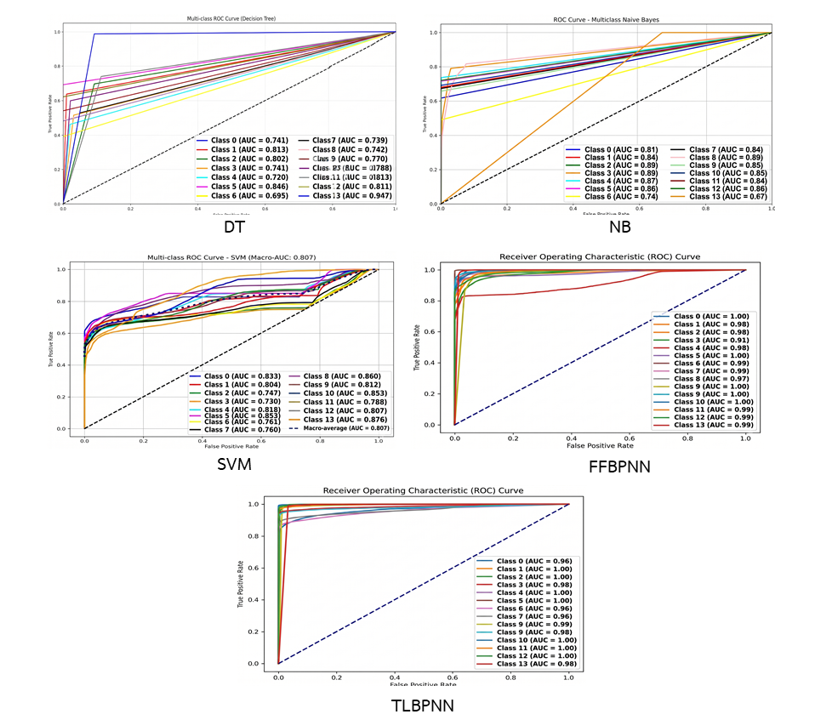
งานวิจัยนี้มีวัตถุประสงค์เพื่อศึกษา และวิเคราะห์ปัญหาลูปในเครือข่ายสวิตช์เลเยอร์ 2 รวมถึงผลกระทบต่อประสิทธิภาพของระบบ เพื่อพัฒนาแบบจำลองการเรียนรู้ของเครื่องโดยใช้โครงข่ายประสาทเทียมแบบกระจายย้อนกลับชนิดหน่วงเวลาในการระบุตำแหน่งปัญหาลูปในเครือข่าย และเพื่อประเมินพร้อมเปรียบเทียบประสิทธิภาพของแบบจำลองที่พัฒนาขึ้นภายใต้เกณฑ์วัดที่กำหนด การดำเนินงานวิจัยประกอบด้วย 8 ขั้นตอนหลัก ได้แก่ 1) การจำลองเครือข่าย 2) การจำลองการเกิดปัญหาลูป 3) การเก็บข้อมูลทราฟฟิก 4) การเตรียมและทำความสะอาดข้อมูล 5) การแบ่งชุดข้อมูลฝึกและทดสอบ 6) การพัฒนาแบบจำลองด้วยอัลกอริทึมที่หลากหลาย 7) การปรับแต่งพารามิเตอร์ และ 8) การประเมินประสิทธิภาพของแบบจำลองโดยใช้ตารางความสับสนร่วมกับตัวชี้วัดทางสถิติ ผลงานวิจัยพบว่าแบบจำลองที่พัฒนาขึ้นทั้ง 5 แบบจำลองสามารถระบุตำแหน่งการเกิดปัญหาลูปได้สำเร็จ ซึ่งแบบจำลองโครงข่ายประสาทเทียมแบบกระจายย้อนกลับชนิดหน่วงเวลาให้ผลลัพธ์ดีที่สุด โดยให้ค่าความถูกต้อง (Accuracy) ร้อยละ 91.46 ค่าความแม่นยำ (Precision) ร้อยละ 95.27 ค่าการเรียกคืน (Recall) ร้อยละ 91.46 ค่าประสิทธิภาพโดยรวม (F1-score) ร้อยละ 93.11 และพื้นที่ใต้กราฟ (AUC) เท่ากับ 0.986 แสดงให้เห็นว่าแบบจำลองดังกล่าวมีประสิทธิภาพสูงในการตรวจจับ และระบุตำแหน่งปัญหาลูปได้อย่างแม่นยำ
Downloads
เอกสารอ้างอิง
Ahmad, Z., Khan, A. H., Shiang, C. W., Abdullah, J., & Ahmad, F. (2021). Network Intrusion Detection System: A Systematic Study of Machine Learning and Deep Learning Approaches. Transactions on Emerging Telecommunications Technologies, 32(1), e4150. https://doi.org/10.1002/ett.4150
Berman, D. S., Buczak, A. L., Chavis, J. S., & Corbett, C. L. (2019). A Survey of Deep Learning Methods for Cyber Security. Information, 10(4), 122. https://doi.org/10.3390/info10040122
Ferrag, M. A., Maglaras, L., Moschoyiannis, S., & Janicke, H. (2020). Deep Learning for Cyber Security Intrusion Detection: Approaches, Datasets, and Comparative Study. Journal of Information Security and Applications, 50, 102419. https://doi.org/10.1016/j.jisa.2019.102419
Grandini, M., Bagli, E., & Visani, G. (2020). Metrics for Multi-Class Classification: An Overview. arXiv. https://doi.org/10.48550/arXiv.2008.05756
Hewamalage, H., Bergmeir, C., & Bandara, K. (2021). Recurrent Neural Networks for Time Series Forecasting: Current Status and Future Directions. International Journal of Forecasting, 37(1), 388–427. https://doi.org/10.1016/j.ijforecast.2020.06.008
Institute of Electrical and Electronics Engineers. (2004). 802.1D-2004 - IEEE Standard for Local and Metropolitan Area Networks: Media Access Control (MAC) Bridges. https://doi.org/10.1109/IEEESTD.2004.94569
Kilincer, I. F., Ertam, F., & Sengur, A. (2021). Machine Learning Methods for Cyber Security Intrusion Detection: Datasets and Comparative Study. Computer Networks, 188, 107840. https://doi.org/10.1016/j.comnet.2021.107840
Le, T.-T.-H., Kim, Y., & Kim, H. (2019). Network Intrusion Detection Based on Novel Feature Selection Model and Various Recurrent Neural Networks. Applied Sciences, 9(7), 1392. https://doi.org/10.3390/app9071392
Lim, B., & Zohren, S. (2021). Time-Series Forecasting with Deep Learning: A Survey. Philosophical transactions - Royal Society. Mathematical, Physical and Engineering Sciences, 379(2194), 20200209. https://doi.org/10.1098/rsta.2020.0209
Luque, A., Carrasco, A., Martín, A., & De Las Heras, A. (2019). The Impact of Class Imbalance in Classification Performance Metrics Based on the Binary Confusion Matrix. Pattern Recognition, 91, 216–231. https://doi.org/10.1016/j.patcog.2019.02.023
Pešović, U., Pešović, S. Đ., Savić, B., & Marković, D. (2024, 20-22 September). Detection of Broadcast Storms in Local Area Networks. 10th International Scientific Conference Technics, Informatic, and Education, 136–139. https://doi.org/10.46793/TIE24.136P
Surakhi, O., Zaidan, M. A., Fung, P. L., Hossein Motlagh, N., Serhan, S., AlKhanafseh, M., Ghoniem, R. M., & Hussein, T. (2021). Time-Lag Selection for Time-Series Forecasting Using Neural Network and Heuristic Algorithm. Electronics, 10(20), 2518. https://doi.org/10.3390/electronics10202518
Waqas, M., Humphries, U. W., Wangwongchai, A., Dechpichai, P., & Ahmad, S. (2023). Potential of Artificial Intelligence-Based Techniques for Rainfall Forecasting in Thailand: A Comprehensive Review. Water, 15(16), 2979. https://doi.org/10.3390/w15162979
ดาวน์โหลด
เผยแพร่แล้ว
รูปแบบการอ้างอิง
ฉบับ
ประเภทบทความ
หมวดหมู่
สัญญาอนุญาต
ลิขสิทธิ์ (c) 2026 วารสารคอมพิวเตอร์และเทคโนโลยีสร้างสรรค์

อนุญาตภายใต้เงื่อนไข Creative Commons Attribution-NonCommercial-NoDerivatives 4.0 International License.