Development of a Centralized System for Exchanging Geometric Point Movements in 3D Models for Visual Effects and Computer Animation
DOI:
https://doi.org/10.65205/jcct.2026.e3713Keywords:
Centralized System, Geometric Points, 3D Models, Visual Effects, Computer AnimationAbstract
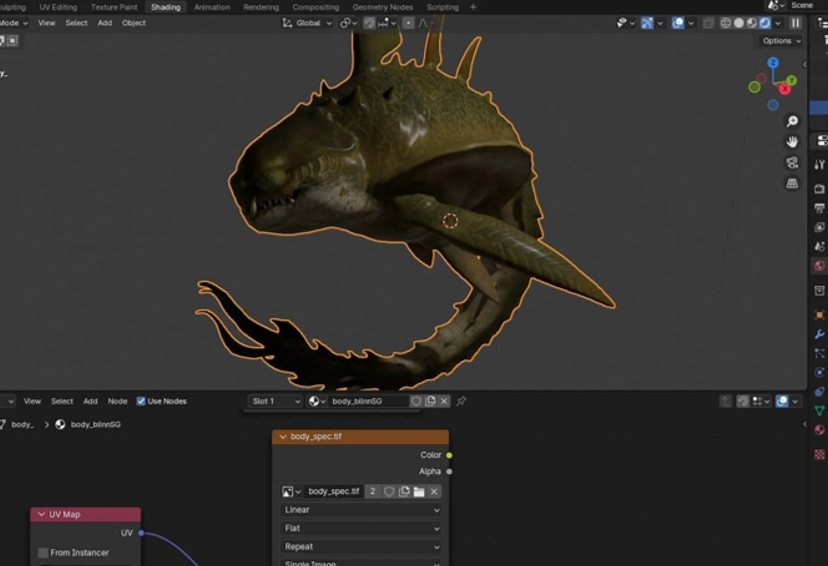
This study explores techniques for reducing file sizes and processing time of geometric point movements in 3D models, leading to the development of a GPU Cache algorithm. The objectives of the research were: 1) to design and develop a centralized system for exchanging geometric point movement data in 3D models between visual effects and computer animation software, and 2) to examine user satisfaction and compare the usability of the developed system in supporting workflows in visual effects and computer animation. The sample group consisted of 34 undergraduate students majoring in Multimedia Technology at Rajamangala University of Technology Isan, selected based on their prior coursework in visual effects and computer animation. The research employed mean, standard deviation, and t-test statistics. Results indicated that 1) the developed centralized system was highly effective, with an average score of 4.38, and 2) the sample group showed a statistically significant difference in satisfaction levels before and after using the centralized system at the .05 significance level. Satisfaction after using the system was higher than before, with a mean score of 4.157.
Downloads
References
Boyd, R. J., Powney, G. D., & Pescott, O. L. (2023). We Need to Talk About Nonprobability Samples. Trends in Ecology & Evolution, 38(6), 521-531. https://doi.org/10.1016/j.tree.2023.01.001
Cholodenko, A. (2024). The Animation of Cinema. Semiotic Review, 10(Animation). https://doi.org/10.71743/S3P4X084
Domke, J., Vatai, E., Gerofi, B., Kodama, Y., Wahib, M., Podobas, A., Mittal, S., Pericàs, M., Zhang, L., Chen, P., Drozd, A., & Matsuoka, S. (2023). At the Locus of Performance: Quantifying the Effects of Copious 3D-Stacked Cache on HPC Workloads. ACM Transactions on Architecture and Code Optimization, 20(4), 57. https://doi.org/10.1145/3629520
Jia, H., & Sundar, S. S. (2024). Vivid and Engaging: Effects of Interactive Data Visualization on Perceptions and Attitudes about Social Issues. Digital Journalism, 12(8), 1205-1229. https://doi.org/10.1080/21670811.2023.2250815
Jiang, R., Wang, L., & Tsai, S.-B. (2022). An Empirical Study on Digital Media Technology in Film and Television Animation Design. Mathematical Problems in Engineering, 2022, 5905117. https://doi.org/10.1155/2022/5905117
Jimeno, J. B., & Prado, N. I. (2024). Quality Leadership and Management, Technology-Based Instruction, Work Attitude and Teachers’ Performance in the New Normal. International Journal of Multidisciplinary: Applied Business and Education Research, 5(1), 251-284. https://doi.org/10.11594/ijmaber.05.01.24
Jones, N. (2023). Far from Houdini: The ‘Magic’ of the VFX Breakdown. Animation, 18(1), 42-58. https://doi.org/10.1177/17468477231155541
Kenzel, M., Kerbl, B., Tatzgern, W., Ivanchenko, E., Schmalstieg, D., & Steinberger, M. (2018). On-the-fly Vertex Reuse for Massively-Parallel Software Geometry Processing. Proceedings of the ACM on Computer Graphics and Interactive Techniques, 1(2), 28. https://doi.org/10.1145/3233303
Kerbl, B., Kenzel, M., Ivanchenko, E., Schmalstieg, D., & Steinberger, M. (2018). Revisiting The Vertex Cache: Understanding and Optimizing Vertex Processing on the modern GPU. Proceedings of the ACM on Computer Graphics and Interactive Techniques, 1(2), 29. https://doi.org/10.1145/3233302
Li, L., Qiao, X., Lu, Q., Ren, P., & Lin, R. (2020). Rendering Optimization for Mobile Web 3D Based on Animation Data Separation and On-Demand Loading. IEEE Access, 8, 88474–88486. https://doi.org/10.1109/ACCESS.2020.2993613
Morales, J. (2024). What is Waterfall Model: Complete Definition, Pros, and Cons. MindOnMap. https://www.mindonmap.com/blog/what-is-waterfall-model
Pardeshi, A. S., & Karbhari, V. B. (2019). Recent Trends in VFX (Virtual Effects) and SFX (Special Effects). International Journal of Engineering Research & Technology, 8(7), 882-884.
Rungsoongnern, A., Tirakoat, S., & Kaenampornpan, M. (2024). Efficiency and Effectiveness of the Blender Extension to 3D Modelling for Metaverse. The Journal of Social Communication Innovation, 12(1), 62-71. (In Thai)
Rungsoongnern, A., Tirakoat, S., & Kaenampornpan, M. (2025). Innovative Techniques for 3D Model Optimization in the Metaverse. Science & Technology Asia, 30(4), 323-332. https://doi.org/10.14456/scitechasia.2025.87
Rungsoongnern, P., & Chaiyasit, S. (2022). The Designs and Development of 3D Fantasy Model for Study the Composition in the Old Town of Nakhon Ratchasima. Journal of Fine Arts, Chiang Mai University, 13(1), 144-168. (In Thai)
Schütz, M., Mandlburger, G., Otepka, J., & Wimmer, M. (2020). Progressive Real-Time Rendering of One Billion Points Without Hierarchical Acceleration Structures. Computer Graphics Forum, 39(2), 51-64. https://doi.org/10.1111/cgf.13911
VIVERSE Team. (2024). Overcome Challenges of Real-time Rendering in 3D with Polygon Streaming. VIVERSE. https://www.news.viverse.com/post/overcome-challenges-of-real-time-rendering-in-3d-with-polygon-streaming
Wyman, N. J., Park, M. A., Baker, P., & Chawner, J. R. (2021, January 11-15 & 19-21). A Framework for Mesh-Geometry Associativity During Mesh Adaptation. AIAA Scitech 2021 Forum. https://doi.org/10.2514/6.2021-1900
Zhang, C., Lu, H., & Chen, C. W. (2025). Caching Optimization in User-Centric Networks: A Stochastic Geometry Perspective. IEEE Transactions on Vehicular Technology, 74(5), 8187-8200. https://doi.org/10.1109/tvt.2025.3527725
Downloads
Published
How to Cite
Issue
Section
Categories
License
Copyright (c) 2026 Journal of Computer and Creative Technology

This work is licensed under a Creative Commons Attribution-NonCommercial-NoDerivatives 4.0 International License.