The Role and Development Approach for Innovative Teachers Competence in Creating Learning Management Innovations with Digital Technology
DOI:
https://doi.org/10.65205/jcct.2026.e3292Keywords:
Innovative Teachers Competence, Innovation in Learning Management, Digital TechnologyAbstract
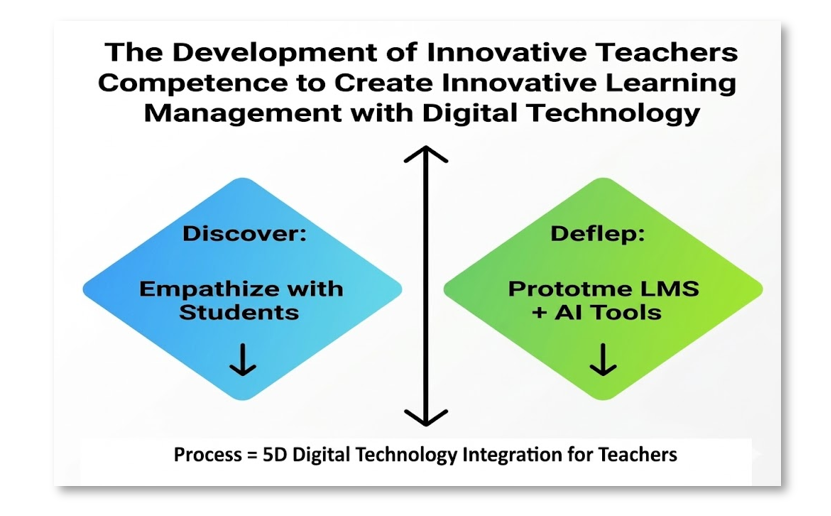
The role and development for innovative teacher competencies in creating learning management innovations with the digital technology era is extremely important, enabling teachers to adapt and apply digital technology effectively and modernly in learning management, with the aim of developing learners to possess the necessary skills and competencies for the 21st century. The development of innovative teacher competencies enhances teachers' abilities to create and apply educational innovations in the learning process to continuously improve the quality of learners, which involves developing knowledge, skills, and attributes essential for being an innovator. The creation of innovative learning management involves the development of new, effective and modern teaching methods to promote creative and sustainable learning among students, focusing on improving the learning process, using technology, and applying new ideas to teaching management, so that students can engage in meaningful learning and apply knowledge in real life. Importantly, learning management in the digital age involves using digital technology and online media as tools for teaching and learning management to enhance effectiveness and create a more diverse and engaging learning experience in the present era.
Downloads
References
Announcement of the Teachers’ Council of Thailand Board on the Competency Development Framework for Teachers in the 21st Century. (2025, November 5). Royal Thai Government Gazette. Book No. 142 Chapter 352 Ngor, 50-51. (In Thai)
Asanok, M. (2018). Development, Efficiency and Effectiveness of Innovation for Self-Learning Model. Journal of Educational Technology and Communications Faculty of Education Mahasarakham University, 1(2), 9-18. (In Thai)
Chantakul, P. (2024). The Developing Innovative Management Processes KCNPB Model to Promote the Creation of Innovators into the Classrooms of Teachers and Students, Kanchanaphisek Wittayalai Phetchabun School. Journal of Intellect Education, 2(5), 26-38. (In Thai)
Gagné, R. M., & Briggs, L. J. (1979). Principles of Instructional Design (2nd ed.). Holt, Rinehart and Winston.
Good, C. V., & Merkel, W. R. (1973). Dictionary of Education (3rd ed.). McGraw-Hill.
Malithong, K. (2005). Technology and Communication for Education. Aroon KarnPim. (In Thai)
Mishra, P., & Koehler, M. J. (2006). Technological Pedagogical Content Knowledge: A Framework for Teacher Knowledge. Teachers College Record, 108(6), 1017-1054. https://doi.org/10.1111/j.1467-9620.2006.00684.x
Office of National Higher Education Science Research and Innovation Policy Council. (2024). Higher Education Sandbox: Lessons Learned from Higher Education Innovation and Policy Support Recommendations. https://www.nxpo.or.th/th/report/29603 (In Thai)
Phisitsaranyu, D., & Buakham, T. (2012). Effect of Emotion on Creativity. [Bachelor’s thesis, Chulalongkorn University].Chulalongkorn University Intellectual Repository. https://doi.org/10.58837/chula.sp.2012.48 (In Thai)
Pichitpornchai, C. (2018). Creating Innovation in Learning Management. Mahidol University. (In Thai)
Pornkul, C. (2002). CATS: A Student-Centered Instructional Model (2nd ed.). Chulalongkorn University Press. (In Thai)
Roblyer, M. D., & Doering, A. H. (2013). Integrating Educational Technology into Teaching (6th ed.). Pearson.
Rogers, E. M. (2003). Diffusion of Innovations (5th ed.). The Free Press.
Samcharoen, K. (2023). Guidelines for Active Learning Teaching. Sripatum University. (In Thai)
Sirirattanajitt, A. (2024). Research and Development (R&D) in Education. AP Book and Infopreneur. (In Thai)
Siririn, J. (2022). Higher Education 4.0: The Adaptation of Global University. National Interest, 2(6), 49-55.
Somabut, A. (2012). Development of Learning Innovation Diffusion Model: Case Study Constructivist Learning Innovation. [Unpublished doctoral dissertation]. Khon Kean University. (In Thai)
Sosongchan, A. (2025). Innovation towards Technology. Buriram Rajabhat University. (In Thai)
Thongking, P. (2020). The Teacher’s Role in Establishing a Positive Learning Environment In the 21st Century Classroom. Journal of Inclusive and Innovative Education, 4(1), 50-59. (In Thai)
Waitayasin, P. (2019). “Change” Learner to be Innovator is New Educational Innovation in Education 4.0 Era. Education and Communication Technology Journal, 14(17), 37-51. (In Thai)
Wutthirong, P. (2014). Innovation Management: Resource Learning Organization and Innovation. Chulalongkorn University Press. (In Thai)
Yooyuen, P., Phumiota, A., & Sriyothin, S. (2017, August 4). Factors that Influence the Innovator: A Case Study of PUNN Products. The 4th National Conference on Public Affairs Management, 827-833. Khon Kaen University. (In Thai)
Yuenyaw, P. (2019). Professional Teachers in the 21st Century. Nakhon Pathom Rajabhat University. (In Thai)
Downloads
Published
How to Cite
Issue
Section
Categories
License
Copyright (c) 2026 Journal of Computer and Creative Technology

This work is licensed under a Creative Commons Attribution-NonCommercial-NoDerivatives 4.0 International License.