The Development of an Online Hybrid Learning Lesson Incorporating the CIPPA Model to Promote Analytical Thinking Skills on Responsible Use of Information Technology for Mathayomsuksa 2 Students
DOI:
https://doi.org/10.65205/jcct.2026.e3172Keywords:
Online Hybrid Learning, CIPPA Model, Analytical ThinkingAbstract
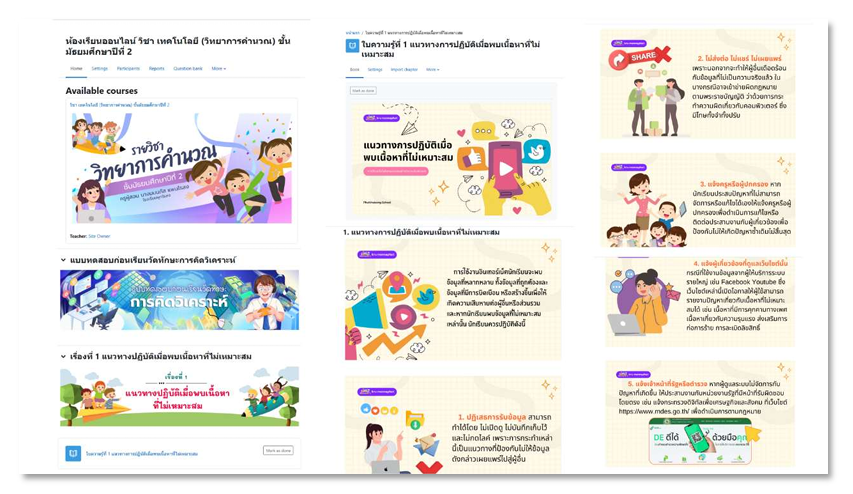
The objectives of this research were to: (1) develop an online hybrid learning lesson with an efficiency of 80/80, (2) study students’analytical thinking skills before and after learning through the online hybrid learning lesson integrated with the CIPPA model on the topic “Using Information Technology Responsibly” for Mathayomsuksa 2 students, (3) compare students’ learning achievement before and after learning with the online hybrid learning lesson, and (4) study students’ satisfaction toward the online hybrid learning lesson. The sample consisted of 39 Mathayomsuksa 2/1 students from Phutthaisong School, Phutthaisong District, Buriram Province, under the Secondary Educational Service Area Office Buriram, in the first semester of the academic year 2025. The research instruments included: (1) an online hybrid learning lesson, (2) five CIPPA-based lesson plans totalling 10 hours, (3) a 20-item multiple-choice analytical thinking test, (4) a 20-item multiple-choice learning achievement test, and (5) a student satisfaction questionnaire. The results revealed that: (1) the efficiency of the online hybrid learning lesson met the 80/80 criterion, achieving 84.13/86.17; (2) students’ analytical thinking skills after learning were significantly higher than before learning at the .05 level; (3) students’ learning achievement after learning was significantly higher than before learning at the .05 level; and (4) students’ satisfaction with the online hybrid learning lesson was at the highest level.
Downloads
References
Bamrungsetthapong, S., Tharnpanya, P., Satjaharuthai, K. (2020). Hybrid Learning and the Quality Improvement of Thailand’s Education in the 21st Century. Narkkhabut Paritat Journal, 12(3), 213-224. (In Thai)
Bloom, B. S. (1956). Taxonomy of Educational Objectives: The Classification of Educational Goals. Handbook I: Cognitive Domain. David McKay.
Insa-ard, S. (2018). Design of e-Learning Lessons to Develop Higher-Order Thinking Skills. SE-Education. (In Thai)
Jamkrajang, N., & Ketpan, J. (2020). Developing Analytical Thinking Skill from Youth Literature, Wonder by R.J. Palacio, Using Marzano Taxonomy Together with CAI for Tenth Grade Students. Academic Journal of Curriculum and Instruction Sakon Nakhon Rajabhat University, 12(34), 83-91. (In Thai)
Jarmonmarn, S., & Sirawong, N. (2023). The Development of Online Learning to Promote Using Skills of Digital Technology to Education for Undergraduate Students in Education Programs Srinakharinwirot University. Journal of Education Research, Faculty of Education, Srinakharinwirot University, 18(1), 15-30. (In Thai)
Khemmani, T. (2020). The Science of Teaching (24th ed.). Chulalongkorn University Press. (In Thai)
Khlaisang, J., & Koraneekit, P. (2016). Design of Web-Based Learning: A Framework for Integrating Blended Learning, e-Learning and Online Learning in Your Class. Chulalongkorn University Press. (In Thai)
Litthikhun, L., & Sangsavang, J. (2021). Development of Interactive Computer-Assisted Instruction Information Technology and Communication for Grade 2 Students of Buriram Rajabhat University Demonstration School. Journal of Educational Technology and Communications Faculty of Education Mahasarakham University, 4(10), 137-146. (In Thai)
Ministry of Education. (2008). The Basic Education Core Curriculum B.E. 2551 (A.D. 2008). https://academic.obec.go.th/images/document/1525235513_d_1.pdf
Nijarunkul, K., Phonbun, M., Masyaya, W., & Siri, A. (2024). Development of Hybrid Learning Model to Developing Problem-Solving Skills for Grade 9 Students. Journal of Buddhist Psychology, 9(2), 330-343. (In Thai)
Prasansri, A. (2021). Developing Hybrid Learning Digital Media Module on Creation of Computer Graphics. [Unpublished master’s thesis]. King Mongkut's University of Technology Thonburi. (In Thai)
Susaraj, P. (2008). Thinking Development. 9119 Technic Printing. (In Thai)
Downloads
Published
How to Cite
Issue
Section
Categories
License
Copyright (c) 2026 Journal of Computer and Creative Technology

This work is licensed under a Creative Commons Attribution-NonCommercial-NoDerivatives 4.0 International License.