ACADEMIC ADMINISTRATION BASED ON LEAN THINKING IN SECONDARY SCHOOLS
Keywords:
Academic Administration, Lean ThinkingAbstract
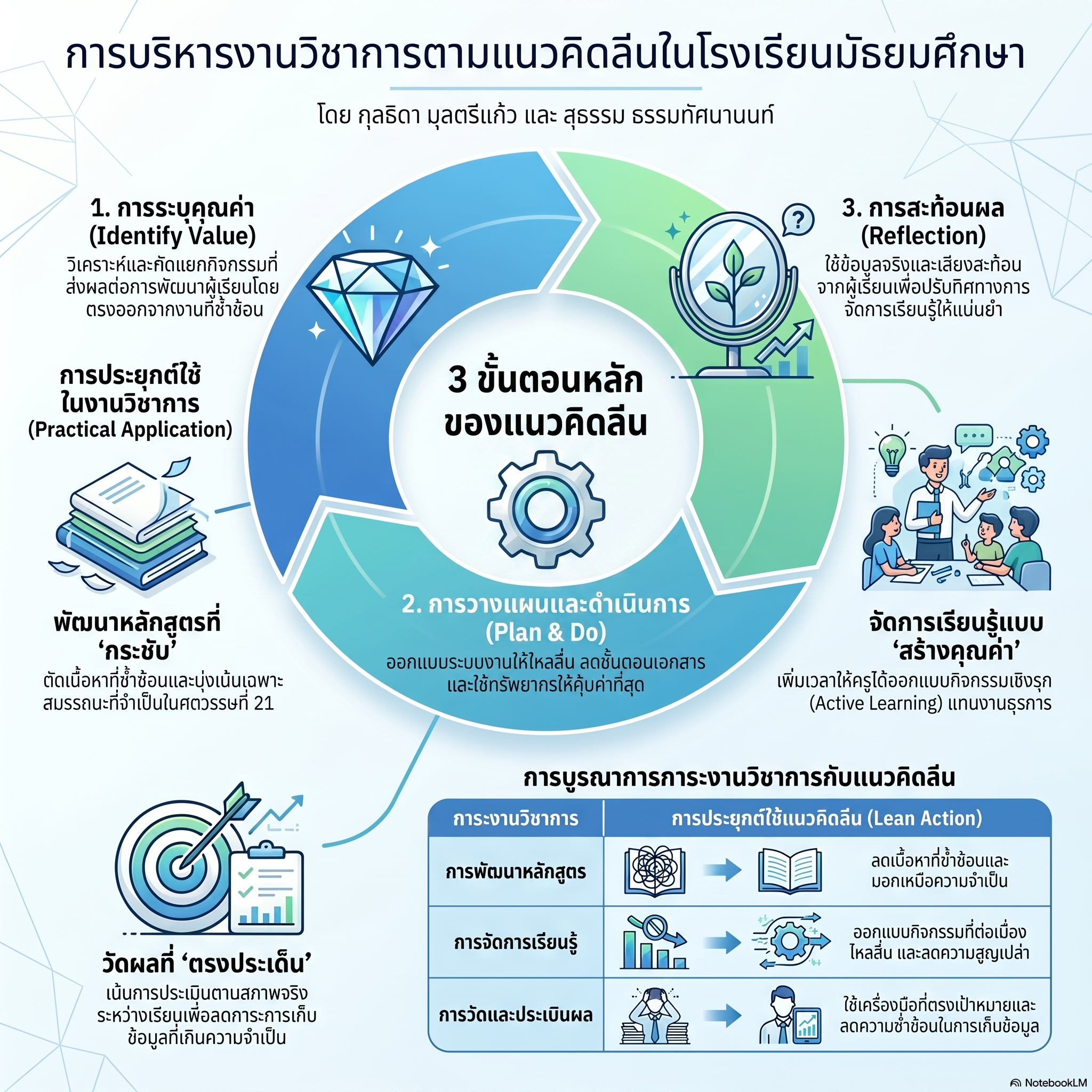
This article examines the application of Lean Thinking to academic administration in secondary schools, addressing persistent issues such as redundant academic processes, excessive teacher workload, limited resources, and the lack of system coherence. Although national policies emphasize competency-based learning and the reduction of educational waste, schools continue to face structural challenges that hinder the development of efficient academic management systems. These conditions highlight the need for modern management approaches—particularly Lean Thinking—to enhance educational quality in a practical and systematic manner. The article synthesizes three core components of academic administration—curriculum development, learning management, and assessment and evaluation—and integrates them with four Lean stages: identifying value, planning and implementation, reflection, and continuous improvement. This integration creates a streamlined system that minimizes waste, enhances process flow, supports effective resource allocation, and strengthens the ability of schools to respond to learners’ needs. Findings indicate that Lean Thinking enables schools to recognize value-adding processes, eliminate non-value-adding activities, improve teacher efficiency, optimize resource utilization, and enhance student learning outcomes sustainably. The academic contribution of this article lies in presenting a systemic conceptual framework for applying Lean Thinking to academic administration in secondary schools, offering strategic guidance for improving educational quality in response to 21st-century demands.
References
กมล ภู่ประเสริฐ. (2544). การจัดการเรียนรู้เพื่อพัฒนาทักษะการคิด. สำนักพิมพ์แห่งจุฬาลงกรณ์มหาวิทยาลัย.
กระทรวงศึกษาธิการ. (2544). แนวทางการจัดการเรียนรู้เพื่อพัฒนาผู้เรียน. สำนักงานคณะกรรมการการศึกษาขั้นพื้นฐาน.
กระทรวงศึกษาธิการ. (2568). นโยบายและจุดเน้นการดำเนินงานของกระทรวงศึกษาธิการ ปีงบประมาณ พ.ศ. 2568. https://www.moe.go.th
กุลชญา เที่ยงตรง. (2550). การจัดการเรียนรู้แบบสร้างสรรค์. สำนักพิมพ์แห่งจุฬาลงกรณ์มหาวิทยาลัย.
โกศล ดีศีลธรรม. (2556). การประยุกต์ใช้แนวคิดลีนในการบริหารองค์กร. สำนักพิมพ์ซีเอ็ด.
ชุติมา เกตุษา. (2553). แนวคิดลีนในการปรับปรุงกระบวนการผลิต. มหาวิทยาลัยเทคโนโลยีพระจอมเกล้าพระนครเหนือ.
โชติกา ภาษีผล. (2559). การวัดและประเมินผลการเรียนรู้ = Learning measurement and evaluation. โรงพิมพ์แห่งจุฬาลงกรณ์มหาวิทยาลัย.
ดามธรรม จินากูล. (2557). การลดค่าใช้จ่ายในกระบวนการทำงานด้วยแนวคิดลีน. วารสารวิชาการ มหาวิทยาลัยหอการค้าไทย, 36(3), 44-58.
ธำรง บัวศรี. (2542). ทฤษฎีหลักสูตร: การออกแบบและการพัฒนา (พิมพ์ครั้งที่ 2). พัฒนาศึกษา.
นภัสรพี ปัญญาธนวาณิช. (2560). การจัดการการผลิตด้วยแนวคิดลีนในอุตสาหกรรมการผลิตอิเล็กทรอนิกส์. วารสารการจัดการอุตสาหกรรม, 8(3), 89-102.
นิภาวรรณ ศิริธนิกุล. (2565). แนวทางการบริหารสถานศึกษาที่มีต่อการลดภาระงานตามการรับรู้ของครูในโรงเรียนมัธยมศึกษาจังหวัดสมุทรสงคราม สังกัดสำนักงานเขตพื้นที่การศึกษามัธยมศึกษาสมุทรสาคร สมุทรสงคราม. วารสารวิชาการมหาวิทยาลัยราชภัฏเพชรบุรี, 13(1), 52-61.
ประภาศิริ สุรพันธ์. (2550). การบริหารสถานศึกษาขั้นพื้นฐานที่ส่งผลต่อมาตรฐานด้านการบริหารและการจัดการศึกษาของสถานศึกษาสังกัดเทศบาลภูมิภาค. มหาวิทยาลัยมหาสารคาม.
พรเทพ โพธิ์พันธุ์. (2562). การพัฒนาหลักสูตรฝึกอบรมการระดมทุนเพื่อการศึกษาของสถานศึกษาขั้นพื้นฐาน กระทรวงศึกษาธิการ [ดุษฎีนิพนธ์ปริญญาดุษฎีบัณฑิต, มหาวิทยาลัยมหาสารคาม].
พัชนา เฮ้งบริบูรณ์พงศ์. (2560). ระบบการบริหารแบบลีน: จากแนวคิดสู่การปฏิบัติในงานสาธารณสุขที่สร้างความผูกพันกับชุมชน. วารสารสาธารณสุข มหาวิทยาลัยบูรพา, 12(2), 135.
ยุวดี ศิริยทรัพย์. (2560). การวางแผนทรัพยากรมนุษย์. ภาควิชาการจัดการธุรกิจ คณะวิทยาการจัดการ มหาวิทยาลัยเกษตรศาสตร์ วิทยาเขตศรีราชา.
รัตนะ บัวสนธ์. (2551). การประเมินผลและการวิจัยในการพัฒนาการศึกษา. จุฬาลงกรณ์มหาวิทยาลัย.
รุ่งชัชดาพร เวหะชาติ. (2553). การพัฒนาหลักสูตรสถานศึกษา: แนวคิดและการปฏิบัติ. สำนักพิมพ์แห่งจุฬาลงกรณ์มหาวิทยาลัย.
วรธิดา รัตนโค้น. (2559). การวิเคราะห์และประยุกต์ใช้แนวคิดลีนในกระบวนการผลิต. มหาวิทยาลัยขอนแก่น.
วิโรจน์ ลักขณาอดิศร. (2552). การนำแนวคิดลีนมาประยุกต์ใช้ในอุตสาหกรรมการผลิต. มหาวิทยาลัยธรรมศาสตร์.
วิไลลักษณ์ เจริญทรัพย์. (2555). การพัฒนาหลักสูตรสถานศึกษา: แนวทางและกระบวนการ. สำนักพิมพ์แห่งจุฬาลงกรณ์มหาวิทยาลัย.
สมศักดิ์ ภู่วิภาดาวรรธน์. (2563). การจัดการความสูญเปล่าในกระบวนการผลิตในอุตสาหกรรมขนาดใหญ่. มหาวิทยาลัยเกษตรศาสตร์.
สหธร เพชรวิโรจน์ชัย. (2564). การพัฒนากระบวนการลีนเพื่อเพิ่มประสิทธิภาพในการบริหารจัดการองค์กร. มหาวิทยาลัยเชียงใหม่.
สำนักงานคณะกรรมการการศึกษาขั้นพื้นฐาน. (2550). ขอบข่ายและภารกิจการบริหารสถานศึกษา. กระทรวงศึกษาธิการ.
สำนักงานคณะกรรมการการศึกษาขั้นพื้นฐาน. (2568). นโยบายและจุดเน้นของสำนักงานคณะกรรมการการศึกษาขั้นพื้นฐาน ประจำปีงบประมาณ พ.ศ. 2568.
สำนักงานเลขาธิการสภาการศึกษา. (2560). แผนการศึกษาแห่งชาติ พ.ศ. 2560-2579.
สุคนธ์ สินธพานนท์. (2562). การจัดการเรียนรู้เพื่อพัฒนาทักษะการคิดขั้นสูง. สำนักพิมพ์แห่งจุฬาลงกรณ์มหาวิทยาลัย.
สุธรรม ธรรมทัศนานนท์. (2554). หลักการ ทฤษฎี และนวัตกรรมการบริหารการศึกษา (พิมพ์ครั้งที่ 2). มหาวิทยาลัยมหาสารคาม.
อดิพงษ์ สุขนาค. (2560). การสังเคราะห์รูปแบบความสัมพันธ์เชิงเส้นขององค์ประกอบเชิงสาเหตุที่ส่งผลต่อประสิทธิภาพการบริหารงานวิชาการของโรงเรียนมัธยมศึกษาขนาดใหญ่ สังกัดสำนักงานคณะกรรมการการศึกษาขั้นพื้นฐาน [ดุษฎีนิพนธ์ปรัชญาดุษฎีบัณฑิต, มหาวิทยาลัยบูรพา].
อติกานต์ ม่วงเงิน. (2562). การประยุกต์แนวคิดลีนเพื่อเพิ่มประสิทธิภาพการบริหารจัดการในองค์กรการศึกษา [วิทยานิพนธ์ปริญญาดุษฎีบัณฑิต, มหาวิทยาลัยเกษตรศาสตร์].
อนุศักดิ์ สมิตสันต์. (2566). การบริหารวิชาการ. ภาควิชาการบริการการศึกษา คณะศึกษาศาสตร์ มหาวิทยาลัยศรีนครินทรวิโรฒ.
Bush, T. (2008). Leadership and management development in education. Educational Management Administration & Leadership, 36(1), 3–8. https://doi.org/10.1177/1741143207084066
Do, D. (2017). Lean production and its application in manufacturing industries. International Journal of Industrial Management, 7(2), 125–138.
Emiliani, M. L. (2005). Lean behaviors: Tools for improving the workplace. Journal of Behavioral Science, 11(3), 25–36.
Fukuda, R. (2013). Managerial engineering: Techniques for improving quality and productivity in the workplace. Productivity Press.
Glatthorn, A. A., Boschee, F. A., Whitehead, B. M., & Boschee, B. F. (2018). Curriculum leadership: Strategies for development and implementation (5th ed.). SAGE.
Glickman, C. D. (2017). Supervision of instruction: A developmental approach (5th ed.). Allyn & Bacon.
Good, C. V. (1973). Dictionary of education (3rd ed.). McGraw-Hill.
Hoy, W. K., & Miskel, C. G. (2013). Educational administration: Theory, research, and practice (9th ed.). McGraw-Hill.
Kotter, J. P. (2021). Change: How organizations achieve hard-to-imagine results in uncertain and volatile times. John Wiley & Sons.
Merrill, M. D. (2002). First principles of instruction. Educational Technology Research and Development, 50(3), 43–59.
Robbins, S. P., & Coulter, M. (2016). Management (13th ed.). Pearson.
Taba, H. (1962). Curriculum development: Theory and practice. Harcourt Brace & World.
Tapping, D. (2006). Value stream management for lean companies. Productivity Press.
Tyler, R. W. (1949). Basic principles of curriculum and instruction. University of Chicago Press.
Wiles, J., & Bondi, J. (2019). Curriculum development: A guide to practice (9th ed.). Pearson.
Womack, J. P., & Jones, D. T. (2003). Lean thinking: Banish waste and create wealth in your corporation. Simon & Schuster.
Downloads
Published
How to Cite
Issue
Section
Categories
License
Copyright (c) 2026 Faculty of Education, Srinakharinwirot university

This work is licensed under a Creative Commons Attribution-NonCommercial-NoDerivatives 4.0 International License.


