
A SYNTHESIS OF RESEARCH ON THE USE OF ARTIFICIAL INTELLIGENCE TO ENHANCE ENGLISH WRITING SKILLS AND LEARNING MOTIVATION AMONG EFL LEARNERS (2021–2025)
Keywords:
Artificial Intelligence (AI), English Writing Skills, Learner MotivationAbstract
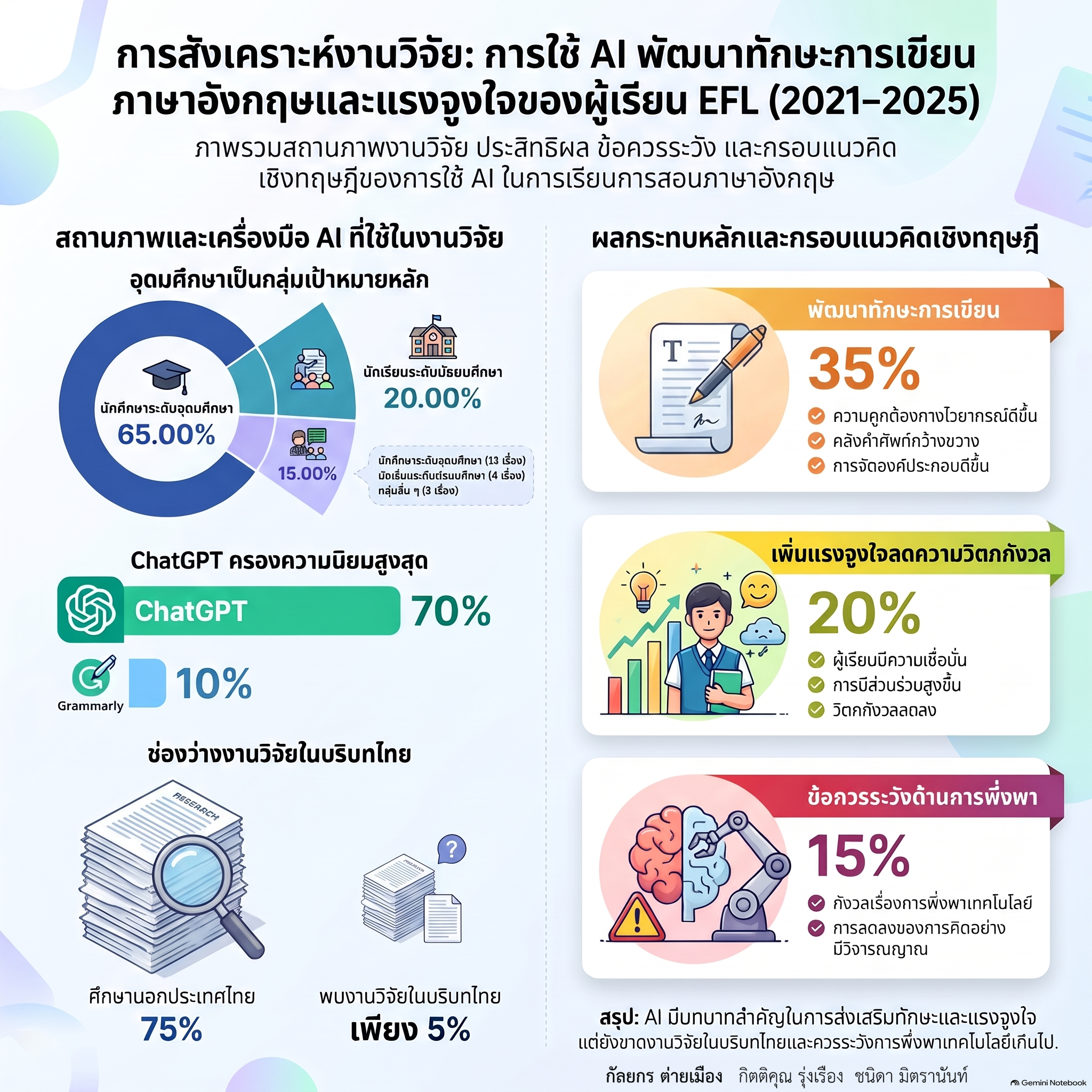
This documentary research aimed to (1) examine the current status of research on the use of Artificial Intelligence (AI) in developing English writing skills, (2) synthesize knowledge concerning the effects of AI on writing proficiency and learning motivation among English as a Foreign Language (EFL) learners, and (3) synthesize the theoretical frameworks researchers have applied alongside AI as a foundation for developing an integrative conceptual framework. The sample comprised 20 peer-reviewed empirical studies published between 2021 and 2025, retrieved from Scopus, ERIC, Google Scholar, ScienceDirect, SpringerLink, Taylor & Francis, SAGE, IEEE Xplore, and DOAJ. Data were collected using a data extraction form and analyzed through descriptive synthesis combined with thematic analysis. The findings revealed that samples in the synthesized studies were higher-education learners in 13 studies (65%), secondary-school learners in 4 studies (20%), and teachers, mixed samples, or document analysis in 3 studies (15%). The most frequently used AI tool was ChatGPT (14 studies, 70%), followed by Grammarly (2 studies, 10%). The most common research design was quasi-experimental (7 studies, 35%). Regarding outcomes, AI supported the development of writing skills in 7 studies (35%), particularly grammatical accuracy, lexical variety, and text organization. For motivation, 4 studies (20%) frequently reported gains in self-efficacy, engagement, and reduced writing anxiety. Mixed findings also emerged; for instance, Fan (2023) found that Grammarly feedback did not significantly outperform teacher feedback alone in improving writing quality. Concerns regarding over-reliance on technology and reduced critical thinking were reported in 3 studies (15%). Contextually, most synthesized studies (75%) were conducted in Asian settings outside Thailand, while only one study (5%) was conducted in a Thai context, highlighting a gap in empirical research on AI-assisted English writing in Thailand. The synthesis of theoretical frameworks indicated that AI's role can be explained through Constructivism and Sociocultural Theory, functioning as both a process-support tool and a motivational mediator. These findings provide a foundation for designing ethically integrated AI-assisted English instruction in the Thai educational context.
References
Alangari, T. S. (2025). The effect of AI-assisted learning on EFL writing proficiency: Quasi-experimental and cluster analysis. Educational Process: International Journal, 17, Article e2025345.
Bandura, A. (1997). Self-efficacy: The exercise of control. W. H. Freeman.
Fan, N. (2023). Exploring the effects of automated written corrective feedback on EFL students' writing quality: A mixed-methods study. SAGE Open, 13(2), 1–17. https://doi.org/10.1177/21582440231181296
Holmes, W., Bialik, M., & Fadel, C. (2019). Artificial intelligence in education: Promises and implications for teaching and learning. Center for Curriculum Redesign.
Huang, H.-W., Teng, D. C.-E., & Wu, R. (2023). Teaching chatbot prompt strategies in EFL essay writing instruction. In Proceedings of the 2023 5th International Workshop on Artificial Intelligence and Education (WAIE) (pp. 12–17). IEEE. https://doi.org/10.1109/WAIE60568.2023.00010
Jmaiel, H. A., Abukhait, R. O., Mohamed, A. M., & Shaaban, T. S. (2025). The role of ChatGPT in enhancing EFL students' ESP writing skills: An experimental study of gender and major differences. Discover Education, 4, Article 240. https://doi.org/10.1007/s44217-025-00700-6
Kasneci, E., Sessler, K., Küchemann, S., Bannert, M., Dementieva, D., Fischer, F., Gasser, U., Groh, G., Günnemann, S., Hüllermeier, E., Krusche, S., Kutyniok, G., Michaeli, T., Nerger, M., Pfeffer, J., Poquet, O., Sailer, M., Schmidt, A., Seidel, T., & Kasneci, G. (2023). ChatGPT for good? On opportunities and challenges of large language models for education. Learning and Individual Differences, 103, Article 102274. https://doi.org/10.1016/j.lindif.2023.102274
Li, J., Huang, J., Wu, W., & Whipple, P. B. (2024). Evaluating the role of ChatGPT in enhancing EFL writing assessments in classroom settings: A preliminary investigation. Humanities and Social Sciences Communications, 11, Article 1268. https://doi.org/10.1057/s41599-024-03755-2
Limna, P., & Shaengchart, Y. (2025). Generative AI as an English writing aid: Thai university students' perceptions and experiences with ChatGPT and Gemini. Suranaree Journal of Social Science. Advance online publication. https://doi.org/10.55766/sjss279466
Liu, W., & Wang, Y. (2024). The effects of using AI tools on critical thinking in English literature classes among EFL learners: An intervention study. European Journal of Education, 59(4), Article e12804. https://doi.org/10.1111/ejed.12804
Marisa, S., Rachman, D., Puspita, R. H., & Rahmawati, Y. (2025). The dark side of dependency: Negative consequences of EFL students' use of ChatGPT for academic writing. Borneo Educational Journal (Borju), 7(2), 255–274.
Marzuki, Widiati, U., Rusdin, D., Darwin, & Indrawati, I. (2023). The impact of AI writing tools on the content and organization of students' writing: EFL teachers' perspective. Cogent Education, 10(2), Article 2236469. https://doi.org/10.1080/2331186X.2023.2236469
Nguyen, L. Q., Le, H. V., & Nguyen, P. T. (2024). A mixed-methods study on the use of ChatGPT in the pre-writing stage: EFL learners' utilization patterns, affective engagement, and writing performance. Education and Information Technologies, 30, 10511–10534. https://doi.org/10.1007/s10639-024-13231-8
Organisation for Economic Co-operation and Development. (2019). OECD learning compass 2030: A series of concept notes. https://www.oecd.org/education/2030-project
Piaget, J. (1970). Science of education and the psychology of the child. Orion Press.
Poláková, P., & Ivenz, R. (2024). The impact of ChatGPT feedback on the development of EFL students' writing skills. Cogent Education, 11(1), Article 2410101. https://doi.org/10.1080/2331186X.2024.2410101
Robillos, R. J. (2024). Synergizing generative pre-trained transformer (GPT) chatbots in a process-based writing paradigm to enhance university students' writing skills. Journal of Language and Education, 10(3), 79–94. https://doi.org/10.17323/jle.2024.18708
Shi, S., & Zhang, H. (2025). EFL students' motivation predicted by their self-efficacy and resilience in artificial intelligence (AI)-based context: From a self-determination theory perspective. Learning and Motivation, 91, Article 102151. https://doi.org/10.1016/j.lmot.2025.102151
Song, C., & Song, Y. (2023). Enhancing academic writing skills and motivation: Assessing the efficacy of ChatGPT in AI-assisted language learning for EFL students. Frontiers in Psychology, 14, Article 1260843. https://doi.org/10.3389/fpsyg.2023.1260843
Teng, M. F. (2024). "ChatGPT is the companion, not enemies": EFL learners' perceptions and experiences in using ChatGPT for feedback in writing. Computers and Education: Artificial Intelligence, 7, Article 100270. https://doi.org/10.1016/j.caeai.2024.100270
UNESCO. (2021). Recommendation on the ethics of artificial intelligence. https://unesdoc.unesco.org/ark:/48223/pf0000380455
Vygotsky, L. S. (1978). Mind in society: The development of higher psychological processes. Harvard University Press.
Wale, B. D., & Kassahun, Y. F. (2024). The transformative power of AI writing technologies: Enhancing EFL writing instruction through the integrative use of Writerly and Google Docs. Human Behavior and Emerging Technologies, 2024, Article 9221377. https://doi.org/10.1155/2024/9221377
Woo, D. J., Wang, D., Guo, K., & Susanto, H. (2024). Teaching EFL students to write with ChatGPT: Students' motivation to learn, cognitive load, and satisfaction with the learning process. Education and Information Technologies, 29(18), 24963–24990. https://doi.org/10.1007/s10639-024-12819-4
Yan, D. (2023). Impact of ChatGPT on learners in a L2 writing practicum: An exploratory investigation. Education and Information Technologies, 28(11), 13943–13967. https://doi.org/10.1007/s10639-023-11742-4
Yan, D., & Zhang, R. (2024). L2 writer engagement with automated written corrective feedback provided by ChatGPT: A mixed-method multiple case study. Humanities and Social Sciences Communications, 11, Article 1063. https://doi.org/10.1057/s41599-024-03543-y
Yousofi, R. (2022). Grammarly deployment (in)efficacy within EFL academic writing classrooms: An attitudinal report from Afghanistan. Cogent Education, 9(1), Article 2142446. https://doi.org/10.1080/2331186X.2022.2142446
Zawacki-Richter, O., Marín, V. I., Bond, M., & Gouverneur, F. (2019). Systematic review of research on artificial intelligence applications in higher education—Where are the educators? International Journal of Educational Technology in Higher Education, 16(1), Article 39. https://doi.org/10.1186/s41239-019-0171-0
Zhai, N., & Ma, X. (2023). The effectiveness of automated writing evaluation on writing quality: A meta-analysis. Journal of Educational Computing Research, 61(4), 875–900. https://doi.org/10.1177/07356331221127300
Downloads
Published
How to Cite
Issue
Section
Categories
License
Copyright (c) 2026 Faculty of Education, Srinakharinwirot university

This work is licensed under a Creative Commons Attribution-NonCommercial-NoDerivatives 4.0 International License.

