การสังเคราะห์งานวิจัยการใช้ปัญญาประดิษฐ์เพื่อพัฒนาทักษะการเขียนภาษาอังกฤษ และแรงจูงใจในการเรียนของผู้เรียน EFL ระหว่างปี ค.ศ. 2021–2025
คำสำคัญ:
ปัญญาประดิษฐ์, ทักษะการเขียนภาษาอังกฤษ, แรงจูงใจของผู้เรียนบทคัดย่อ
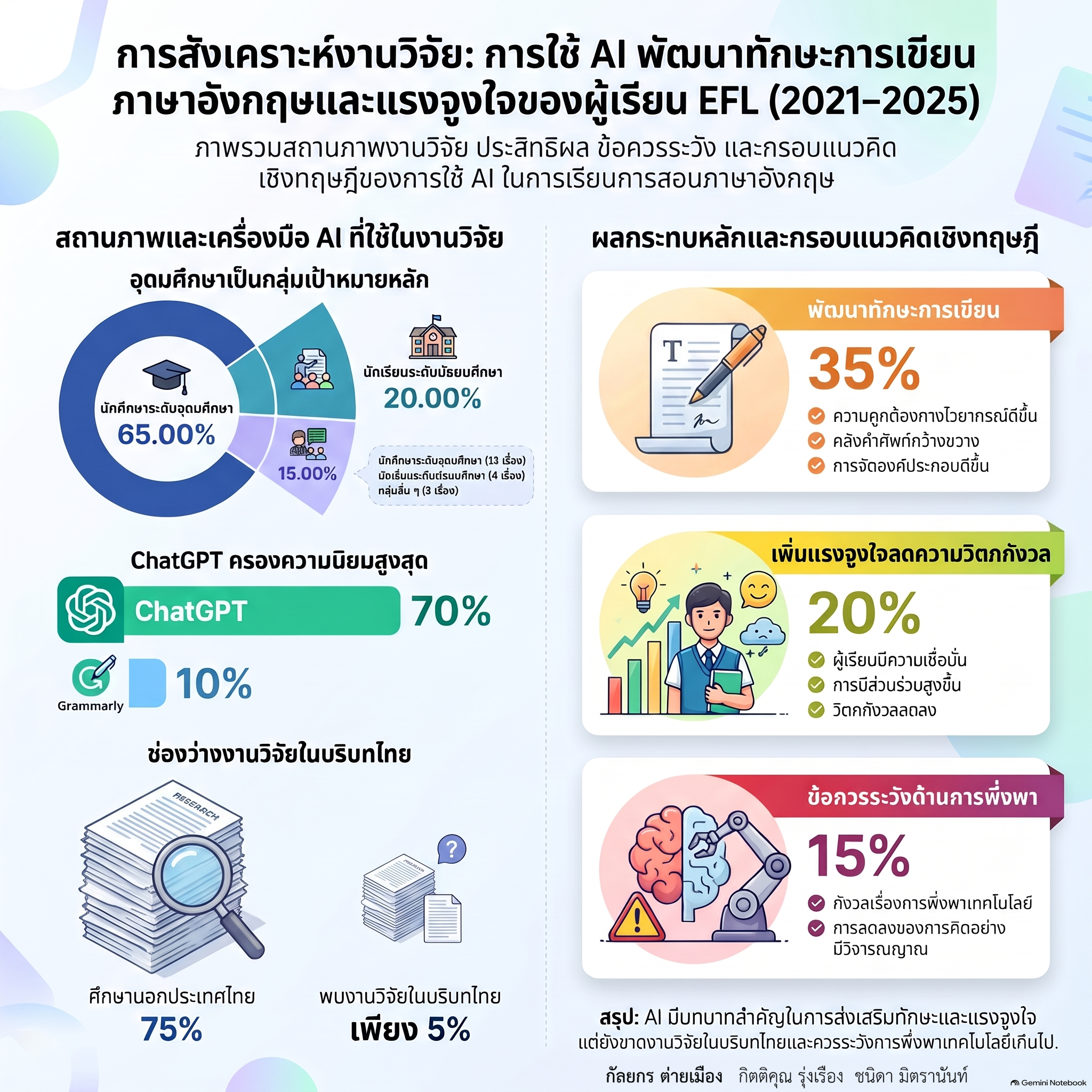
การวิจัยนี้เป็นการวิจัยเชิงเอกสาร (documentary research) มีวัตถุประสงค์เพื่อ (1) ศึกษาสถานภาพของงานวิจัยเกี่ยวกับการใช้ปัญญาประดิษฐ์ (Artificial Intelligence: AI) ในการพัฒนาทักษะการเขียนภาษาอังกฤษ (2) สังเคราะห์องค์ความรู้เกี่ยวกับผลของ AI ต่อทักษะการเขียนและแรงจูงใจในการเรียนรู้ของผู้เรียนภาษาอังกฤษในฐานะภาษาต่างประเทศ (English as a Foreign Language: EFL) และ (3) สังเคราะห์กรอบแนวคิดเชิงทฤษฎีที่นักวิจัยนำมาใช้ร่วมกับ AI เพื่อเป็นฐานในการพัฒนากรอบแนวคิดเชิงบูรณาการ กลุ่มตัวอย่างคืองานวิจัยเชิงประจักษ์ที่ตีพิมพ์ในวารสารที่ผ่านการประเมินโดยผู้ทรงคุณวุฒิ (peer-reviewed) ระหว่างปี ค.ศ. 2021–2025 จำนวน 20 เรื่อง สืบค้นจากฐานข้อมูล Scopus, ERIC, Google Scholar, ScienceDirect, SpringerLink, Taylor & Francis, SAGE, IEEE Xplore และ DOAJ เก็บรวบรวมข้อมูลด้วยแบบบันทึกข้อมูล (data extraction form) และวิเคราะห์ด้วยการสังเคราะห์เชิงพรรณนาร่วมกับการวิเคราะห์เชิงประเด็น (thematic synthesis) ผลการสังเคราะห์พบว่า กลุ่มตัวอย่างในงานวิจัยที่นำมาสังเคราะห์เป็นผู้เรียนระดับอุดมศึกษา 13 เรื่อง (ร้อยละ 65) มัธยมศึกษา 4 เรื่อง (ร้อยละ 20) และครูผู้สอน/กลุ่มผสม/การวิเคราะห์เอกสาร 3 เรื่อง (ร้อยละ 15) โดยเครื่องมือ AI ที่พบมากที่สุดคือ ChatGPT จำนวน 14 เรื่อง (ร้อยละ 70) รองลงมาคือ Grammarly 2 เรื่อง (ร้อยละ 10) รูปแบบการวิจัยที่พบมากที่สุดคือ quasi-experimental จำนวน 7 เรื่อง (ร้อยละ 35) ด้านผลสัมฤทธิ์ พบว่า AI มีบทบาทสนับสนุนการพัฒนาทักษะการเขียนใน 7 เรื่อง (ร้อยละ 35) โดยเฉพาะความถูกต้องทางไวยากรณ์ ความหลากหลายของคำศัพท์ และการจัดองค์ประกอบของงานเขียน สำหรับด้านแรงจูงใจ พบใน 4 เรื่อง (ร้อยละ 20) ซึ่งรายงานผลด้านความเชื่อมั่นในตนเอง การมีส่วนร่วม และการลดความวิตกกังวลในการเขียนอย่างสม่ำเสมอ (frequently reported) ทั้งนี้ยังพบข้อค้นพบที่ไม่สอดคล้องกัน (mixed findings) ในบางเรื่อง เช่น Fan (2023) ที่ระบุว่าข้อมูลป้อนกลับจาก Grammarly ไม่ได้ทำให้คุณภาพงานเขียนดีขึ้นอย่างมีนัยสำคัญเมื่อเทียบกับข้อมูลป้อนกลับจากครูเพียงอย่างเดียว และพบข้อกังวลด้านการพึ่งพาเทคโนโลยีเกินความจำเป็นและการคิดอย่างมีวิจารณญาณใน 3 เรื่อง (ร้อยละ 15) ในเชิงบริบท งานวิจัยที่นำมาสังเคราะห์ดำเนินการในบริบทเอเชียอื่นนอกประเทศไทยมากที่สุด (ร้อยละ 75) ขณะที่มีงานวิจัยในบริบทไทยเพียง 1 เรื่อง (ร้อยละ 5) ซึ่งสะท้อนช่องว่างของงานวิจัยเชิงประจักษ์ในบริบทการเรียนภาษาอังกฤษของไทย ผลการสังเคราะห์กรอบแนวคิดเชิงทฤษฎีชี้ให้เห็นว่า AI มีบทบาทที่อธิบายได้ด้วยทฤษฎีการสร้างความรู้ด้วยตนเอง (Constructivism) และทฤษฎีสังคมวัฒนธรรม (Sociocultural Theory) โดยทำหน้าที่เป็นทั้งเครื่องมือสนับสนุนกระบวนการเขียน (process tool) และตัวกลางทางปัญญาที่เชื่อมโยงกับแรงจูงใจ (motivational mediator) ซึ่งสามารถใช้เป็นฐานสำหรับการออกแบบการเรียนการสอนภาษาอังกฤษที่บูรณาการ AI อย่างมีจริยธรรมในบริบทการศึกษาไทยต่อไป
เอกสารอ้างอิง
Alangari, T. S. (2025). The effect of AI-assisted learning on EFL writing proficiency: Quasi-experimental and cluster analysis. Educational Process: International Journal, 17, Article e2025345.
Bandura, A. (1997). Self-efficacy: The exercise of control. W. H. Freeman.
Fan, N. (2023). Exploring the effects of automated written corrective feedback on EFL students' writing quality: A mixed-methods study. SAGE Open, 13(2), 1–17. https://doi.org/10.1177/21582440231181296
Holmes, W., Bialik, M., & Fadel, C. (2019). Artificial intelligence in education: Promises and implications for teaching and learning. Center for Curriculum Redesign.
Huang, H.-W., Teng, D. C.-E., & Wu, R. (2023). Teaching chatbot prompt strategies in EFL essay writing instruction. In Proceedings of the 2023 5th International Workshop on Artificial Intelligence and Education (WAIE) (pp. 12–17). IEEE. https://doi.org/10.1109/WAIE60568.2023.00010
Jmaiel, H. A., Abukhait, R. O., Mohamed, A. M., & Shaaban, T. S. (2025). The role of ChatGPT in enhancing EFL students' ESP writing skills: An experimental study of gender and major differences. Discover Education, 4, Article 240. https://doi.org/10.1007/s44217-025-00700-6
Kasneci, E., Sessler, K., Küchemann, S., Bannert, M., Dementieva, D., Fischer, F., Gasser, U., Groh, G., Günnemann, S., Hüllermeier, E., Krusche, S., Kutyniok, G., Michaeli, T., Nerger, M., Pfeffer, J., Poquet, O., Sailer, M., Schmidt, A., Seidel, T., & Kasneci, G. (2023). ChatGPT for good? On opportunities and challenges of large language models for education. Learning and Individual Differences, 103, Article 102274. https://doi.org/10.1016/j.lindif.2023.102274
Li, J., Huang, J., Wu, W., & Whipple, P. B. (2024). Evaluating the role of ChatGPT in enhancing EFL writing assessments in classroom settings: A preliminary investigation. Humanities and Social Sciences Communications, 11, Article 1268. https://doi.org/10.1057/s41599-024-03755-2
Limna, P., & Shaengchart, Y. (2025). Generative AI as an English writing aid: Thai university students' perceptions and experiences with ChatGPT and Gemini. Suranaree Journal of Social Science. Advance online publication. https://doi.org/10.55766/sjss279466
Liu, W., & Wang, Y. (2024). The effects of using AI tools on critical thinking in English literature classes among EFL learners: An intervention study. European Journal of Education, 59(4), Article e12804. https://doi.org/10.1111/ejed.12804
Marisa, S., Rachman, D., Puspita, R. H., & Rahmawati, Y. (2025). The dark side of dependency: Negative consequences of EFL students' use of ChatGPT for academic writing. Borneo Educational Journal (Borju), 7(2), 255–274.
Marzuki, Widiati, U., Rusdin, D., Darwin, & Indrawati, I. (2023). The impact of AI writing tools on the content and organization of students' writing: EFL teachers' perspective. Cogent Education, 10(2), Article 2236469. https://doi.org/10.1080/2331186X.2023.2236469
Nguyen, L. Q., Le, H. V., & Nguyen, P. T. (2024). A mixed-methods study on the use of ChatGPT in the pre-writing stage: EFL learners' utilization patterns, affective engagement, and writing performance. Education and Information Technologies, 30, 10511–10534. https://doi.org/10.1007/s10639-024-13231-8
Organisation for Economic Co-operation and Development. (2019). OECD learning compass 2030: A series of concept notes. https://www.oecd.org/education/2030-project
Piaget, J. (1970). Science of education and the psychology of the child. Orion Press.
Poláková, P., & Ivenz, R. (2024). The impact of ChatGPT feedback on the development of EFL students' writing skills. Cogent Education, 11(1), Article 2410101. https://doi.org/10.1080/2331186X.2024.2410101
Robillos, R. J. (2024). Synergizing generative pre-trained transformer (GPT) chatbots in a process-based writing paradigm to enhance university students' writing skills. Journal of Language and Education, 10(3), 79–94. https://doi.org/10.17323/jle.2024.18708
Shi, S., & Zhang, H. (2025). EFL students' motivation predicted by their self-efficacy and resilience in artificial intelligence (AI)-based context: From a self-determination theory perspective. Learning and Motivation, 91, Article 102151. https://doi.org/10.1016/j.lmot.2025.102151
Song, C., & Song, Y. (2023). Enhancing academic writing skills and motivation: Assessing the efficacy of ChatGPT in AI-assisted language learning for EFL students. Frontiers in Psychology, 14, Article 1260843. https://doi.org/10.3389/fpsyg.2023.1260843
Teng, M. F. (2024). "ChatGPT is the companion, not enemies": EFL learners' perceptions and experiences in using ChatGPT for feedback in writing. Computers and Education: Artificial Intelligence, 7, Article 100270. https://doi.org/10.1016/j.caeai.2024.100270
UNESCO. (2021). Recommendation on the ethics of artificial intelligence. https://unesdoc.unesco.org/ark:/48223/pf0000380455
Vygotsky, L. S. (1978). Mind in society: The development of higher psychological processes. Harvard University Press.
Wale, B. D., & Kassahun, Y. F. (2024). The transformative power of AI writing technologies: Enhancing EFL writing instruction through the integrative use of Writerly and Google Docs. Human Behavior and Emerging Technologies, 2024, Article 9221377. https://doi.org/10.1155/2024/9221377
Woo, D. J., Wang, D., Guo, K., & Susanto, H. (2024). Teaching EFL students to write with ChatGPT: Students' motivation to learn, cognitive load, and satisfaction with the learning process. Education and Information Technologies, 29(18), 24963–24990. https://doi.org/10.1007/s10639-024-12819-4
Yan, D. (2023). Impact of ChatGPT on learners in a L2 writing practicum: An exploratory investigation. Education and Information Technologies, 28(11), 13943–13967. https://doi.org/10.1007/s10639-023-11742-4
Yan, D., & Zhang, R. (2024). L2 writer engagement with automated written corrective feedback provided by ChatGPT: A mixed-method multiple case study. Humanities and Social Sciences Communications, 11, Article 1063. https://doi.org/10.1057/s41599-024-03543-y
Yousofi, R. (2022). Grammarly deployment (in)efficacy within EFL academic writing classrooms: An attitudinal report from Afghanistan. Cogent Education, 9(1), Article 2142446. https://doi.org/10.1080/2331186X.2022.2142446
Zawacki-Richter, O., Marín, V. I., Bond, M., & Gouverneur, F. (2019). Systematic review of research on artificial intelligence applications in higher education—Where are the educators? International Journal of Educational Technology in Higher Education, 16(1), Article 39. https://doi.org/10.1186/s41239-019-0171-0
Zhai, N., & Ma, X. (2023). The effectiveness of automated writing evaluation on writing quality: A meta-analysis. Journal of Educational Computing Research, 61(4), 875–900. https://doi.org/10.1177/07356331221127300
ดาวน์โหลด
เผยแพร่แล้ว
รูปแบบการอ้างอิง
ฉบับ
ประเภทบทความ
หมวดหมู่
สัญญาอนุญาต
ลิขสิทธิ์ (c) 2026 คณะศึกษาศาสตร์ มหาวิทยาลัยศรีนครินทรวิโรฒ

อนุญาตภายใต้เงื่อนไข Creative Commons Attribution-NonCommercial-NoDerivatives 4.0 International License.

