การพัฒนาระบบตรวจวัดการใช้พลังงานไฟฟ้าโดยใช้เทคโนโลยีอินเทอร์เน็ตของสรรพสิ่ง
DOI:
https://doi.org/10.14456/jcct.2025.18คำสำคัญ:
ระบบตรวจวัดการใช้พลังงานไฟฟ้า, อินเทอร์เน็ตของสรรพสิ่ง, อีเอสพี32, กูเกิลลูเคอร์สตูดิโอบทคัดย่อ
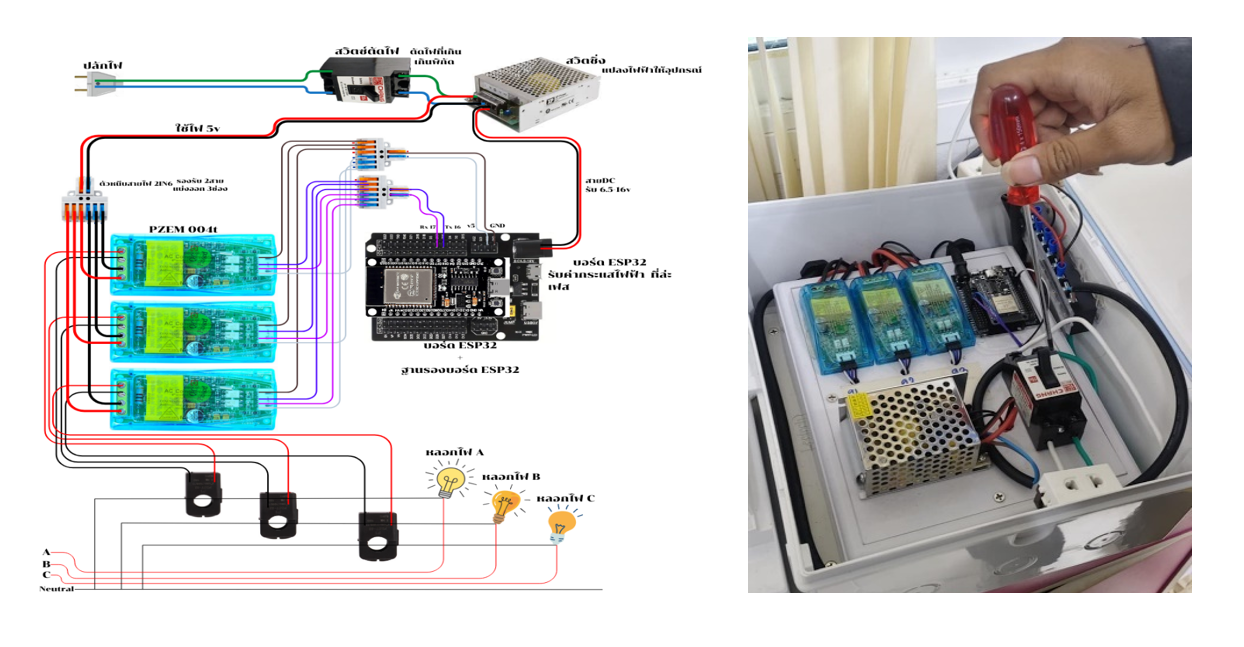
การวิจัยครั้งนี้มีวัตถุประสงค์เพื่อพัฒนาระบบตรวจวัดการใช้พลังงานไฟฟ้าโดยใช้เทคโนโลยีอินเทอร์เน็ตของสรรพสิ่งและประเมินประสิทธิภาพของระบบดังกล่าว โดยระบบที่พัฒนาขึ้นประกอบด้วยเซ็นเซอร์ PZEM-004T จำนวน 3 ตัว ซึ่งสามารถวัดค่าทางไฟฟ้า ได้แก่ แรงดันไฟฟ้า กระแสไฟฟ้า กำลังไฟฟ้า พลังงานสะสม ความถี่ และตัวประกอบกำลังไฟฟ้า ทั้งนี้ได้ทำการเชื่อมต่อเซ็นเซอร์กับอีเอสพี32 ซึ่งทำหน้าที่เป็นตัวกลางในการรับข้อมูลและส่งข้อมูลผ่านเครือข่ายไร้สาย ไปยังกูเกิลชีต โดยใช้กูเกิลแอปสคริปต์ เป็นตัวกลางในการรับส่งข้อมูล และนำข้อมูลที่ได้ไปแสดงผลในรูปแบบกราฟผ่านกูเกิลลูเคอร์สตูดิโอ กลุ่มตัวอย่างได้แก่ ผู้เชี่ยวชาญ จำนวน 10 คน โดยการคัดเลือกแบบเจาะจง เครื่องมือที่ใช้ในการวิจัยได้แก่แบบสอบถาม สถิติที่ใช้ในการวิเคราะห์ข้อมูล ได้แก่ ค่าเฉลี่ย ค่าเบี่ยงเบนมาตรฐาน ผลการดำเนินการพัฒนาระบบพบว่าสามารถวัดและเก็บข้อมูลการใช้พลังงานไฟฟ้าได้อย่างต่อเนื่องแบบเรียลไทม์ ระบบสามารถแสดงแนวโน้มการใช้พลังงานของอาคารได้อย่างชัดเจนผ่านแดชบอร์ด ที่ใช้งานง่าย และสนับสนุนการวางแผนลดการใช้พลังงานอย่างเป็นระบบ และระบบมีค่าเฉลี่ยโดยรวมอยู่ในระดับ “มากที่สุด” ( = 4.58, S.D. = 0.18) ซึ่งสะท้อนถึงความถูกต้อง ความเสถียร และความเหมาะสมในการใช้งานจริงในสภาพแวดล้อมของอาคารเรียนหรือสำนักงาน ผลการวิจัยชี้ให้เห็นว่า ระบบที่พัฒนาขึ้นสามารถนำไปประยุกต์ใช้ในด้านการจัดการพลังงานขององค์กรเพื่อเพิ่มประสิทธิภาพและลดต้นทุนด้านพลังงานในระยะยาวได้อย่างมีนัยสำคัญ ทั้งนี้ยังเป็นต้นแบบในการพัฒนาระบบตรวจวัดพลังงานที่ประยุกต์ใช้เทคโนโลยีอินเทอร์เน็ตของสรรพสิ่ง อย่างเป็นรูปธรรมและมีประสิทธิภาพ
Downloads
เอกสารอ้างอิง
Apiruchpinyo, N., & Chaochaikong, S. (2022). Electrical Power Management System in Buildings via the Internet of Things: A Case Study of Srikodtraboon Building of Nakhon Phanom University. Udon Thani Rajabhat University Journal of Sciences and Technology, 10(3), 43-62. (In Thai)
Chaiyong, W., & Sonasang, S. (2022). Applications of Energy Monitoring Using the IoT. SNRU Journal of Science and Technology, 14(2), 1-9. https://doi.org/10.55674/snrujst.v14i2.245041.
Choochart, K. (2022). Development of the Internet of Things Platform System for Electricity Usage Monitoring Case study: Srivitsawavitthaya Buildings, Faculty of Engineering, Rajamangala University of Technology Srivijaya. [Master's dissertation, Prince of Songkla University]. PSU Knowledge Bank. http://kb.psu.ac.th/psukb/handle/2016/17921. (In Thai)
Chunpungsuk, C., & Lertbumroongchai, K. (2018). Sufficient Ecosystem Management via IoT for Educational Institutions. Journal of Vacational and Technical Education, 8(15), 25-31. (In Thai)
ELM Learning. (2024). What is ADDIE? Your Complete Guide to the ADDIE Model. https://elmlearning.com/hub/instructional-design/addie-model.
Hantoro, C. D., & Setiawidayat, S. (2023). Monitoring and Control of 3 Phase Electrical Energy Internet of Things (IoT) Based. European Journal of Electrical Engineering and Computer Science, 7(3), 80-86. https://doi.org/10.24018/ejece.2023.7.3.522.
Hjelle, S., Mikalef, P., Altwaijry, N., & Parida, V. (2024). Organizational Decision Making and Analytics: An Experimental Study on Dashboard Visualizations. Information & Management, 61(6), 104011. https://doi.org/10.1016/j.im.2024.104011.
Huang, G.-L., Anwar, A., Loke, S. W., Zaslavsky, A., & Choi, J. (2023). IoT-based Analysis for Smart Energy Management. arXiv. https://doi.org/10.48550/ARXIV.2311.18643.
Napitupulu, D. (2020). User-Acceptance Instrument Development: A Content Validity Study in the e-Participation Context. Journal of Applied Research and Technology, 18(1), 34-43. https://doi.org/10.22201/icat.24486736e.2020.18.1.931.
Rovinelli, R. J., & Hambleton, R. K. (1977). On the Use of Content Specialists in the Assessment of Criterion-Referenced Test Item Validity. https://files.eric.ed.gov/fulltext/ED121845.pdf.
Saha, N., Aulia, M. M., Rahman, Md. M., & Khan, M. S. A. (2024). IoT-Driven Cloud-based Energy and Environment Monitoring System for Manufacturing Industry. arXiv. https://doi.org/10.48550/ARXIV.2404.11771.
Seepan, K., & Trongtorkarn, M. (2024). Design and Development of 3 Phase Energy Meters for Energy Monitoring: Case Study of Suratthani Rajabhat University's Industrial Technology Laboratory Department. Journal of Industrial Education, 18(2), 10-25. (In Thai)
Songputh, T., & Rungkaew, J. (2022). The Internet of Things for Controlling use of Electricity through the Internet Network. Science and Technology Journal of Sisaket Rajabhat University, 2(1), 22-30. (In Thai)
Yasa, K. A., Purbhawa, I. M., Yasa, I. M. S., Teresna, I. W., Nugroho, A., & Winardi, S. (2023). IoT-based Electrical Power Recording using ESP32 and PZEM-004T Microcontrollers. Journal of Computer Science and Technology Studies, 5(4), 62-68. https://doi.org/10.32996/jcsts.2023.5.4.7.
ดาวน์โหลด
เผยแพร่แล้ว
รูปแบบการอ้างอิง
ฉบับ
ประเภทบทความ
หมวดหมู่
สัญญาอนุญาต
ลิขสิทธิ์ (c) 2025 วารสารคอมพิวเตอร์และเทคโนโลยีสร้างสรรค์

อนุญาตภายใต้เงื่อนไข Creative Commons Attribution-NonCommercial-NoDerivatives 4.0 International License.