The Illusion of Multimedia Exposure: Predicting Study Engagement in Kuwaiti Undergraduates
DOI:
https://doi.org/10.65205/jcct.2026.e3726Keywords:
Multimedia Exposure, Student Engagement, Technology-Enhanced Learning, Pedagogical Design, Instructional QualityAbstract
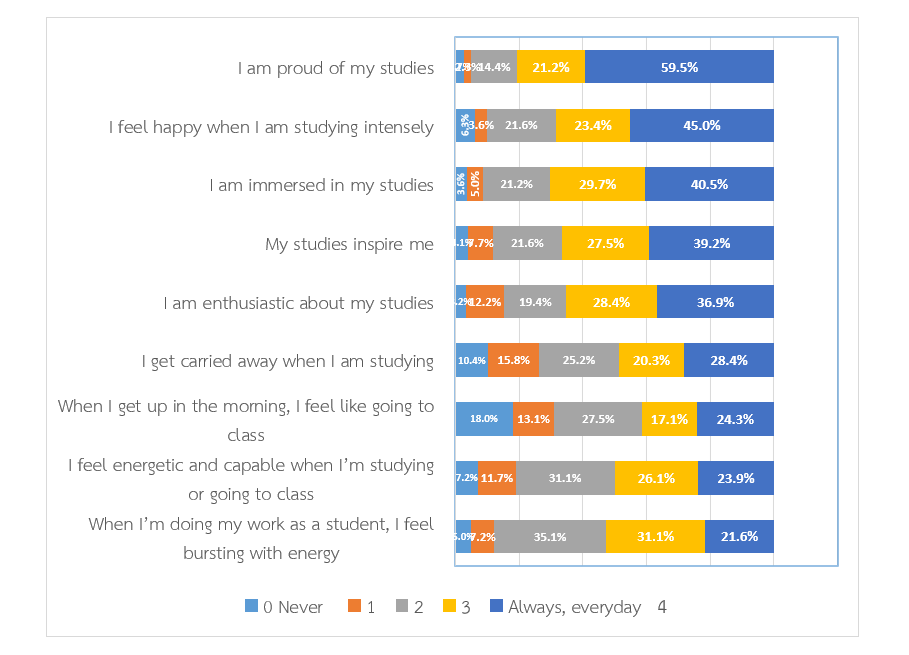
Amidst the global integration of Technology-Enhanced Learning (TEL), this study investigates the relationship between students' holistic multimedia exposure and their study engagement in the under-researched context of Kuwaiti higher education. Drawing on the Cognitive Theory of Multimedia Learning (CTML), the study examines if increased exposure to multimedia predicts higher levels of study engagement. A quantitative, cross-sectional survey design was employed. A sample of 222 undergraduate students from Kuwait’s Public Authority for Applied Education and Training (PAAET) completed a self-administered online questionnaire. The sample was predominantly female (85.1%) and largely within the 18–21 age range (76.1%), indicating limited demographic diversity. Multimedia exposure was measured using a custom 8-item scale (α = .893), and study engagement was assessed using the 9-item Utrecht Work Engagement Scale (UWES-S) (α = .903). Data were analyzed using t-tests, ANOVA and simple linear regression. The findings indicate that while students report high levels of study engagement, particularly on affective dimensions, their multimedia exposure is dominated by traditional tools like PowerPoint. No significant differences were found across gender or age groups. Crucially, linear regression analysis revealed that multimedia experience is not a statistically significant predictor of study engagement (R² = .002, p = .553). The assumption that frequent multimedia use inherently enhances student engagement is challenged. In the Kuwaiti context, technology functions primarily as a delivery medium rather than a catalyst for engagement. This underscores the critical importance of pedagogical design and instructional quality over mere technological access in fostering meaningful student involvement.
Downloads
References
Baddeley, A. (2020). Working Memory. In Baddeley, A., Eysenck, A. W., & Anderson, M. C. (Eds), Memory (3rd ed) (71-112). Routledge.
Bakker, A. B., Sanz Vergel, A. I., & Kuntze, J. (2015). Student Engagement and Performance: A Weekly Diary Study on the Role of Openness. Motivation and Emotion, 39(1), 49-62. https://doi.org/10.1007/s11031-014-9422-5
Calculator.Net. (n.d.). Sample Size Calculator. https://www.calculator.net/sample-size-calculator.html
Chipangura, A.T., & Aldridge, J.M. (2019). Multimedia: A Means of Improving Students’ Engagement in Mathematics Classrooms? Semantic Scholar. https://api.semanticscholar.org/CorpusID:219630321
Consoli, T., Schmitz, M.-L., Antonietti, C., Gonon, P., Cattaneo, A., & Petko, D. (2025). Quality of Technology Integration Matters: Positive Associations with Students’ Behavioral Engagement and Digital Competencies for Learning. Education and Information Technologies, 30(6), 7719-7752. https://doi.org/10.1007/s10639-024-13118-8
Demir, S. (2022). Comparison of Normality Tests in Terms of Sample Sizes under Different Skewness and Kurtosis Coefficients. International Journal of Assessment Tools in Education, 9(2), 397-409. https://doi.org/10.21449/ijate.1101295
Doherty, C. (2022). An Investigation into the Relationship Between Multimedia Lecture Design and Learners’ Engagement Behaviours Using Web Log Analysis. PLOS ONE, 17(8), e0273007. https://doi.org/10.1371/journal.pone.0273007
Education in Kuwait. (2025). In Wikipedia. https://en.wikipedia.org/w/index.php?title=Education_in_Kuwait&oldid=1305274839
Eltaiba, N., Hosseini, S., & Okoye, K. (2025). Benefits and Impact of Technology-Enhanced Learning Applications in Higher Education in Middle East and North Africa: A Systematic Review. Global Transitions, 7, 350-374. https://doi.org/10.1016/j.glt.2025.06.004
Fareed, F., Bi, R., Rehman, S., Lee, J. D., Rollinson, Y. G., & Yuan, T. (2025). Digital Transformation in the Gulf Cooperation Council Economies. International Monetary Fund.
Heo, M., & Toomey, N. (2020). Learning with Multimedia: The Effects of Gender, Type of Multimedia Learning Resources, and Spatial Ability. Computers & Education, 146, 103747. https://doi.org/10.1016/j.compedu.2019.103747
Jerez, E. (2024). Exploring the Contribution of Student Engagement Factors to Mature-Aged Students’ Persistence and Academic Achievement During the First Year of University. The Journal of Continuing Higher Education, 72(3), 304-319. https://doi.org/10.1080/07377363.2023.2279797
Joshi, D. R., Adhikari, K. P., Khanal, B., Khadka, J., & Belbase, S. (2022). Behavioral, Cognitive, Emotional, and Social Engagement in Mathematics Learning During the COVID-19 Pandemic. PLOS ONE, 17(11), e0278052. https://doi.org/10.1371/journal.pone.0278052
Kassa, S. T. (2025). Cognitive Benefits and Risks of Digital Technology Engagement. Discover Psychology, 6(1), 10. https://doi.org/10.1007/s44202-025-00527-0
Kehrwald, B. A., & McCallum, F. (2015). Degrees of Change: Understanding Academics Experiences with a Shift to Flexible Technology-Enhanced Learning in Initial Teacher Education. Australian Journal of Teacher Education, 40(7),4. https://doi.org/10.14221/ajte.2015v40n7.4
Kim, H.-Y. (2013). Statistical Notes for Clinical Researchers: Assessing Normal Distribution (2) Using Skewness and Kurtosis. Restorative Dentistry & Endodontics, 38(1), 52. https://doi.org/10.5395/rde.2013.38.1.52
Kobicheva, A. (2022). Comparative Study on Students’ Engagement and Academic Outcomes in Live Online Learning at University. Education Sciences, 12(6), 371. https://doi.org/10.3390/educsci12060371
Lata, K. (2024). Innovation in Pedagogical Practices: Technology-Enhanced Learning in Higher Education. ShodhKosh: Journal of Visual and Performing Arts, 5(7), 232-236. https://doi.org/10.29121/shodhkosh.v5.i7.2024.2362
Liu, Q., Chen, H., & Crabbe, M. J. C. (2021). Interactive Study of Multimedia and Virtual Technology in Art Education. International Journal of Emerging Technologies in Learning, 16(1), 80-93. https://doi.org/10.3991/ijet.v16i01.18227
Mayer, R. E. (2002). Multimedia Learning. Psychology of Learning and Motivation, 41, 85-139. https://doi.org/10.1016/S0079-7421(02)80005-6
Mayer, R. E. (2009). Multimedia Learning (2nd ed.). Cambridge University Press. https://doi.org/10.1017/CBO9780511811678
Mayer, R. E. (2020). Multimedia Learning (3rd ed.). Cambridge University Press. https://doi.org/10.1017/9781316941355
Noroozi, O. (2025). Towards Technology-Enhanced Transformative Learning Environments. International Journal of Technology in Education, 8(2), 541-556. https://doi.org/10.46328/ijte.1209
Ouweneel, E., Le Blanc, P. M., & Schaufeli, W. B. (2011). Flourishing Students: A Longitudinal Study on Positive Emotions, Personal Resources, and Study Engagement. The Journal of Positive Psychology, 6(2), 142-153. https://doi.org/10.1080/17439760.2011.558847
Passig, D., & Levin, H. (2001). The Interaction Between Gender, Age, and Multimedia Interface Design. Education and Information Technologies, 6(4), 241-250. https://doi.org/10.1023/A:1012924718226
Schaufeli, W. B., & Bakker, A. B. (2004). Utrecht Work Engagement Scale (UWES) Preliminary Manual Overview. https://www.wilmarschaufeli.nl/publications/Schaufeli/Test%20Manuals/Test_manual_UWES_English.pdf
Schmidt, K. J., Dukewich, K. R., Symonds, C. I., & Thrasher, A. V. (2025). When More Isn’t Better: Evidence for an Instructional Equivalence Hypothesis in Multimedia Design. Frontiers in Psychology, 16, 1718397. https://doi.org/10.3389/fpsyg.2025.1718397
Singh, M., James, P. S., Paul, H., & Bolar, K. (2022). Impact of Cognitive-Behavioral Motivation on Student Engagement. Heliyon, 8(7), e09843. https://doi.org/10.1016/j.heliyon.2022.e09843
Staneviciene, E., & Žekienė, G. (2025). The Use of Multimedia in the Teaching and Learning Process of Higher Education: A Systematic Review. Sustainability, 17(19), 8859. https://doi.org/10.3390/su17198859
Svenningsson, J., Höst, G., Hultén, M., & Hallström, J. (2022). Students’ Attitudes Toward Technology: Exploring the Relationship Among Affective, Cognitive, and Behavioral Components of the Attitude Construct. International Journal of Technology and Design Education, 32(3), 1531-1551. https://doi.org/10.1007/s10798-021-09657-7
Wong, Z. Y., & Liem, G. A. D. (2022). Student Engagement: Current State of the Construct, Conceptual Refinement, and Future Research Directions. Educational Psychology Review, 34(1), 107-138. https://doi.org/10.1007/s10648-021-09628-3
Wong, Z. Y., Liem, G. A. D., Chan, M., & Datu, J. A. D. (2024). Student Engagement and Its Association with Academic Achievement and Subjective Well-Being: A Systematic Review and Meta-Analysis. Journal of Educational Psychology, 116(1), 48-75. https://doi.org/10.1037/edu0000833
Wood, E., & Zivcakova, L. (2015). Understanding Multimedia Multitasking in Educational Settings. In Rosen, L. D., Cheever, N. A., & Carrier, L. M. (Eds.), The Wiley Handbook of Psychology, Technology, and Society (404-419). Wiley. https://doi.org/10.1002/9781118771952.ch23
Xu, X., Shi, Z., Bos, N. A., & Wu, H. (2023). Student Engagement and Learning Outcomes: An Empirical Study Applying a Four-Dimensional Framework. Medical Education Online, 28(1), 2268347. https://doi.org/10.1080/10872981.2023.2268347
Yulhendri, Y., Mardhotillah, N. I., Alisha, W. P., & Susanti, N. (2022). Analysis of Media Use and Learning Interaction to Improving Student Engagement. Dinamika Pendidikan, 17(1), 37-47. https://doi.org/10.15294/dp.v17i1.35304
Zhai, X., & Li, S. (2025). The Roles of Growth Mindset, Resilience, and Self-Efficacy in Student Engagement with AI-Enhanced Chinese Learning: A Self-Determination Theory Perspective. Learning and Motivation, 92, 102183. https://doi.org/10.1016/j.lmot.2025.102183
Zhang, W., Guan, Y., Hu, Z., Wang, C., Lu, D., & Lu, H. (2025). Interplay of Student Characteristics Multidimensional Engagement and Influencing Factors in Online Computer Science Education. Scientific Reports, 15(1), 6976. https://doi.org/10.1038/s41598-025-90142-9
Downloads
Published
How to Cite
Issue
Section
Categories
License
Copyright (c) 2026 Journal of Computer and Creative Technology

This work is licensed under a Creative Commons Attribution-NonCommercial-NoDerivatives 4.0 International License.