Effect of Internal and External Interactive Scenarios Video on Science Problem-Solving Abilities of Grade 9 Students
DOI:
https://doi.org/10.65205/jcct.2026.e3585Keywords:
Video Scenarios, Interactive VDO, Problem-Solving AbilityAbstract
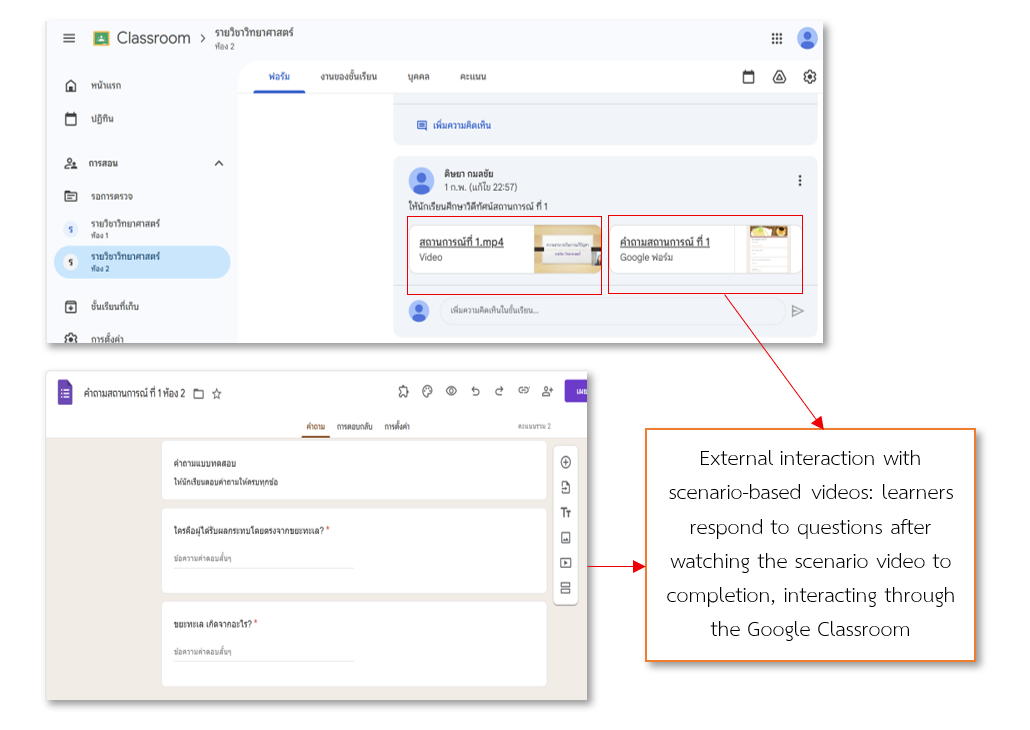
The purposes of this research were: 1) to compare Students’ Problem-Solving Abilities Before and After Learning Through Internal Interactive Scenarios Video; 2) to compare students’ Problem-Solving Abilities Before and After Learning Through External Interactive Scenarios Video; and 3) to Compare Students’ Problem-Solving Abilities After Learning Through Internal and External Interactive Scenarios Video. The research sample consisted of 52 Grade 9 students from the Chom Phra 1 Integrated Educational Network, Chom Phra District, Surin Province. The participants were selected using the matched-pair sampling method. The research instruments included: 1) Internal and External Interactive Scenarios Video, 2) science lesson plans, and 3) a science problem-solving ability assessment test. Data were analyzed using mean, standard deviation (S.D.), and t-test for hypothesis testing. The research findings revealed that: 1) Students who learned using the Internal Interactive Scenarios Video achieved significantly higher post-learning problem-solving scores than their pre-learning scores at the .05 significance level. 2) Students who learned using the External Interactive Scenarios Video achieved significantly higher post-learning problem-solving scores than their pre-learning scores at the .05 significance level. 3) Students using the Internal Interactive Scenarios Video demonstrated significantly higher problem-solving abilities than those using the External Interactive Scenarios Video at the .05 significance level.
Downloads
References
Agarwal, R. (2017). Learning@Videos: Charting the Evolution, Success and Growing Popularity of Video-Based Learning. G-Cube Solutions. https://www.gc-solutions.net/wp-content/uploads/2019/12/eBook_Learning-Videos.pdf
Bonk, C. J., & Zhang, K. (2008). Empowering Online Learning: 100+ Activities for Reading, Reflecting, Displaying, and Doing. Wiley.
Chatpakkarattana, T. (2013). Development of an Interactive E-Tutorial System to Develop Problem-Solving Ability for Undergraduate Students in Sukhothai Thammathirat Open University. [Doctoral dissertation, Chulalongkorn University]. Chula DigiVerse. https://doi.org/10.58837/chula.the.2013.6 (In Thai) DOI: https://doi.org/10.58837/CHULA.THE.2013.6
D’Zurilla, T. J., Nezu, A. M., & Maydeu-Olivares, A. (2004). Social Problem Solving: Theory and Assessment. In Chang, E. C., D’Zurilla, T. J., & Sanna, L. J. (Eds.), Social Problem Solving: Theory, Research, and Training (11-27). American Psychological Association. https://doi.org/10.1037/10805-001 DOI: https://doi.org/10.1037/10805-001
De Corte, E., Lodewijks, H., Parmentier, R., & Span, P. (1987). Learning and Instruction: European Research in an International Context. Leuven University Press.
Dewey, J. (1983). The Middle Works of John Dewey, Volume 15, 1899-1924. Southern Illinois University Press.
G-Cube Webwide Software. (2017). Getting Started with Video-Based Learning. eLearning Industry. https://elearningindustry.com/video-based-learning-getting-started
Guilford, J. P., & Hoepfner, R. (1971). The Analysis of Intelligence. McGraw-Hill.
Jonassen, D. H. (2004). Learning to Solve Problems: An Instructional Design Guide. John Wiley & Sons.
Khammanee, T. (2016). Science of Teaching: Knowledge for Effective Learning Process Management. Chulalongkorn University Press. (In Thai)
Morton, K. (2018). 4 Ways to Make Your Sales Training Videos Work Harder. Association for Talent Development. https://www.td.org/content/atd-blog/4-ways-to-make-your-sales-training-videos-work-harder
Nakmongkhon, K. (2019). Development of U-Learning Model with Interactive Scenario Video and Reflective Thinking to Enhance Problem Solving Ability of Distance Undergraduate Students in Open Universities. [Master’s thesis, Chulalongkorn University]. Chulalongkorn University Intellectual Repository. https://digital.car.chula.ac.th/chulaetd/8969 (In Thai)
Nonthamand, N. (2011). Effects of an Insertion of 5W1H Questions in Lecture Videos on Demand via Web 2.0 on Learning Achievement and Problem-Solving Ability of Undergraduate Students. [Master’s thesis, Chulalongkorn University]. Chula DigiVerse. https://doi.org/10.58837/chula.the.2011.10 (In Thai) DOI: https://doi.org/10.58837/CHULA.THE.2011.10
Nonthamand, N. (2018). Interactive Videos with Open Learning in the 21st Century. Journal of Education Studies, Chulalongkorn University, 46(4), 211-227. (In Thai)
Nuriddin, H. (2017). 5 Reasons to Get Started Using Scenario-Based E-Learning. Association for Talent Development. https://www.td.org/content/atd-blog/5-reasons-to-get-started-using-scenario-based-e-learning
Petcharawej, K. (2014). The Results of Measuring Safe Driving Problem-Solving Skills Using Online Simulation Lessons for Undergraduates at Bangkok University. [Unpublished master's thesis]. Ramkhamhaeng University. (In Thai)
Phadke, S. (2021). 4 Examples of Using Scenarios to Create Context for Learning. eLearning Industry. https://elearningindustry.com/scenarios-to-create-context-for-learning-4-examples
Rodkroh, P. (2015). Research and Development of a Problem-Based Learning Digital Game to Enhance Problem Solving Ability in Science Subject for Elementary Students. [Doctoral dissertation, Chulalongkorn University]. Chulalongkorn University Intellectual Repository. http://cuir.car.chula.ac.th/handle/123456789/51156 (In Thai)
Sitipipattanakoon, S. (2010). Development of Problem-Solving and Team Learning Abilities of Undergraduate Students with a Blended Learning Model Using Learning Together Technique with Different Case-Based Learning and Knowledge Sharing Technology. [Doctoral dissertation, Chulalongkorn University]. Chula DigiVerse. https://doi.org/10.58837/chula.the.2010.25 (In Thai) DOI: https://doi.org/10.58837/CHULA.THE.2010.25
Somyaron, W. (2020). Development of Creative Learning Skills Through Multimedia Learning Based on Constructionism Theory to Enhance Learning Competency Skills in the 21st Century of Primary Schools in Phayao Province. Journal of Education, Prince of Songkla University, Pattani Campus, 31(1), 99-109. (In Thai)
Songkram, N. (2010). Development of a Problem-Based Learning Model Using Hypermedia-Based Cognitive Tools to Enhance Problem-Solving Ability of Undergraduate Agriculture Students. [Doctoral dissertation, Chulalongkorn University]. Chula DigiVerse. https://doi.org/10.58837/chula.the.2010.7 (In Thai) DOI: https://doi.org/10.58837/CHULA.THE.2010.7
Spencer, R. (2025). Using Real Life Scenarios in eLearning: 5 Advantages. eLearning Industry. https://elearningindustry.com/using-real-life-scenarios-in-elearning-5-advantages
Surin Primary Educational Service Area Office 1. (2025, June 10). 2568-1-Gender, Grade Level, Publish on Website. https://drive.google.com/file/d/1sF4rXn9v0m78iE0zy153nIVgysN1UfO1/view (In Thai)
Suriyakrai, S. (2007). A Development of an Adaptive Web-Based Learning Model for Individual Differences Based on the Mastery Learning Principle to Enhance Learning Achievement and Problem-Solving Skills of Pharmacy Students. [Doctoral dissertation, Chulalongkorn University]. Chula DigiVerse. https://doi.org/10.58837/chula.the.2007.4 (In Thai) DOI: https://doi.org/10.58837/CHULA.THE.2007.4
Weir, A. J. (1974). General Integration and Measure. Cambridge University Press.
Zhang, D., Zhou, L., Briggs, R. O., & Nunamaker, J. F. (2006). Instructional Video in E-Learning: Assessing the Impact of Interactive Video on Learning Effectiveness. Information & Management, 43(1), 15-27. https://doi.org/10.1016/j.im.2005.01.004 DOI: https://doi.org/10.1016/j.im.2005.01.004
Downloads
Published
How to Cite
Issue
Section
Categories
License
Copyright (c) 2026 Journal of Computer and Creative Technology

This work is licensed under a Creative Commons Attribution-NonCommercial-NoDerivatives 4.0 International License.