The Development of a 3D Game Titled Treasure Hunt on a Floating Island
DOI:
https://doi.org/10.65205/jcct.2025.3048Keywords:
3D Game, MDA Framework Game Design, Unreal Engine 5, User Experience, User Satisfaction EvaluationAbstract
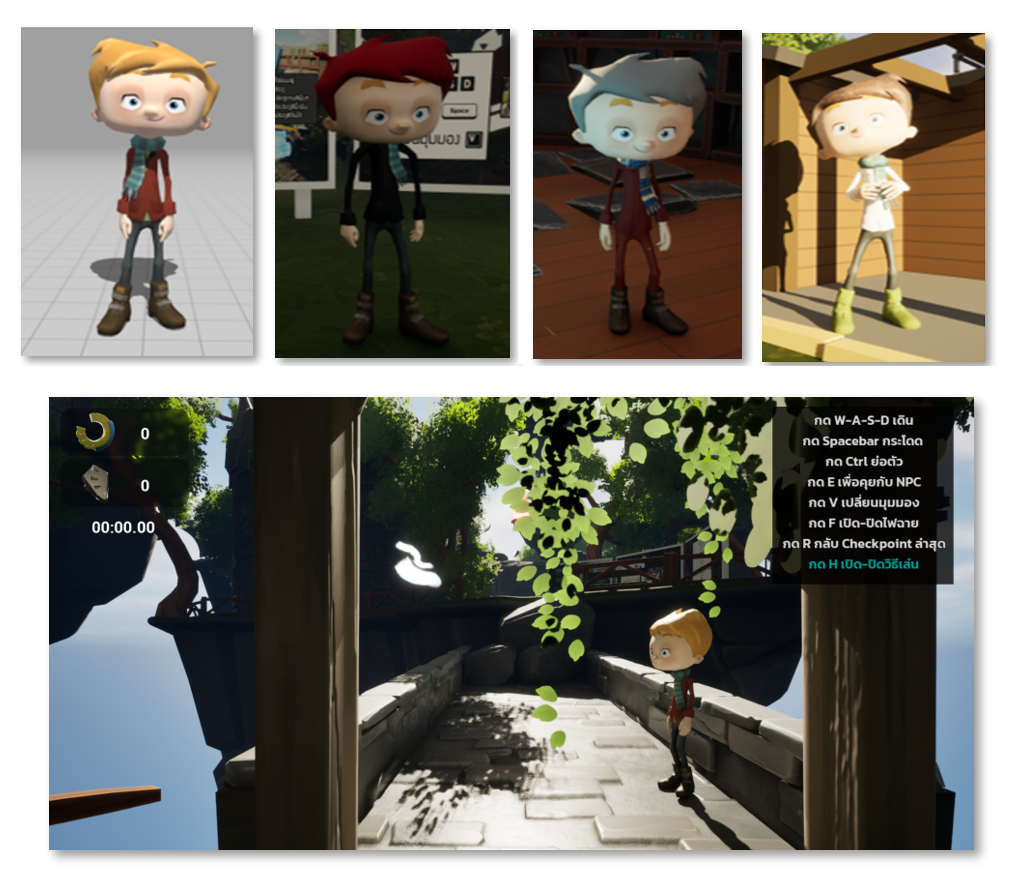
This research aimed 1. to develop a three-dimensional game titled “Treasure Hunt on the Floating Island”, adapted from the game design concepts of Only Up! and Subway Surfers, and grounded in the Mechanics–Dynamics–Aesthetics (MDA) framework as a guideline for system development using Unreal Engine 5; and 2. to evaluate the satisfaction levels of users who participated in testing the developed game. The sample consisted of 60 first- to third-year students from the Faculty of Science and Technology, Surindra Rajabhat University, in the 2024 academic year. The participants included 30 Computer Science students and 30 Computer Technology students, selected through purposive sampling. Each participant played the game for 30 minutes and completed a satisfaction questionnaire. Data analysis employed statistical tests to examine the mean differences between the two groups in order to assess user satisfaction levels. The results indicated a p-value of 0.95, which is higher than the predetermined significance level, suggesting that there was no statistically significant difference in satisfaction between the two groups. This reflects the effectiveness of the developed game in providing a consistent playing experience across all participants. The findings highlight that applying the MDA framework in conjunction with modern game development technologies can effectively enhance player experience and is suitable for adoption in other game development contexts.
Downloads
References
Adams, E. (2014). Fundamentals of Adventure Game Design. Peachpit Press.
Beatty, I. D. (2014). Gaming the System: Video Games as a Theoretical Framework for Instructional Design. arXiv. https://doi.org/10.48550/arXiv.1401.6716.
Deterding, S., Dixon, D., Khaled, R., & Nacke, L. (2011, September 28 - 30). From Game Design Elements to Gamefulness: Defining “Gamification”. The 15th International Academic MindTrek Conference: Envisioning Future Media Environments, 9 - 15. Tampere. https://doi.org/10.1145/2181037.2181040
Epic Games. (n.d.). Unreal Engine 5.7 Documentation. https://dev.epicgames.com/documentation/en-us/unreal-engine/unreal-engine-5-7-documentation.
Fullerton, T. (2018). Game Design Workshop: A Playcentric Approach to Creating Innovative Games (4th ed.). CRC Press.
Hunicke, R., LeBlanc, M., & Zubek, R. (2004). MDA: A Formal Approach to Game Design and Game Research. Association for the Advancement of Artificial Intelligence. https://cdn.aaai.org/Workshops/2004/WS-04-04/WS04-04-001.pdf.
Juul, J. (2005). Half-Real: Video Games Between Real Rules and Fictional Worlds. MIT Press.
Kanchana, C. (2022). Development of Mathematical Basic Skills and Computational Thinking Skills of Early Childhood Through Educational Game. [Master’s thesis, University of Phayao]. University of Phayao Digital Collections. https://updc.up.ac.th/handle/123456789/221. (In Thai)
Lan, Y. (2023). Development and Application of 3D Modeling in Game. Academic Journal of Science and Technology, 7(2), 94 - 97. https://doi.org/10.54097/ajst.v7i2.11949.
Liem, C. L. C., Sompie, S. R. U. A., & Sugiarso, B. A. (2023). 3D Adventure Game Introduction to South Minahasa Historical Buildings. Jurnal Teknik Elektro Dan Komputer, 12(2), 75 - 84. https://doi.org/10.35793/jtek.v12i2.47311. (In Bahasa Indonesia)
Meepain, P., & Ua-apisitwong, U. (2023). Developing 3D Games for English Learning for Anubunpracharat Samakkee School. Academic Journal of Science and Technology, Dhonburi Rajabhat University, 1(1), 13 - 26. (In Thai)
Ovrick, J. (2017). 3D Modeling Best Practices. Artella. https://www.artella.com/index.php/2017/10/18/pro-tips-3d-modeling-best-practices.
Panyarotjananon, K., Mitmoolpitak, K., Yindeechai, N., Yuenying, W., & Yasaka, P. (2023). Game Development Promoted the Proper Sorting of Solid Waste . Journal of Computer and Creative Technology, 1(2), 15 - 22. https://doi.org/10.14456/jcct.2023.8. (In Thai)
Plum, F., Bulla, R., Beck, H. K., Imirzian, N., & Labonte, D. (2023). replicAnt: A Pipeline for Generating Annotated Images of Animals in Complex Environments Using Unreal Engine. Nature Communications, 14, 7195. https://doi.org/10.1038/s41467-023-42898-9.
Putra, S. D., & Yasin, V. (2021). MDA Framework Approach for Gamification-Based Elementary Mathematics Learning Design. International Journal of Engineering, Science & Information Technology, 1(3), 35 - 39.
Sicart, M. (2008). Defining Game Mechanics. Game studies. https://gamestudies.org/0802/articles/sicart.
Srisaard, B. (2000). Preliminary Research (6th ed.). Suwiriyasan. (In Thai)
Tekinbas, K. S., & Zimmerman, E. (2004). Rules of Play: Game Design Fundamentals. MIT Press.
Thanyasiri, D., & Uparimakul, A. (2024). Developing a 3D game titled “Learning Reading and Writing Skills in Thai Language” for Matthayom 1 Level. Research and Development Journal Suan Sunandha Rajabhat University, 16(2), 55 - 67. (In Thai)
Zainol Abidin, M. K., & Ismail, A. (2021). Developing A 3D Action-Adventure Game Called “Code - E” for Learning C++ Function Codes. Journal of ICT in Education, 8(3), 13 - 26. https://doi.org/10.37134/jictie.vol8.sp.1.2.2021.
Downloads
Published
How to Cite
Issue
Section
Categories
License
Copyright (c) 2025 Journal of Computer and Creative Technology

This work is licensed under a Creative Commons Attribution-NonCommercial-NoDerivatives 4.0 International License.