The Development of Digital Volunteers to Promote Knowledge and Skills in Technology as Guideline for Model Digital Community in Surin Province
DOI:
https://doi.org/10.65205/jcct.2025.2717Keywords:
Digital Volunteer, Technology Skills, Model Digital CommunityAbstract
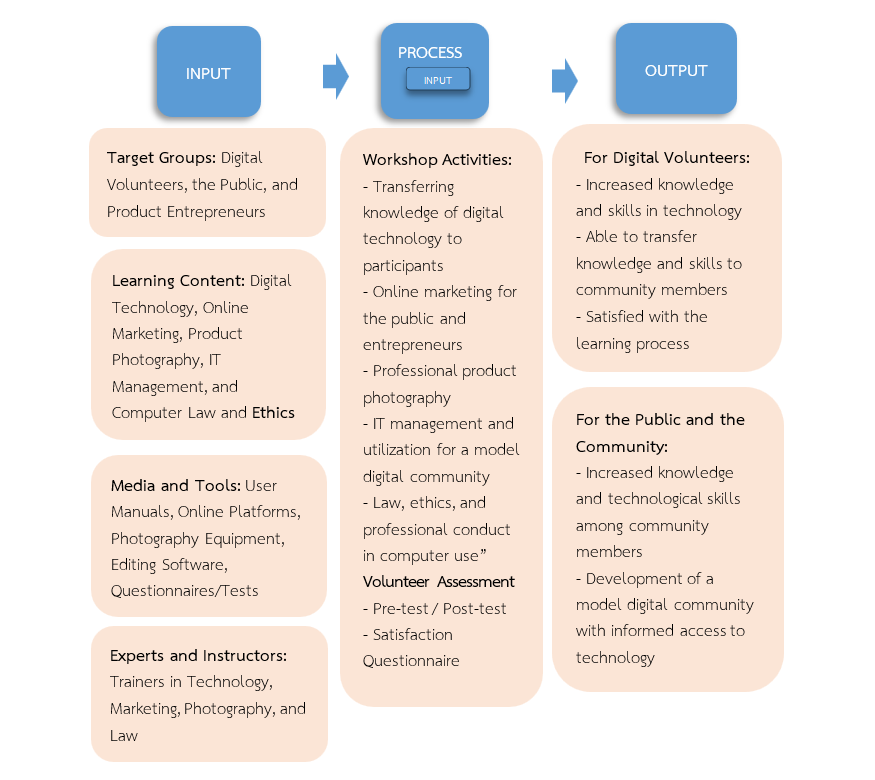
This study aimed to develop digital volunteers with the competencies, knowledge, and skills necessary for effectively transferring digital technology knowledge to the community, to compare digital technology learning outcomes of digital volunteers before and after the training, and to evaluate the satisfaction with the implementation of the digital volunteer development program in promoting digital knowledge and skills, as guideline for model digital communities in Surin Province. The study targeted 150 digital volunteers from Ban Mueang Ling, Ban Charaphat, Ban Nong Saeng, Ban Nong Khu, Ban Prathun, and Huayjingwittaya School in Surin Province, selected through purposive sampling. The research instruments included 1) digital volunteer learning activities, 2) pre-training and post-training technology learning tests, and 3) satisfaction questionnaires. Data was analyzed using descriptive statistics: percentages, means, standard deviations, and a dependent t-test for comparative analysis. Results showed that the technology learning activities were of high quality overall (M = 4.54, S.D. = 0.54). Moreover, the participants’ mean scores increased from 8.71 pre-training to 19.69 post-training, with a statistically significant improvement at the .05 level. Overall satisfaction with the program was at the highest level (M = 4.88, S.D. = 0.31). These findings indicate that the training effectively enhanced the knowledge and skills of digital volunteers and that the program was highly appreciated by participants, supporting the development of model digital communities in Surin Province.
Downloads
References
Bandura, A. (2018). Toward a Psychology of Human Agency: Pathways and Reflections. Perspectives on Psychological Science, 13(2), 130-136. https://doi.org/10.1177/1745691617699280.
Branch, R. M. (2009). Instructional Design: The ADDIE Approach. Springer US. https://doi.org/10.1007/978-0-387-09506-6.
Digital Economy Promotion Agency. (2022). Digital Transformation Fund for Community. https://www.depa.or.th/digitalservice/digital-transformation-Fund-for-community. (In Thai)
Doungphummes, N., Tantivejakul, N., & Sangsingkeo, N. (2023). Thai Village Health Volunteers’ Employment of Self-Directed Learning and Collective Power in Time of Pandemic. Social Work with Groups, 46(3), 264-277. https://doi.org/10.1080/01609513.2023.2205459.
Jongpinij, M. (2020). Factors Influencing Satisfaction with the Use of Identity Verification in Digital Identity (Digital ID). [Master's dissertation, Thammasat University]. TU Digital Collections. https://digital.library.tu.ac.th/tu_dc/frontend/Info/item/dc:184296. (In Thai)
Kewsuwan, N., Saengthong, T., & Theppaya, T. (2024). Developing a Training Course to Reduce the Gap in Information and Digital Knowledge Access of Governmental Service: A Case Study of a Community in Satun Province. Journal of Information Science Research and Practice, 42(4), 1-23. https://doi.org/10.14456/jiskku.2024.25.
Knowles, M. S. (1984). Andragogy in Action: Applying Modern Principles of Adult Learning. Jossey-Bass.
Kolb, D. A. (1984). Experiential Learning: Experience as the Source of Learning and Development. Prentice-Hall.
Ministry of Digital Economy and Society. (2022). Annual Report 2022 of Ministry of Digital Economy and Society. Ministry of Digital Economy and Society. (In Thai)
Ng, D. T. K., Leung, J. K. L., Chu, S. K. W., & Qiao, M. S. (2021). Conceptualizing AI literacy: An Exploratory Review. Computers and Education: Artificial Intelligence, 2, 100041. https://doi.org/10.1016/j.caeai.2021.100041.
Organisation for Economic Co-operation and Development. (2000). Knowledge Management in the Learning Society. https://www.oecd.org/content/dam/oecd/en/publications/reports/2000/02/knowledge-management-in-the-learning-society_g1gh266b/9789264181045-en.pdf.
Piaget, J. (1970). Science of Education and the Psychology of the Child. Orion Press.
Shaengchart, Y., & Bhumpenpein, N. (2025). Bridging the Digital Divide in Rural Thailand: Understanding Potential Factors Influencing Starlink’s Satellite Internet Adoption. Social Sciences & Humanities Open, 11, 101355. https://doi.org/10.1016/j.ssaho.2025.101355.
UNESCO. (2021). Global Education Monitoring Report 2021/2: Non-State Actors in Education: Who Chooses? Who Loses?. https://digitallibrary.un.org/record/4020380/files/1382516_EN.pdf.
Vuorikari, R., Kluzer, S., & Punie, Y. (2022). DigComp 2.2, The Digital Competence Framework for Citizens: with New Examples of Knowledge, Skills and Attitudes. Publications Office. https://data.europa.eu/doi/10.2760/115376.
Warnathong, C., & Diteeyont, W. (2020). Development of Mobile Training Application to Increase Digital Literacy for Government Officers of The Ministry of Higher Education, Science, Research and Innovation. Journal of Education and Innovation, 24(4), 111-120. (In Thai)
Wenger-Trayner, E., & Wenger-Trayner, B. (2020). Learning to Make a Difference: Value Creation in Social Learning Spaces. Cambridge University Press. https://doi.org/10.1017/9781108677431.
Wongchanadech, P., Singsa, N., Phongdumrong, P., & Torthienchai, N. (2020). The Influence of Digital Satisfaction and Precursor Factors Affecting Consumer Behavior of E-book Purchase Intentions through Application Channels of Consumers in Bangkok. Journal of Business Administration and Languages, 11(2), 45-62. (In Thai)
Downloads
Published
How to Cite
Issue
Section
Categories
License
Copyright (c) 2025 Journal of Computer and Creative Technology

This work is licensed under a Creative Commons Attribution-NonCommercial-NoDerivatives 4.0 International License.