A Development Electrical Energy Measure System Using Internet of Things Technology
DOI:
https://doi.org/10.14456/jcct.2025.18Keywords:
Electricity Consumption Monitoring System, Internet of Things, ESP32, Google Looker StudioAbstract
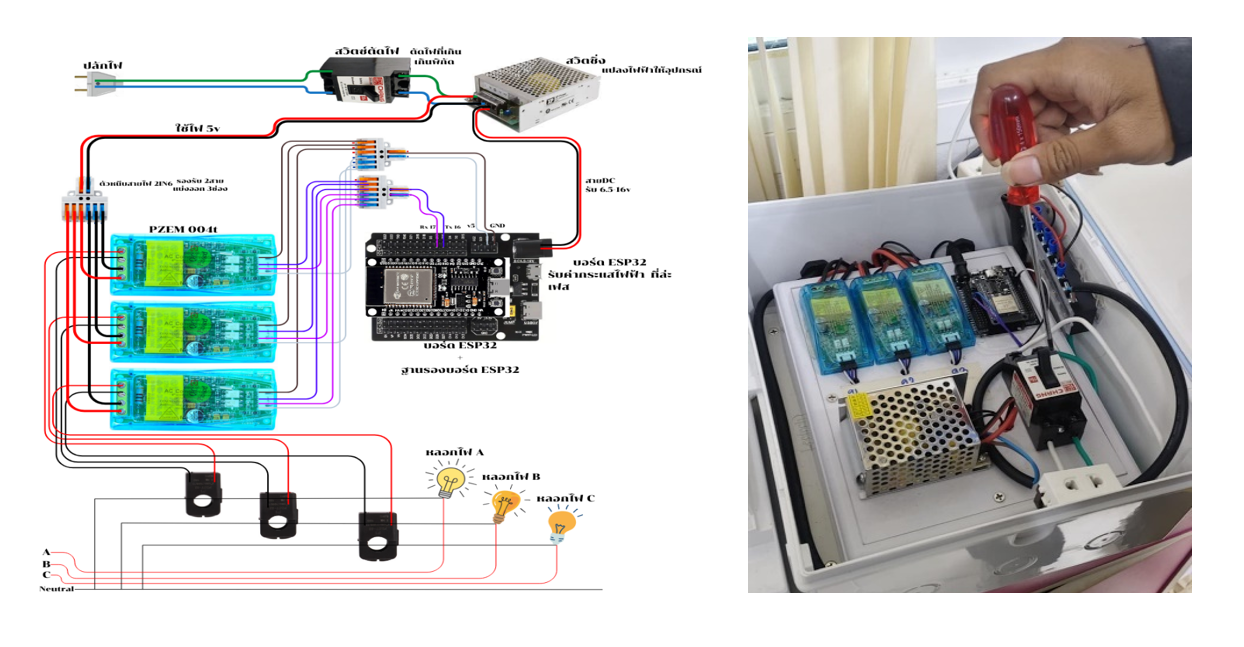
This research aimed to develop an electricity consumption monitoring system using Internet of Things (IoT) technology and to evaluate its performance. The developed system integrates three PZEM-004T sensors to measure key electrical parameters, including voltage, current, power, energy accumulation, frequency, and power factor. These sensors are connected to an ESP32 microcontroller, which collects and transmits data wirelessly to Google Sheets using Google Apps Script. The collected data is then visualized in interactive graphs via Google Looker Studio. A purposive sample of 10 experts was selected to evaluate the system using a questionnaire. Data was analyzed using mean and standard deviation. The results indicate that the system effectively captures real-time energy consumption data and presents clear trends through a user-friendly dashboard, supporting systematic energy-saving planning. The overall performance was rated at the highest level ( = 4.58, S.D. = 0.18), reflecting high accuracy, stability, and suitability for implementation in educational and office environments. The findings suggest that the system can be effectively applied in organizational energy management to enhance efficiency and significantly reduce long-term energy costs. Furthermore, it serves as a concrete and effective prototype for IoT-based energy monitoring system development.
Downloads
References
Apiruchpinyo, N., & Chaochaikong, S. (2022). Electrical Power Management System in Buildings via the Internet of Things: A Case Study of Srikodtraboon Building of Nakhon Phanom University. Udon Thani Rajabhat University Journal of Sciences and Technology, 10(3), 43-62. (In Thai)
Chaiyong, W., & Sonasang, S. (2022). Applications of Energy Monitoring Using the IoT. SNRU Journal of Science and Technology, 14(2), 1-9. https://doi.org/10.55674/snrujst.v14i2.245041.
Choochart, K. (2022). Development of the Internet of Things Platform System for Electricity Usage Monitoring Case study: Srivitsawavitthaya Buildings, Faculty of Engineering, Rajamangala University of Technology Srivijaya. [Master's dissertation, Prince of Songkla University]. PSU Knowledge Bank. http://kb.psu.ac.th/psukb/handle/2016/17921. (In Thai)
Chunpungsuk, C., & Lertbumroongchai, K. (2018). Sufficient Ecosystem Management via IoT for Educational Institutions. Journal of Vacational and Technical Education, 8(15), 25-31. (In Thai)
ELM Learning. (2024). What is ADDIE? Your Complete Guide to the ADDIE Model. https://elmlearning.com/hub/instructional-design/addie-model.
Hantoro, C. D., & Setiawidayat, S. (2023). Monitoring and Control of 3 Phase Electrical Energy Internet of Things (IoT) Based. European Journal of Electrical Engineering and Computer Science, 7(3), 80-86. https://doi.org/10.24018/ejece.2023.7.3.522.
Hjelle, S., Mikalef, P., Altwaijry, N., & Parida, V. (2024). Organizational Decision Making and Analytics: An Experimental Study on Dashboard Visualizations. Information & Management, 61(6), 104011. https://doi.org/10.1016/j.im.2024.104011.
Huang, G.-L., Anwar, A., Loke, S. W., Zaslavsky, A., & Choi, J. (2023). IoT-based Analysis for Smart Energy Management. arXiv. https://doi.org/10.48550/ARXIV.2311.18643.
Napitupulu, D. (2020). User-Acceptance Instrument Development: A Content Validity Study in the e-Participation Context. Journal of Applied Research and Technology, 18(1), 34-43. https://doi.org/10.22201/icat.24486736e.2020.18.1.931.
Rovinelli, R. J., & Hambleton, R. K. (1977). On the Use of Content Specialists in the Assessment of Criterion-Referenced Test Item Validity. https://files.eric.ed.gov/fulltext/ED121845.pdf.
Saha, N., Aulia, M. M., Rahman, Md. M., & Khan, M. S. A. (2024). IoT-Driven Cloud-based Energy and Environment Monitoring System for Manufacturing Industry. arXiv. https://doi.org/10.48550/ARXIV.2404.11771.
Seepan, K., & Trongtorkarn, M. (2024). Design and Development of 3 Phase Energy Meters for Energy Monitoring: Case Study of Suratthani Rajabhat University's Industrial Technology Laboratory Department. Journal of Industrial Education, 18(2), 10-25. (In Thai)
Songputh, T., & Rungkaew, J. (2022). The Internet of Things for Controlling use of Electricity through the Internet Network. Science and Technology Journal of Sisaket Rajabhat University, 2(1), 22-30. (In Thai)
Yasa, K. A., Purbhawa, I. M., Yasa, I. M. S., Teresna, I. W., Nugroho, A., & Winardi, S. (2023). IoT-based Electrical Power Recording using ESP32 and PZEM-004T Microcontrollers. Journal of Computer Science and Technology Studies, 5(4), 62-68. https://doi.org/10.32996/jcsts.2023.5.4.7.
Downloads
Published
How to Cite
Issue
Section
Categories
License
Copyright (c) 2025 Journal of Computer and Creative Technology

This work is licensed under a Creative Commons Attribution-NonCommercial-NoDerivatives 4.0 International License.