Development of Learning Outcomes via Competency-Based Web Learning in the Topic of Integrated Marketing Communication for Higher Vocational Certificate Students Under Office of the Vocational Education Commission
DOI:
https://doi.org/10.14456/jcct.2025.23Keywords:
Web-Based Learning, Competency-Based, Acceptance Factors, Learning OutcomesAbstract
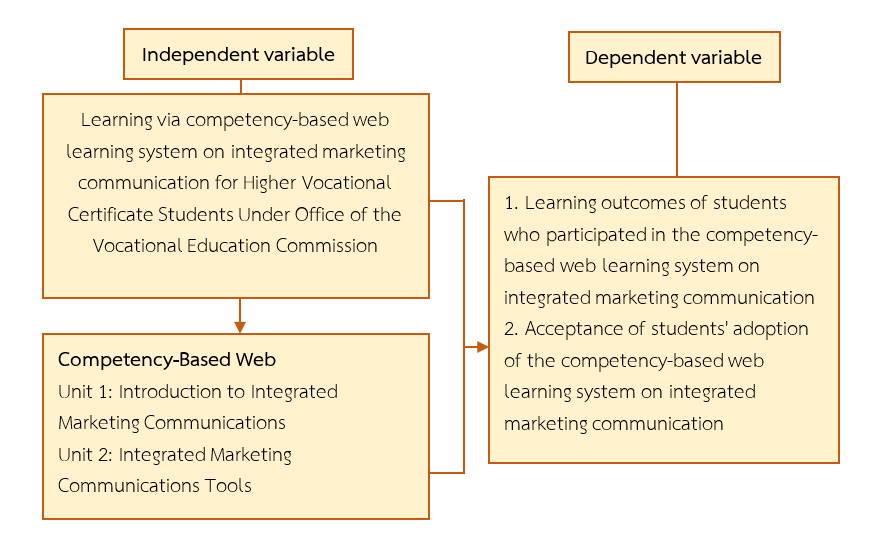
This study aimed to: 1) examine the learning outcomes of students who participated in the competency-based web learning system on integrated marketing communication; and 2) investigate the acceptance factors influencing students' adoption of the competency-based web learning system on integrated marketing communication. The target group comprised 53 second-year Higher Vocational Certificate students from Saraburi Industrial and Community Education College enrolled in the second semester of the 2024 academic year, selected through purposive sampling. The research tools included: 1) the competency-based web learning system on integrated marketing communication; 2) a professional competency assessment tool aligned with the 2020 Higher Vocational Certificate curriculum in Business Administration, Marketing major, under the Office of the Vocational Education Commission; and 3) a questionnaire assessing acceptance factors for the competency-based web learning system. The study employed statistical analyses such as the index of item-objective congruence (IOC), percentage, mean, standard deviation, paired t-test, and correlation coefficient analysis. The findings revealed that: 1) students’ post-learning outcomes were significantly higher than their pre-learning outcomes at the .05 level; and 2) all 28 pairs of acceptance factors exhibited positive correlations, with correlation coefficients ranging from .392 to .788., meaning that when one acceptance factor increases, the other acceptance factor that is related to it increases as well.
Downloads
References
Announcement of the Office of the Prime Minister: Promulgation of the National Reform Plan (Revised Edition). (2021, February 25). Royal Thai Government Gazette. Book No. 138 Chapter 44 Ngor, 293-323. https://ratchakitcha.soc.go.th/documents/17159146.pdf. (In Thai)
Avianti, R. A. (2024). The Effectiveness of Online Learning Models and Assessment Methods in Improving Learning Competence in the Field of Mechatronics. Global International Journal of Innovative Research, 2(11), 2690-2701. https://doi.org/10.59613/global.v2i11.357.
Beibei, Z. (2011). On Higher Vocational Students' Web-Based Autonomous English Learning Strategies. Journal of Jiangsu Ocean University (Humanities& Social Edition), 2011(15), 78-79. https://doi.org/10.3969/j.issn.1008-3499.2011.15.029. (In Chinese)
Changkanak, N. (2017). The Development of the Adaptive Web-Based Instruction Entitled “Computer System” on Information and Technology Subject for Mathayomsuksa 1 Student. [Unpublished master's dissertation]. Naresuan University. (In Thai)
Imran, M. C. & Sulviana. (2022). Using BBC Web-Based Learning Courses to Improve Vocational High School (VHS) Students’ Speaking Skill. Education, Language, and Culture Journal, 2(1), 94-100. https://doi.org/10.56314/edulec.v2i1.34.
Khampongpai, W. (2020). Effects of Instruction Using the Concentrated Language Encounter Instruction with Electronic Multimedia to Develop Reading Comprehension and Writing Abilities of Grade 2 Students. [Master's Dissertation, Srinakharinwirot University]. DSpace at Srinakharinwirot University. http://ir-ithesis.swu.ac.th/dspace/handle/123456789/1285. (In Thai).
Kim, M., Kim, Y., & Lee, G. (2023). Effect of Situational Factors (Control, Convenience, Time Pressure, and Order Complexity) on Customers’ Self-Service Technology Choices. Journal of Hospitality Marketing & Management, 32(5), 649-669. https://doi.org/10.1080/19368623.2023.2195398.
Nachairit, D. (2019). Teaching and Studying Development by Online Lesson with Case Study Approach for Enhance Solving-Problem Skill of Teacher College Students. Research Report. Rajabhat Maharakham University. (In Thai)
Office of the Permanent Secretary. (2024). The Cabinet has approved Phase 2 of the Anywhere-Anytime Basic Learning Promotion Project, aiming to Provide Appropriate Learning Equipment for Learners of All Ages. Ministry of Education. https://ops.moe.go.th/anywhere-anytime. (In Thai)
Office of the Vocational Education Commission. (2019). Development of a Competency-Based Curriculum. https://bsq.vec.go.th/Portals/9/document/Course%20criteria/2.pdf. (In Thai).
Office of the Vocational Education Commission. (2020). High Vocational Certificate Year 2020, Business Administration, Program in Marketing. Ministry of Education. https://bsq.vec.go.th/Portals/9/Course/30/2563/30200/30202v13.pdf. (In Thai)
Promla, P., & Sintanakul, K. (2021). The Effect of Learning Management by Competency-Based Learning blend with Web-Based Teaching and Problem-Based Learning according to MIAP Process to Develop Computation Thinking Skill of Vocational Certificate Student, Information Technology Subject. KKU Research Journal of Humanities and Social Sciences (Graduate Studies), 9(2), 181-194.
Sukhum, C., & Vanichwatanavorachai, S. (2023). Competency-based Learning Design: Concepts, Instructional Design and Learning Evaluation. Research and Development Journal Suan Sunandha Rajabhat University, 15(1), 65-78. (In Thai)
Suryani, K., Khairudin, Widyastuti, R., Amelia, R., & Riska, L. (2018). Using Interactive Web-Based Learning Multimedia to Assess Competency Standards for Installing LAN Among Vocational High School Students in Padang, Indonesia. International Journal of Engineering & Technology, 7(4.9), 262-267. https://doi.org/10.14419/ijet.v7i4.9.21093.
Thamsuwan, P. (2023). Development of Web-Based Training Using GROW Coaching Model and AIDA Marketing Technique to Enhance e-Commerce Competencies of Higher Education Learners. [Doctoral Dissertation, Chulalongkorn University]. Chulalongkorn University Theses and Dissertations. https://digital.car.chula.ac.th/chulaetd/10163. (In Thai)
Tsania, J., Putro, B. L., & Nugraha, E. (2023). Implementation of the Guided Discovery Learning Model Using Web-Based Learning Media to Improve Vocational School Students’ Cognition. Jurnal Guru Komputer, 4(1), 31-40. https://doi.org/10.17509/jgrkom.v4i1.64139.
Venkatesh, V., & Davis, F. D. (2000). A Theoretical Extension of the Technology Acceptance Model: Four Longitudinal Field Studies. Management Science, 45(2), 186-204.
Wahyuni, D. S., Ariadi, G., Sugihartini, N., & Mertayasa, I. N. E. (2023, February 9). The Impact of Achievement Motivation on Educational Compatibility Mediated by Perceived Ease of Use. The 5th International Conference on Vocational Education and Technology. Universitas Pendidikan Ganesha. http://dx.doi.org/10.4108/eai.6-10-2022.2327429.
Downloads
Published
How to Cite
Issue
Section
Categories
License
Copyright (c) 2025 Journal of Computer and Creative Technology

This work is licensed under a Creative Commons Attribution-NonCommercial-NoDerivatives 4.0 International License.