LEARNER RESILIENCE IN EDUCATIONAL CONTEXTS: A SYSTEMATIC LITERATURE REVIEW OF THAI AND INTERNATIONAL STUDIES (2019–2024)
Keywords:
Learner Resilience, Systematic Literature Review, Educational Contexts, Thai and International StudiesAbstract
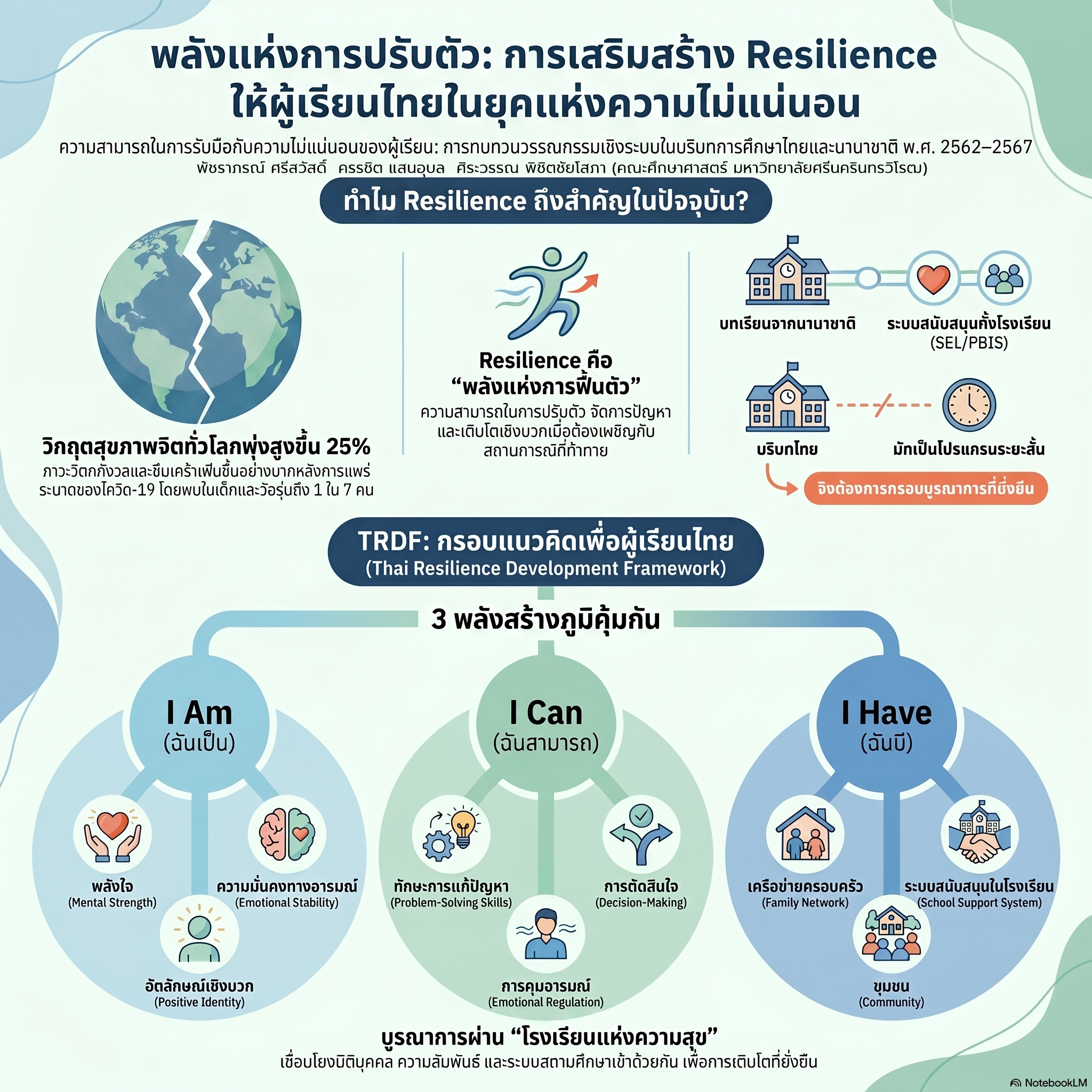
In the 21st century, the world is facing increasing uncertainty across multiple dimensions, making adaptive capacity and resilience essential competencies for learners today. This systematic literature review aimed to synthesize concepts, theories, components, and practices related to resilience development between 2019 and 2024 by using PICO-based selection criteria and rigorous critical appraisal procedures. The findings indicate that resilience is a dynamic process influenced by internal factors, adaptive skills, and supportive social resources at the levels of individuals, relationships, and educational environments. International practices commonly develop resilience through social and emotional learning frameworks and multi-tiered positive support systems, while the Thai context highlights guidance activities and group counseling programs grounded in the “I Am – I Can – I Have” framework to strengthen learners’ internal assets, capabilities, and social support networks. Based on the synthesized evidence, this article proposes the Thai Resilience Development Framework (TRDF), an integrative conceptual model linking personal, relational, and educational system dimensions. The framework serves as a structural guideline for promoting resilience among Thai learners and supports policy development, instructional practices, and school counseling preparation aimed at enhancing well-being, adaptive functioning, and positive developmental growth in a rapidly changing society.
References
มารุต ศักดิ์แสงวิจิตร. (2562). การเสริมสร้างความหยุ่นตัวด้านการปรับตัวของนักเรียนครอบครัวเลี้ยงเดี่ยวด้วยการให้คำปรึกษากลุ่ม [ปริญญานิพนธ์ปริญญามหาบัณฑิต, มหาวิทยาลัยศรีนครินทรวิโรฒ]. คลังปัญญา มหาวิทยาลัยศรีนครินทรวิโรฒ. https://hdl.handle.net/20.500.14740/34258
วิไลลักษณ์ ลังกา, พัชราภรณ์ ศรีสวัสดิ์, อรอุมา เจริญสุข, นริสรา พึ่งโพธิ์สภ, ทวิกา ตั้งประภา, มนตา ตุลย์เมธาการ, อิทธิพัทธ์ สุวทันพรกูล, และ พนิดา ศกุนตนาค. (2564). การวิจัยและพัฒนาคู่มือกิจกรรมเสริมสร้างทุนทางจิตวิทยาในการป้องกันการใช้สารเสพติดในกลุ่มนักเรียนช่วงอายุ 13-15 ปีสำหรับครูในสถานศึกษา. วารสารสำนักงาน ป.ป.ส., 38(1), 52–65.
Ashurst, K. L., Hans, J. D., & Smith, D. R. (2009). The resilience factor: What extension can learn from adolescents coping with parental cancer. The Journal of Extension, 47(2), 1–13. https://commons.joe.org/joe/vol47/iss2/25
Barker, K., Poed, S., & Whitefiled, P. (Eds.). (2023). School-wide positive support: The Australia handbook. Routledge.
Bonanno, G. A., Galea, S., Bucciarelli, A., & Vlahov, D. (2006). Psychological resilience after disaster: New York City in the aftermath of the September 11th terrorist attack. Psychological Science, 17(3), 181–186. https://doi.org/10.1111/j.1467-9280.2006.01682.x
Bronfenbrenner, U. (1979). The ecology of human development: Experiments by nature and design. Harvard University Press.
Center on Positive Behavioral Interventions and Supports. (2023a). PBIS implementation blueprint. University of Oregon. https://www.pbis.org
Center on Positive Behavioral Interventions and Supports. (2023b). What is PBIS? https://www.pbis.org/pbis/what-is-pbis
Collaborative for Academic, Social, and Emotional Learning. (2020). SEL framework: What are the core competencies? https://casel.org/core-competencies/
Collaborative for Academic, Social, and Emotional Learning. (2023). What is SEL? https://casel.org/what-is-sel/
Durlak, J. A., Weissberg, R. P., Dymnicki, A. B., Taylor, R. D., & Schellinger, K. B. (2011). The impact of enhancing students’ social and emotional learning: A meta-analysis of school-based universal interventions. Child Development, 82(1), 405–432. https://doi.org/10.1111/j.1467-8624.2010.01564.x
Grotberg, E. H. (1999). Tapping your inner strength. New Harbinger.
Llistosella, M., Castellví, P., García-Ortiz, M., López-Hita, G., Torné, C., Ortiz, R., Guallart, E., Uña-Solbas, E., & Martín-Sánchez, J. C. (2024). Effectiveness of a resilience school-based intervention in adolescents at risk: A cluster-randomized controlled trial. Frontiers in Psychology, 15, 1–11. https://doi.org/10.3389/fpsyg.2024.1478424
Llistosella, M., Goni-Fuste, B., Martín-Delgado, L., Miranda-Mendizabal, A., Franch Martinez, B., Pérez-Ventana, C., & Castellvi, P. (2023). Effectiveness of resilience-based interventions in schools for adolescents: A systematic review and meta-analysis. Frontiers in Psychology, 14, 1–21. https://doi.org/10.3389/fpsyg.2023.1211113
Masten, A. S. (2001). Ordinary magic: Resilience processes in development. American Psychologist, 56(3), 227–238.
Pinto, T. M., Laurence, P. G., Macedo, C. R., & Macedo, E. C. (2021). Resilience programs for children and adolescents: A systematic review and meta-analysis. Frontiers in Psychology, 12, 1–13. https://doi.org/10.3389/fpsyg.2021.754115
Seligman, M. E. P. (2011). Flourish: A visionary new understanding of happiness and well-being. Free Press.
Sugai, G., & Horner, R. H. (2002). The evolution of discipline practices: School-wide positive behavior supports. Child & Family Behavior Therapy, 24(1–2), 23–50. https://doi.org/10.1300/J019v24n01_03
Tasijawa, F. A., & Siagian, I. (2022). School-based interventions to improve adolescent resilience: A scoping review. Open Access Macedonian Journal of Medical Sciences, 10(F), 33–40. https://doi.org/10.3889/oamjms.2022.8063
The Resilience Project. (2021). GEM principles. https://www.theresilienceproject.com.au
Ungar, M. (2012). Social ecologies and their contribution to resilience. American Journal of Orthopsychiatry, 82(2), 225–235. https://doi.org/10.1111/j.1939-0025.2012.01144.x
Werner, E. E., & Smith, R. S. (1995). Overcoming the odds: High risk children from birth to adulthood. Cornell University Press.
World Health Organization. (2022). COVID-19 pandemic triggers 25% increase in prevalence of anxiety and depression worldwide. https://www.who.int/news/item/02-03-2022-covid-19-pandemic-triggers-25-increase-in-prevalence-of-anxiety-and-depression-worldwide
World Health Organization, & United Nations Children’s Fund. (2024). WHO and UNICEF launch guidance to improve access to mental health care for children and young people. https://www.who.int/news/item/09-10-2024-who-and-unicef-launch-guidance-to-improve-access-to-mental-health-care-for-children-and-young-people
Downloads
Published
How to Cite
Issue
Section
Categories
License
Copyright (c) 2026 Faculty of Education, Srinakharinwirot university

This work is licensed under a Creative Commons Attribution-NonCommercial-NoDerivatives 4.0 International License.


