กรอบแนวคิดและแนวทางปฏิบัติในการขับเคลื่อนเครือข่ายความร่วมมือทางวิชาการที่ยั่งยืน : กรณีศึกษามหาวิทยาลัยสวนดุสิต
คำสำคัญ:
การสร้างสรรค์ร่วม, เครือข่ายความร่วมมือทางวิชาการ, พื้นที่บ่มเพาะปัญญา, การเรียนรู้บูรณาการกับการทำงานบทคัดย่อ
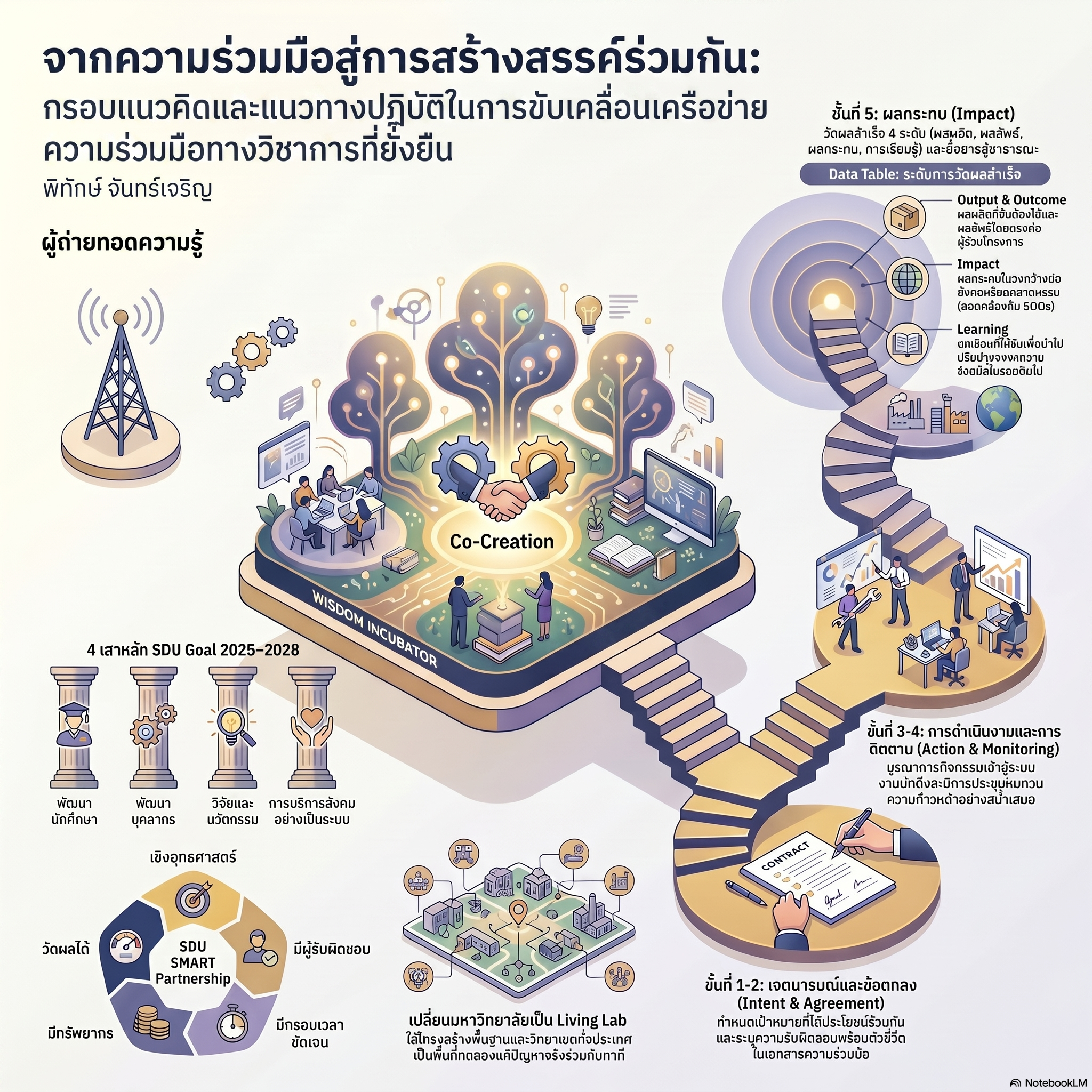
บทความวิชาการนี้นำเสนอและวิเคราะห์กรอบแนวคิด "จากความร่วมมือสู่การสร้างสรรค์ร่วมกัน" (From Collaboration to Co-Creation) ของมหาวิทยาลัยสวนดุสิต ซึ่งพัฒนาขึ้นเพื่อตอบสนองต่อความท้าทายของระบบอุดมศึกษาในยุคปัญญาประดิษฐ์ที่ผลักดันให้มหาวิทยาลัยต้องเปลี่ยนบทบาทจาก "ผู้ถ่ายทอดความรู้" (Knowledge Provider) สู่ "พื้นที่บ่มเพาะปัญญา" (Wisdom Incubator) บทความนี้ใช้วิธีการทบทวนวรรณกรรมเชิงวิเคราะห์ (Analytical Literature Review) ที่ครอบคลุมทั้งเอกสารนโยบายและกรณีศึกษาของมหาวิทยาลัยสวนดุสิต โดยเชื่อมโยงกับงานวิจัยทั้งในประเทศและต่างประเทศ กรอบแนวคิดของมหาวิทยาลัยสวนดุสิตประกอบด้วย 4 องค์ประกอบหลักที่เชื่อมโยงกันอย่างเป็นระบบ ได้แก่ (1) อัตลักษณ์และโครงสร้างพื้นฐานที่เป็นพื้นที่ทดลองจริง (Living Lab) ซึ่งเป็นฐานของความร่วมมือที่มีความพร้อมในทุกระดับ (2) แผนยุทธศาสตร์เป้าหมายการพัฒนามหาวิทยาลัยสวนดุสิต (SDU Goal 2025–2028) ที่ขับเคลื่อนด้วย 4 หลัก ได้แก่ การพัฒนานักศึกษา (Student Development) การพัฒนาบุคลากร (Staff Development) การวิจัยและนวัตกรรม (Research & Innovation) และการบริการสังคม (Social Engagement) (3) โมเดลการขับเคลื่อนความร่วมมือ 5 ขั้นตอน จากเจตนารมณ์สู่ผลกระทบ (Intent to Impact) ที่เปลี่ยนความร่วมมือจากเหตุการณ์ครั้งเดียวสู่กระบวนการต่อเนื่องที่วัดได้ และ (4) หลักการความร่วมมือ SDU SMART Partnership ที่ประกอบด้วย เชิงยุทธศาสตร์ (Strategic) วัดผลได้ (Measurable) มีผู้รับผิดชอบ (Accountable) มีทรัพยากร (Resourced) และมีกรอบเวลา (Time-bound) เป็นเครื่องมือออกแบบความร่วมมือในระดับปฏิบัติ ทั้งหมดนี้ได้รับการพิสูจน์ผ่านกรณีศึกษาความสำเร็จ 3 กรณี และได้รับการสนับสนุนจากหลักฐานเชิงประจักษ์ในเอกสารและงานวิจัยนานาชาติ บทความนี้ได้นำเสนอข้อเสนอแนะเชิงนโยบายสำหรับมหาวิทยาลัยสวนดุสิต มหาวิทยาลัยไทยโดยทั่วไป และกระทรวงการอุดมศึกษา วิทยาศาสตร์ วิจัยและนวัตกรรม (อว.) ในการยกระดับเครือข่ายความร่วมมือทางวิชาการให้สร้างผลกระทบที่ยั่งยืนต่อสังคมไทย
เอกสารอ้างอิง
พิทักษ์ จันทร์เจริญ. (2569). จากข้อตกลงสู่ผลลัพธ์เชิงประจักษ์: การขับเคลื่อนความร่วมมือทางวิชาการให้เกิดผลอย่างเป็นรูปธรรม [สุนทรพจน์]. การประชุมเครือข่ายความร่วมมือทางวิชาการทั้งในและต่างประเทศ มหาวิทยาลัยสวนดุสิต.
มหาวิทยาลัยสวนดุสิต. (2568). SDU Goal 2025–2028: The power of SDU move forward with "Wisdom & Collaboration". สำนักยุทธศาสตร์และแผน มหาวิทยาลัยสวนดุสิต.
สำนักงานปลัดกระทรวงการอุดมศึกษา วิทยาศาสตร์ วิจัยและนวัตกรรม. (2566). รายงานการประเมินผลการดำเนินงานความร่วมมือระหว่างสถาบันอุดมศึกษาไทยกับภาคเอกชน. กระทรวงการอุดมศึกษา วิทยาศาสตร์ วิจัยและนวัตกรรม.
ภาษาอังกฤษ
Atta-Owusu, K., Fitjar, R. D., & Rodríguez-Pose, A. (2021). What drives university–industry collaboration? Research excellence or firm collaboration strategy? Technological Forecasting & Social Change, 173, Article 121084. https://doi.org/10.1016/j.techfore.2021.121084
Castelló, I., Adamczyk, S., & Kang, B. (2023). Bridging academia and enterprise: A framework for collaborative success. Journal of the Knowledge Economy. Advance online publication. https://doi.org/10.1007/s13132-024-02360-7
Curto-Reverte, N., Alcover, C. M., & Vázquez, M. (2025). The role of work-integrated learning in the European Higher Education Area: A systematic review. Review of Education, 13(1), Article e70114. https://doi.org/10.1002/rev3.70114
Jackson, D., Dean, B. A., & Eady, M. J. (2023). Equity and inclusion in work-integrated learning: Participation and outcomes for diverse student groups. Educational Review. Advance online publication. https://doi.org/10.1080/00131911.2023.2182764
Law, S. F., Cattlin, J., & Locke, W. (2021). Understanding university engagement: The impact of COVID-19 on collaborations and partnerships. Melbourne Centre for the Study of Higher Education, The University of Melbourne.
Lubicz-Nawrocka, T., & Bovill, C. (2021). Do students experience genuine partnership in co-creation of the curriculum? In A. Cook-Sather & C. Bovill (Eds.), Pedagogical partnerships: A how-to guide for faculty, students, and academic developers in higher education. Elon University Center for Engaged Learning.
Matthews, K. E., Mercer-Mapstone, L., Dvorakova, S. L., Acai, A., Cook-Sather, A., Felten, P., Healey, M., Healey, R. L., & Marquis, E. (2023). Enhancing outcomes and reducing inhibitors to the engagement of students and staff in learning and teaching partnerships. Higher Education Research & Development, 42(1), 1–15. https://doi.org/10.1080/07294360.2022.2098010
Ruano-Borbalan, J.-C. (2025). The transformative impact of artificial intelligence on higher education: A critical reflection on current trends and futures directions. International Journal of Chinese Education, 14(1), Article 14. https://doi.org/10.1177/2212585X251319364
Santos, T. N., Dias, J. G., & Mendonça, S. (2025). From transfer to co-creation: Charting the prospects for university-industry cooperation. Industry and Higher Education, 39(3), 245–261. https://doi.org/10.1177/09504222251370090
Suan Dusit University. (2025). GXUFE-SDU Teaching and Academic Cooperation Center: Opening report.
UNESCO. (2023). Harnessing the era of artificial intelligence in higher education: A primer for higher education stakeholders. UNESCO Institute for Higher Education in Latin America and the Caribbean (IESALC). https://unesdoc.unesco.org/ark:/48223/pf0000386670
UNESCO-IESALC & Times Higher Education. (2023). The contribution of higher education institutions to sustainable cities and communities. UNESCO Institute for Higher Education in Latin America and the Caribbean.
Zegwaard, K. E., Pretti, T. J., Rowe, A. D., & Ferns, S. J. (2023). Defining work-integrated learning. In K. E. Zegwaard & T. J. Pretti (Eds.), The Routledge international handbook of work-integrated learning (3rd ed., pp. 29–48). Routledge.
Zorwick, M. L., & Ward, J. (2023). Co-creation in higher education: A conceptual systematic review. Higher Education, 87(4), 1089–1107. https://doi.org/10.1007/s10734-024-01364-1
ดาวน์โหลด
เผยแพร่แล้ว
รูปแบบการอ้างอิง
ฉบับ
ประเภทบทความ
หมวดหมู่
สัญญาอนุญาต
ลิขสิทธิ์ (c) 2026 คณะศึกษาศาสตร์ มหาวิทยาลัยศรีนครินทรวิโรฒ

อนุญาตภายใต้เงื่อนไข Creative Commons Attribution-NonCommercial-NoDerivatives 4.0 International License.


