EFFECT OF USING AN INSTRUCTIONAL PROCESS BASED ON MIA AND QUESTIONING TECHNIQUES TO ENHANCE ENGLISH READING COMPREHENSION SKILLS, ATTITUDES TOWARDS LEARNING ENGLISH, AND OPINIONS FOR PRATHOMSUKSA 3 STUDENTS
Keywords:
English reading comprehension, MIA teaching method, Questioning techniques, Attitudes towards learning EnglishAbstract
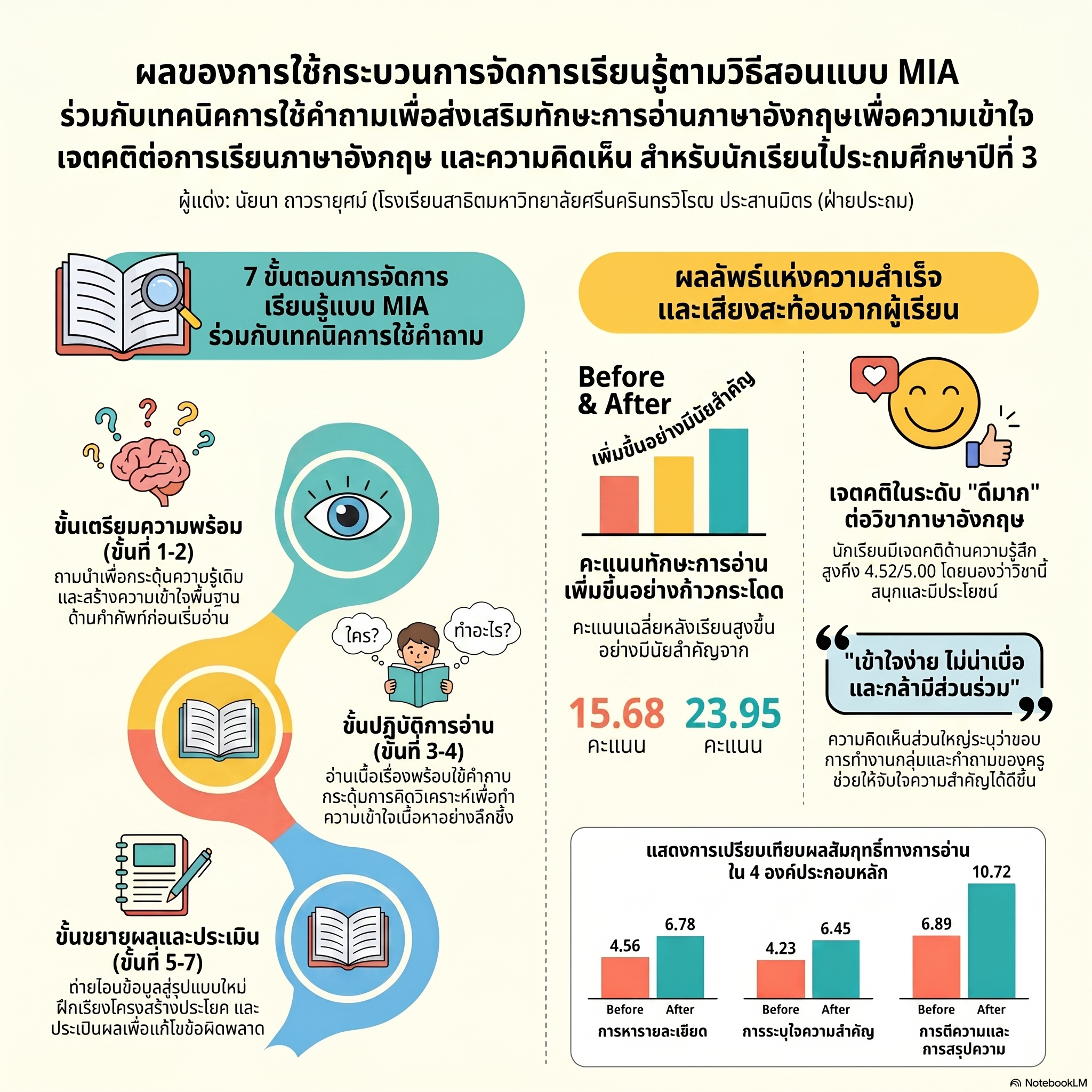
This research aimed to 1) compare the English reading comprehension skills of Grade 3 students before and after learning through the MIA teaching method combined with questioning techniques, 2) examine students' attitudes towards learning English after the intervention, and 3) explore students' opinions on the learning experience. The sample consisted of 120 Grade 3 students in the first semester of the 2023 academic year, selected through stratified random sampling. The research instruments included 1) 8 lesson plans for a total of 24 hours, 2) pre-post tests of reading comprehension using MIA combined with questioning, 3) an attitude towards learning English questionnaire administered after the intervention, and 4) a student opinion interview form. Data were analyzed using mean, standard deviation, t-test (Dependent Samples) for pre-post comparison, One-Way Repeated Measures ANOVA for single-group repeated measurements, and content analysis. The results revealed that students' English reading comprehension skills after the intervention were significantly higher than before at the .05 level, with mean scores increasing from 15.68 to 23.95, students' attitudes towards learning English after the intervention were at a good level (X̄ = 4.43, S.D. = 0.39), and most students expressed positive opinions about the learning experience, reporting that they found the lessons enjoyable and easier to understand, appreciated group work, and felt their English reading skills had improved.
References
กระทรวงศึกษาธิการ. (2560). แนวปฏิบัติตามประกาศกระทรวงศึกษาธิการ เรื่อง นโยบายการปฏิรูปการเรียนการสอนภาษาอังกฤษ. สำนักงานคณะกรรมการการศึกษาขั้นพื้นฐาน.
ทิศนา แขมมณี. (2565). ศาสตร์การสอน: องค์ความรู้เพื่อการจัดกระบวนการเรียนรู้ที่มีประสิทธิภาพ (พิมพ์ครั้งที่ 24). สำนักพิมพ์แห่งจุฬาลงกรณ์มหาวิทยาลัย.
วินัยนา สารสิทธิยศ. (2561). การพัฒนาทักษะการอ่านภาษาอังกฤษเพื่อความเข้าใจโดยใช้วิธีสอนแบบบูรณาการของเมอร์ด็อค(MIA) สำหรับนักเรียนชั้นมัธยมศึกษาปีที่3. วารสารศึกษาศาสตร์ มหาวิทยาลัยนเรศวร, 20(2), 31-43.
วิสาข์ จัติวัตร์. (2561). การสอนอ่านภาษาอังกฤษ: จากทฤษฎีสู่การปฏิบัติ. สำนักพิมพ์มหาวิทยาลัยศิลปากร.
สถาบันทดสอบทางการศึกษาแห่งชาติ. (2564). สรุปผลการทดสอบทางการศึกษาระดับชาติขั้นพื้นฐาน (O-NET) ชั้นประถมศึกษาปีที่ 6 ปีการศึกษา 2563. สถาบันทดสอบทางการศึกษาแห่งชาติ (องค์การมหาชน).
สุภัทรา วงศ์วิเศษ. (2559). การพัฒนาทักษะการอ่านภาษาอังกฤษเพื่อความเข้าใจโดยใช้วิธีการสอนแบบMIA สำหรับนักเรียนชั้นมัธยมศึกษาปีที่3. วารสารศึกษาศาสตร์ มหาวิทยาลัยนเรศวร, 18(3), 80-93.
สุวิทย์ มูลคำ, และ อรทัย มูลคำ. (2563). 19 วิธีจัดการเรียนรู้: เพื่อพัฒนาความรู้และทักษะ (พิมพ์ครั้งที่ 4). ภาพพิมพ์.
อัจฉรา วงศ์โสธร. (2560). การทดสอบและประเมินผลการเรียนการสอนภาษาอังกฤษ. สำนักพิมพ์จุฬาลงกรณ์มหาวิทยาลัย.
Anderson, N. J. (2015). Active reading: The research base for a pedagogical approach in the reading classroom. In N. W. Evans, N. J. Anderson, & W. G. Eggington (Eds.), ESL readers and writers in higher education (pp. 16-33). Routledge.
Bandura, A. (1997). Self-efficacy: The exercise of control. W. H. Freeman and Company.
Barrett, T. C. (1976). Taxonomy of reading comprehension. In R. Smith & T. C. Barrett (Eds.), Teaching reading in the middle grades (pp. 51-58). Addison-Wesley.
Chen, J., Wang, M., Xu, X., & Yang, J. (2021). The impact of questioning techniques on reading comprehension: A meta-analysis. Reading Research Quarterly, 56(3), 543-570.
Cohen, J. (1988). Statistical power analysis for the behavioral sciences (2nd ed.). Lawrence Erlbaum Associates.
Crystal, D. (2012). English as a global language (2nd ed.). Cambridge University Press.
Dörnyei, Z. (2020). Innovations and challenges in language learning motivation. Routledge.
Duke, N. K., & Pearson, P. D. (2008). Effective practices for developing reading comprehension. Journal of Education, 189(1-2), 107-122.
EF Education First. (2023). EF English Proficiency Index: A ranking of 113 countries and regions by English skills. EF Education First.
Fisher, D., & Frey, N. (2014). Better learning through structured teaching: A framework for the gradual release of responsibility (2nd ed.). ASCD.
Gardner, R. C. (2010). Motivation and second language acquisition: The socio-educational model. Peter Lang.
Grabe, W., & Stoller, F. L. (2013). Teaching and researching reading (2nd ed.). Routledge.
Graddol, D. (2006). English next. British Council.
Hinkle, D. E., Wiersma, W., & Jurs, S. G. (2003). Applied statistics for the behavioral sciences (5th ed.). Houghton Mifflin.
Keyuravong, S. (2010). English language education in Thailand. In B. Spolsky & P. Moon (Eds.), Language assessment in Asia (pp. 200-216). Routledge.
Krejcie, R. V., & Morgan, D. W. (1970). Determining sample size for research activities. Educational and Psychological Measurement, 30(3), 607-610.
Li, M., Cheng, L., & Kirby, J. R. (2022). The effectiveness of cooperative learning in enhancing EFL learners' reading comprehension: A meta-analysis. Language Teaching Research, 26(1), 93-116.
Marzano, R. J. (2017). The new art and science of teaching. Solution Tree Press.
Murdoch, G. S. (1986). A more integrated approach to the teaching of reading. English Teaching Forum, 24(1), 9-15.
Noom-ura, S. (2013). English-teaching problems in Thailand and Thai teachers' professional development needs. English Language Teaching, 6(11), 139-147.
PISA Thailand. (2565). ผลการประเมิน PISA 2022 บทสรุปสำหรับผู้บริหาร. สถาบันส่งเสริมการสอนวิทยาศาสตร์และเทคโนโลยี.
Seligman, M. E. P. (2018). PERMA and the building blocks of well-being. The Journal of Positive Psychology, 13(4), 333-335.
Snow, C. E. (2010). Reading for understanding: Toward an R&D program in reading comprehension. RAND Corporation.
Wang, Y., & Seepho, S. (2021). The effects of cognitive strategy instruction on EFL learners' reading comprehension and self-efficacy. Reading Psychology, 42(5), 435-461.
Zhang, L. (2022). The impact of metacognitive strategy instruction on EFL learners' reading comprehension and self-regulation. System, 104, 102723.
Downloads
Published
How to Cite
Issue
Section
Categories
License
Copyright (c) 2026 Faculty of Education, Srinakharinwirot university

This work is licensed under a Creative Commons Attribution-NonCommercial-NoDerivatives 4.0 International License.


