THE EFFECTS OF PROBLEM-BASED LEARNING MANAGEMENT SUPPLEMENTED WITH KWDL TECHNIQUE ON THE TOPIC OF EXPONENTS ON MATHEMATICS LEARNING ACHIEVEMENT AND ATTITUDES TOWARDS LEARNING MANAGEMENT OF MATHAYOMSUKSA 2 STUDENTS
Keywords:
Problem-Based Learning, KWDL Technique, Learning Achievement, Attitude towards Learning ManagementAbstract
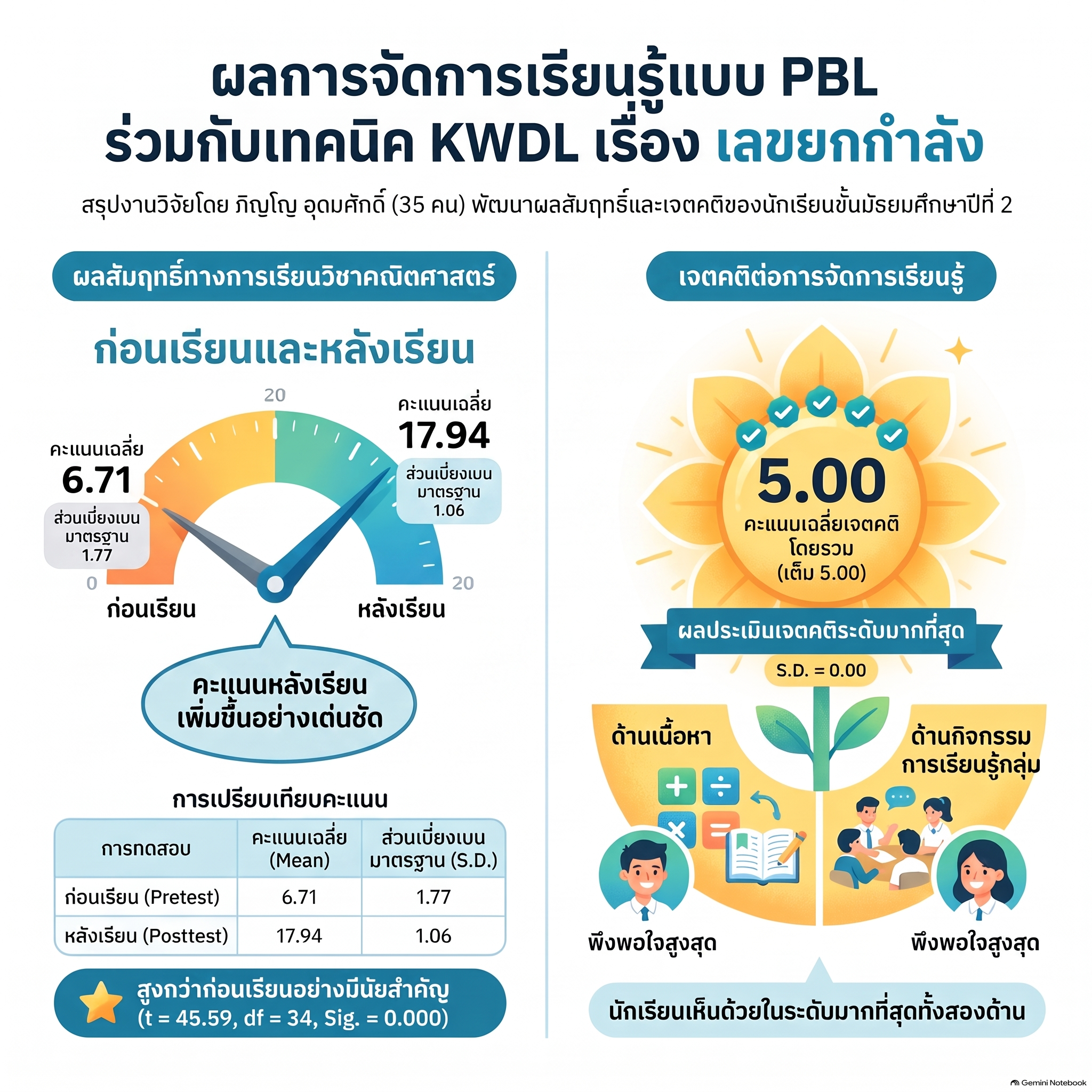
The purposes of this research were to (1) compare the mathematics learning achievement on the topic of Exponents of Mathayomsuksa 2 students before and after learning through problem-based learning supplemented with the KWDL technique, and (2) study the attitudes of Mathayomsuksa 2 students towards problem-based learning supplemented with the KWDL technique. The population used in this research consisted of 105 Mathayomsuksa 2 students from 3 classrooms at Udon Thani Rajabhat University Demonstration School during the first semester of the academic year 2026. The sample consisted of 35 Mathayomsuksa 2 students, obtained using cluster random sampling. The research design was a pre-experimental research using a One-Group Pretest-Posttest Design. The statistics used for data analysis included mean ( ), standard deviation (S.D.), and dependent samples t-test. The research findings revealed that: (1) the students' post-test learning achievement scores ( = 17.94, S.D. = 1.06) were significantly higher than their pre-test scores (
= 6.71, S.D. = 1.77) at the .05 level of statistical significance (t = 45.59, df = 34, Sig. = 0.000); and (2) the students' overall attitudes towards problem-based learning supplemented with the KWDL technique were at the highest level (
= 5.00, S.D. = 0.00). In conclusion, problem-based learning supplemented with the KWDL technique is an effective learning management model for developing mathematics learning achievement and promoting positive learning attitudes among Mathayomsuksa 2 students.
References
กระทรวงศึกษาธิการ. (2560). หลักสูตรแกนกลางการศึกษาขั้นพื้นฐาน พุทธศักราช 2551 (ฉบับปรับปรุง พ.ศ. 2560). โรงพิมพ์ชุมนุมสหกรณ์การเกษตรแห่งประเทศไทย.
ทิศนา แขมมณี. (2562). ศาสตร์การสอน: องค์ความรู้เพื่อการจัดกระบวนการเรียนรู้ที่มีประสิทธิภาพ (พิมพ์ครั้งที่ 21). สำนักพิมพ์แห่งจุฬาลงกรณ์มหาวิทยาลัย.
ประสาท เนืองเฉลิม. (2561). วิจัยปฏิบัติการทางการเรียนการสอน. คลังนานาวิทยา.
วิจารณ์ พานิช. (2555). วิถีสร้างการเรียนรู้ เพื่อศิษย์ในศตวรรษที่ 21. มูลนิธิสดศรี-สฤษดิ์วงศ์.
วรัญชลี จันทร์สมัคร, และ มณีญา สุราช. (2567). การวิจัยเชิงปฏิบัติการเพื่อพัฒนาการจัดการเรียนรู้โดยใช้ปัญหาเป็นฐานเสริมด้วยเทคนิค KWDL ที่ส่งเสริมผลสัมฤทธิ์ทางการเรียนและความสามารถในการแก้ปัญหาทางคณิตศาสตร์สำหรับนักเรียนชั้นมัธยมศึกษาปีที่ 1. วารสารสถาบันวิจัยและพัฒนา มหาวิทยาลัยราชภัฏมหาสารคาม.
ศิริชัย กาญจนวาสี. (2556). ทฤษฎีการทดสอบแบบดั้งเดิม (พิมพ์ครั้งที่ 7). สำนักพิมพ์แห่งจุฬาลงกรณ์มหาวิทยาลัย.
สถาบันทดสอบทางการศึกษาแห่งชาติ (องค์การมหาชน). (2568). ค่าสถิติพื้นฐานผลการทดสอบทางการศึกษาระดับชาติขั้นพื้นฐาน (O-NET) ชั้นมัธยมศึกษาปีที่ 3 ปีการศึกษา 2568. http://www.newonetresult.niets.or.th/AnnouncementWeb/Notice/FrBasicStat.aspx
สุดารัตน์ สุทธิวงศ์. (2563). ผลการจัดกิจกรรมการเรียนรู้โดยใช้ปัญหาเป็นฐานที่มีต่อผลสัมฤทธิ์ทางการเรียนคณิตศาสตร์และความสามารถในการแก้ปัญหาทางคณิตศาสตร์ เรื่อง พีระมิด กรวย และทรงกลม ของนักเรียนชั้นมัธยมศึกษาปีที่ 3 โรงเรียนคำยางพิทยา จังหวัดอุดรธานี [วิทยานิพนธ์ปริญญามหาบัณฑิต ไม่ได้ตีพิมพ์]. มหาวิทยาลัยสุโขทัยธรรมาธิราช.
อิสริยาภรณ์ เศวตรพนิต. (2560). ผลการจัดกิจกรรมการเรียนรู้โดยใช้ปัญหาเป็นฐานที่มีต่อทักษะการแก้ปัญหาและทักษะการเชื่อมโยงทางคณิตศาสตร์ของนักเรียนชั้นมัธยมศึกษาปีที่ 5 [วิทยานิพนธ์ปริญญามหาบัณฑิต ไม่ได้ตีพิมพ์]. มหาวิทยาลัยบูรพา.
Best, J. W., & Kahn, J. V. (2018). Research in education (10th ed.). Pearson Education.
Lertsopha, W. (2001). The use of KWDL learning management in the development of 9 graders' learning achievement of quadratic functions. ERIC.
Somanawat, N., & Surat, M. (2026). An action research on the development of mathematics instructional activities using problem-based learning supplemented with KWDL to enhance mathematical problem-solving ability of Mathayomsuksa 2 students. Journal of MCU Research, 11(2).
Downloads
Published
How to Cite
Issue
Section
Categories
License
Copyright (c) 2026 Faculty of Education, Srinakharinwirot university

This work is licensed under a Creative Commons Attribution-NonCommercial-NoDerivatives 4.0 International License.

