Gamified Web App for Community Exhibition Engagement: A Case Study of Ban Sawai Soh, Buriram
DOI:
https://doi.org/10.65205/jcct.2025.3035Keywords:
Web Application, Gamification, User Experience Design, Community Exhibition, Community-Based TourismAbstract
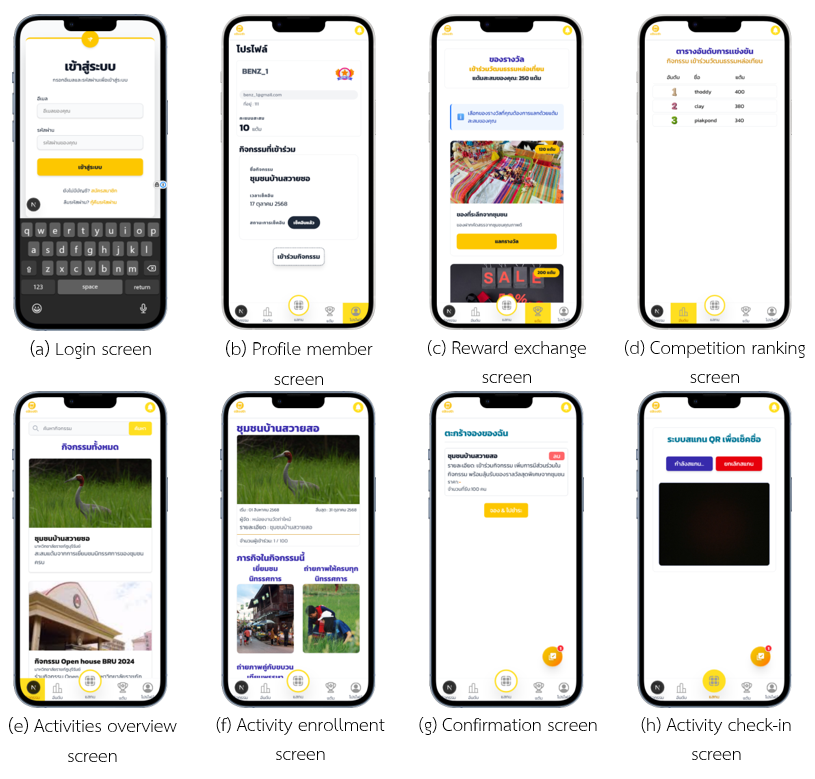
This research aimed to: 1. design and develop a gamified web application to enhance engagement in community exhibitions at Ban Sawai Soh, Buriram Province; 2. evaluate the application’s efficiency through expert assessment; and 3. examine user satisfaction. The sample consisted of five experts selected through purposive sampling and 303 exhibition visitors selected using proportional random sampling based on Yamane’s formula at a 0.05 level of precision. The research instruments included a gamified web application employing Points, Badges, and Leaderboards (PBL) mechanics, an efficiency evaluation form, and a user satisfaction questionnaire. The results indicated that the gamified web application achieved the highest level of efficiency ( = 4.53, S.D. = 0.66), while user satisfaction was also rated at the highest level (
= 4.51, S.D. = 0.64). These findings demonstrate that the gamified web application effectively enhances user engagement in community exhibitions and can serve as a digital innovation to support community-based tourism.
Downloads
References
Bamrungsi, E., Pungpracha, S., Huawanich, P., & Budhong, N. (2023). The Development of Web Application for Creating and Sharing Joint Events. Science Journal, Chandrakasem Rajabhat University, 33(2), 93 - 104. (In Thai)
Branch, R. M., & Kopcha, T. J. (2021). Instructional Design Models. In Reiser, R. A., & Dempsey, J. V. (Eds.), Trends and Issues in Instructional Design and Technology (4th ed.) (77 - 87). Pearson.
Buriram Provincial Office of Natural Resources and Environment. (2023). Introduction to Ban Sawai Soh Community: A BCG Model Pilot. Ministry of Natural Resources and Environment. https://www.mnre.go.th/buriram/th/news/detail/157618. (In Thai)
Deterding, S., Dixon, D., Khaled, R., & Nacke, L. (2011, September 28 - 30). From Game Design Elements to Gamefulness: Defining “Gamification.” The 15th International Academic MindTrek Conference: Envisioning Future Media Environments, 9 - 15. Tampere. https://doi.org/10.1145/2181037.2181040.
Hu, Y., Yu, M. F., Aung, A. T., Pineda, J. A., Chi, X., & Ahn, Y. (2025). The Influence of Exhibition Interactivity on Tourist Experiences at World Heritage Sites. Sustainability, 17(17), 7720. https://doi.org/10.3390/su17177720.
International Organization for Standardization. (2019). ISO 9241 - 210: 2019 Ergonomics of Human-System Interaction - Part 210: Human-Centred Design for Interactive Systems. ISO. https://www.iso.org/standard/77520.html.
Kärpuk, K. (2024). Gamification Marketing Statistics 2023. Adact. https://adact.me/blog/gamification-marketing-statistics.
Koivisto, J., & Hamari, J. (2019). The Rise of Motivational Information Systems: A Review of Gamification Research. International Journal of Information Management, 45, 191 - 210. https://doi.org/10.1016/j.ijinfomgt.2018.10.013.
Li, J., Zheng, X., Watanabe, I., & Ochiai, Y. (2024). A Systematic Review of Digital Transformation Technologies in Museum Exhibition. Computers in Human Behavior, 161, 108407. https://doi.org/10.1016/j.chb.2024.108407.
Mora, A., Riera, D., González, C., & Arnedo-Moreno, J. (2017). Gamification: A Systematic Review of Design Frameworks. Journal of Computing in Higher Education, 29(3), 516 - 548. https://doi.org/10.1007/s12528-017-9150-4.
Nacke, L. E., & Deterding, S. (2017). The Maturing of Gamification Research. Computers in Human Behavior, 71, 450 - 454. https://doi.org/10.1016/j.chb.2016.11.062.
National Strategy Secretariat Office. (2022). National Strategy (2018 - 2037). Office of the Prime Minister. https://bic.moe.go.th/images/stories/pdf/National_Strategy_Summary.pdf.
Santos, A. C. G., Oliveira, W., Hamari, J., Rodrigues, L., Toda, A. M., Palomino, P. T., & Isotani, S. (2021). The Relationship Between User Types and Gamification Designs. User Modeling and User-Adapted Interaction, 31(5), 907 - 940. https://doi.org/10.1007/s11257-021-09300-z.
Srisaard, B. (2013). Preliminary Research (9th ed.). Suwiriyasan. (In Thai)
Toda, A. M., Klock, A. C. T., Oliveira, W., Palomino, P. T., Rodrigues, L., Shi, L., Bittencourt, I., Gasparini, I., Isotani, S., & Cristea, A. I. (2019). Analysing Gamification Elements in Educational Environments Using an Existing Gamification Taxonomy. Smart Learning Environments, 6(1), 16. https://doi.org/10.1186/s40561-019-0106-1.
Toongsuwan, N., & Yothawong, W. (2025). Design of a Gamification-Based Game to Promote Cultural Tourism: A Case Study of Nan. Design Echo, 6(1), 33 - 43. (In Thai)
Yamane, T. (1973). Statistics: An Introductory Analysis (3rd ed.). Harper & Row.
Downloads
Published
How to Cite
Issue
Section
Categories
License
Copyright (c) 2025 Journal of Computer and Creative Technology

This work is licensed under a Creative Commons Attribution-NonCommercial-NoDerivatives 4.0 International License.