Development of a Semi-Automation Foam Grinder with Molding for Waterproof Floor Sheet from Agricultural Waste
DOI:
https://doi.org/10.65205/jcct.2025.2784Keywords:
Foam Grinder, Agricultural Waste, Semi-Automation TechnologyAbstract
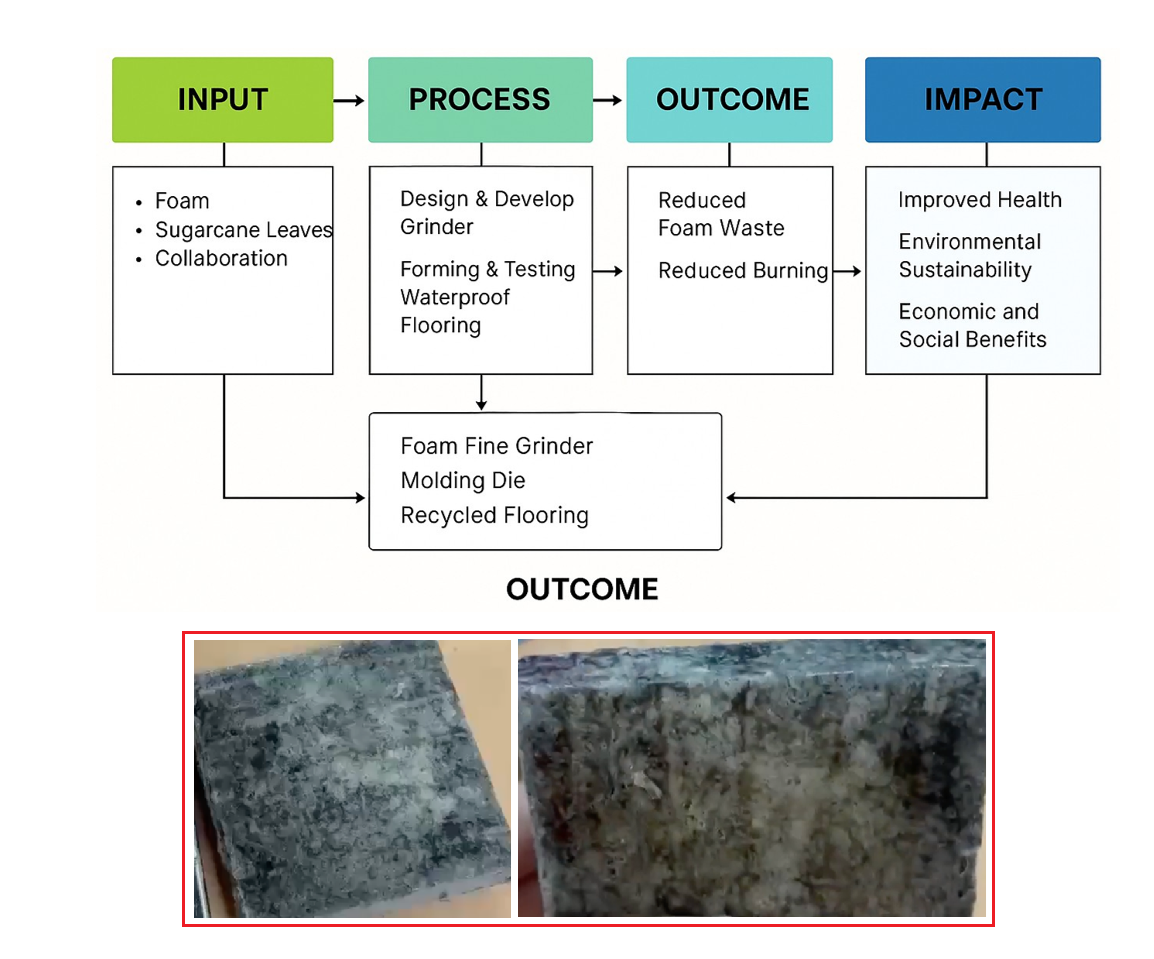
This research aimed to 1) design and develop a semi-automation foam grinding machine integrated with molding for waterproof floor sheets from agricultural waste, and 2) test the mechanical properties of the produced tiles. The study was conducted in the form of developmental research, focusing on repurposing household foam waste, such as food containers, through engineering processes that support the principles of a circular economy. The results revealed that the developed prototype consisted of a foam grinding unit, a mixing chamber, and a molding system, all operated semi-automatically via an LCD control panel. The machine was compact, user-friendly, and suitable for household or community use. The produced floor tiles demonstrated favorable mechanical properties. They exhibited a low water absorption rate of 2.35%, a high compressive strength of 178.6 kilonewtons per square meter (kN/m²), and a Shore D surface hardness of 72, indicating their suitability for outdoor use in areas such as gardens, walkways, and community spaces. Furthermore, the production cost per unit was low, with a projected payback period of approximately one year under continuous production. The findings suggest that recycling waste materials can be transformed into high-quality, functional products that contribute to sustainable waste management. Further enhancement of the prototype to reach higher technology readiness levels, along with technology transfer to community occupational groups, is encouraged to foster local income generation and long-term sustainability.
Downloads
References
Callister, W. D., & Rethwisch, D. G. (2020). Materials Science and Engineering: An Introduction (10th ed.). Wiley.
Chaari, M. Z., Abdelfatah, M., Al-Sulaiti, S., Daroge, F., Al-Rahimi, R., & Pereira, G. (2023). Building a Community-Scale Plastic Recycling Station to Make Flower Pots from Bottle Caps. SN Applied Sciences, 5(5), 128. https://doi.org/10.1007/s42452-023-05344-5.
Department of Health. (2021). The Use of Foam Containers for Food and Safety. Ministry of Public Health. https://foodsan.anamai.moph.go.th/th/no-foam/204464. (In Thai)
European Commission. (2020). Communication from the Commission to the European Parliament, the Council, the European Economic and Social Committee and the Committee of the Regions: A New Circular Economy Action Plan for a Cleaner and More Competitive Europe. https://eur-lex.europa.eu/legal-content/EN/TXT/?uri=CELEX:52020DC0098.
Geyer, R., Jambeck, J. R., & Law, K. L. (2017). Production, Use, and Fate of All Plastics Ever Made. Science Advances, 3(7), e1700782. https://doi.org/10.1126/sciadv.1700782.
Jaroenyos, R., Naumtim, J., & Anuntaratanachai, S. (2019, March 27-28). Processing of Recycled Mixed Foam Fiberglass is a Product. The 11th Walailak Research National Conference, 1-9. Walailak University. (In Thai)
Kamsook, S., Phongphiphat, A., Towprayoon, S., & Vinitnantharat, S. (2023). Investigation of Plastic Waste Management in Thailand Using Material Flow Analysis. Waste Management & Research: The Journal for a Sustainable Circular Economy, 41(4), 924–935. https://doi.org/10.1177/0734242X221126376.
Kioko, M. M., Odhong, E. V., & Ondieki, C. M. (2023). Optimization of Parameters of Plastic Grinding Machine Using Generalized Reduced Gradient Non-Linear Programming. The International Journal of Advanced Manufacturing Technology, 129, 421-427. https://doi.org/10.1007/s00170-023-12268-2.
Kirchherr, J., Yang, N.-H. N., Schulze-Spüntrup, F., Heerink, M. J., & Hartley, K. (2023). Conceptualizing the Circular Economy (Revisited): An Analysis of 221 Definitions. Resources, Conservation and Recycling, 194, 107001. https://doi.org/10.1016/j.resconrec.2023.107001.
Kozak, E. R., Franco-Gordo, C., Mendoza-Pérez, J., Sánchez-Nuño, N., Martínez-Sánchez, X. A., Melo-Agustín, P., Pelayo-Martínez, G., & Gómez-Gutiérrez, J. (2021). Surface Layer Microplastic Pollution in Four Bays of the Central Mexican Pacific. Marine Pollution Bulletin, 169, 112537. https://doi.org/10.1016/j.marpolbul.2021.112537.
Krantz, J., Licata, J., Raju, M. A., Gao, P., Ma, R., & Masato, D. (2025). Machine Learning-Based Process Control for Injection Molding of Recycled Polypropylene. Polymers, 17(7), 940. https://doi.org/10.3390/polym17070940.
Le, A. T. M., Doan, H. D., Ngo, L. P., Huynh, L. T., Huynh, T. N., Phan, H. T., & Tran, T. T. (2019). A Conceptual Design and Numerical Analysis for a Small-Scale and Low-Cost Plastic Recycling Machine. E3S Web of Conferences, 93, 02007. https://doi.org/10.1051/e3sconf/20199302007.
Paopongpaiboon, K. Boonserm, K., Horsakulthai, V., & Chindaprasir, P. (2019). The Effect of Organic Solvent Ratios on Mechanical Properties and Thermal Conductivity of Walkway Block from Waste Foam Residue. Engineering Journal of Research and Development, 30(4), 121-132. (In Thai)
Pollution Control Department. (2023). Plastic Waste Management Action Plan on Phase 2 (2023-2027). Ministry of Natural Resources and Environment. https://www.pcd.go.th/publication/28745. (In Thai)
Ruhiat, U., Kholiloh, R., Adhima, F., & Suryana, A. (2024). Control System for Plastic Molding Machine Using PLC at CV. Guna Teknik. In Saputri, U. S., & Yudono, M. A. S. (Eds), Proceedings of the International Conference on Consumer Technology and Engineering Innovation (233, 34–39). Atlantis Press International BV. https://doi.org/10.2991/978-94-6463-406-8_8.
Sutakhote, P. (2019). Paving Stones and Fiberboard Made from Recycled Foam. https://www.tech2biz.net/index.php/content/1476-แผ่นปูทางเท้าและไฟเบอร์บอร์ดจากโฟมรีไซเคิล. (In Thai)
Tayeh, B. A., Alyousef, R., Alabduljabbar, H., & Alaskar, A. (2021). Recycling of Rice Husk Waste for a Sustainable Concrete: A Critical Review. Journal of Cleaner Production, 312, 127734. https://doi.org/10.1016/j.jclepro.2021.127734.
Thaishopadmin. (n.d). Safe Living EP.5: Decomposition of Different Types of Packaging. Gracz. https://gracz.co.th/blog/post/กินอยู่ปลอดภัย-ep.5-การย่อยสลายของบรรจุภัณฑ์ประเภทต่างๆ-duplicated. (In Thai)
United Nations Environment Programme. (2020). Sustainability and Circularity in the Textile Value Chain: Global Stocktaking. https://wedocs.unep.org/20.500.11822/34184.
Xia, H., Han, J., & Milisavljevic-Syed, J. (2023). Predictive Modeling for the Quantity of Recycled End-of-Life Products Using Optimized Ensemble Learners. Resources, Conservation and Recycling, 197, 107073. https://doi.org/10.1016/j.resconrec.2023.107073.
Downloads
Published
How to Cite
Issue
Section
Categories
License
Copyright (c) 2025 Journal of Computer and Creative Technology

This work is licensed under a Creative Commons Attribution-NonCommercial-NoDerivatives 4.0 International License.