Development of a Web-Based Application for Automatic Traffic Sign Detection and Recognition Using Teachable Machine
DOI:
https://doi.org/10.14456/jcct.2025.14Keywords:
Traffic Sign Recognition, Teachable Machine, Convolutional Neural Networks, Data Augmentation, Web-based Image ClassificationAbstract
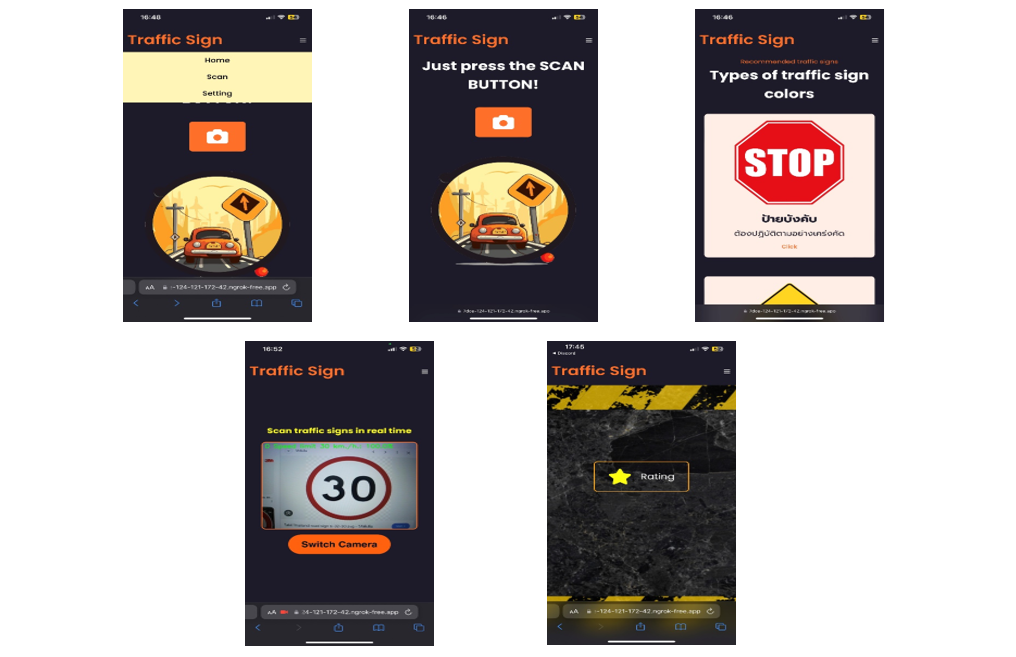
This research aims to develop a model for automatic traffic sign classification using Teachable Machine, a machine learning platform that requires no programming knowledge. The model employs Convolutional Neural Networks, specifically MobileNet architecture, trained using the Adam Optimizer on TensorFlow.js, enabling client-side deployment via a web application. The dataset used consists of 17,440 traffic sign images across 27 classes, compiled from the standard GTSRB dataset and additional photographs taken in Thailand. Data Augmentation techniques, including image rotation, lighting adjustment, noise injection, and perspective transformation, were applied to enhance data diversity and reduce overfitting risk. The model was trained with the following parameters: batch size of 16, 50 training epochs, and a learning rate of 0.001. Model performance was evaluated using standard metrics: Accuracy, Precision, Recall, and F1-Measure, calculated from a 27 × 27 Confusion Matrix. The learning behavior was further analyzed through Accuracy per Epoch and Loss per Epoch graphs. Experimental results indicate that the model achieved high performance, with an average accuracy of 98.93% and an F1-Measure of 98.90%, demonstrating the potential of Teachable Machine in developing accurate models applicable to both educational contexts and intelligent traffic systems.
Downloads
References
Alsiyeu, U., & Duisebekov, Z. (2024). Enhancing Traffic Sign Recognition with Tailored Data Augmentation: Addressing Class Imbalance and Instance Scarcity. arXiv. https://doi.org/10.48550/ARXIV.2406.03576.
Chen, A., Pitaru, A., Webster, B., Alvarado, I., Griffith, J., Phillips, K., Carney, M., & Howell, N. (2020). Teachable Machine: Approachable Web-Based Tool for Exploring Machine Learning Classification. https://research.google/pubs/teachable-machine-approachable-web-based-tool-for-exploring-machine-learning-classification.
Dhawan, K., Srinivasa Perumal, R., & Nadesh, R. K. (2023). Identification of Traffic Signs for Advanced Driving Assistance Systems in Smart Cities Using Deep Learning. Multimedia Tools and Applications, 82, 26465-26480. https://doi.org/10.1007/s11042-023-14823-1.
Dineley, A., Natalia, F., & Sudirman, S. (2024). Data Augmentation for Occlusion-Robust Traffic Sign Recognition Using Deep Learning. ICIC Express Letters, Part B: Applications, 15(4), 381-388. https://doi.org/10.24507/icicelb.15.04.381.
Ge, J. (2023). Traffic Sign Recognition Dataset and Data Augmentation. arXiv. https://doi.org/10.48550/ARXIV.2303.18037.
Google Creative Lab. (2020). Teachable Machine Community Library (Image). GitHub. https://github.com/googlecreativelab/teachablemachine-community/blob/master/libraries/image/src/teachable-mobilenet.ts.
Jantaragate, T. (2024). Deep Convolutional Neural Network for Speed Limit Signs Classification. [Master's dissertation, Srinakharinwirot University]. DSpace at Srinakharinwirot University. http://ir-ithesis.swu.ac.th/dspace/handle/123456789/3127. (In Thai)
Jeong, H. (2020). Feasibility Study of Google’s Teachable Machine in Diagnosis of Tooth-Marked Tongue. Journal of Dental Hygiene Science, 20(4), 206–212. https://doi.org/10.17135/jdhs.2020.20.4.206.
Khunarsa, T., Sahoh, A., & Pubphasomtrakool, P. (2021, June 22). Traffic Signs Detection and Recognition. The 1st Rajamangala University of Technology Suvarnabhumi National Conference, 417-426. Rajamangala University of Technology Suvarnabhumi. (In Thai)
Kingma, D. P., & Ba, J. (2014). Adam: A Method for Stochastic Optimization. arXiv. https://doi.org/10.48550/ARXIV.1412.6980.
Kozhamkulova, Z., Bidakhmet, Z., Vorogushina, M., Tashenova, Z., Tussupova, B., Nurlybaeva, E., & Kambarov, D. (2024). Development of Deep Learning Models for Traffic Sign Recognition in Autonomous Vehicles. International Journal of Advanced Computer Science and Applications, 15(5), 913-920. https://doi.org/10.14569/IJACSA.2024.0150593.
Kurz, T. L., Jayasuriya, S., Swisher, K., Mativo, J., Pidaparti, R., & Robinson, D. T. (2024). The Impact of Teachable Machine on Middle School Teachers’ Perceptions of Science Lessons after Professional Development. Education Sciences, 14(4), 417. https://doi.org/10.3390/educsci14040417.
Stallkamp, J., Schlipsing, M., Salmen, J., & Igel, C. (2011). Dataset. Institut für Neuroinformatik. https://benchmark.ini.rub.de/gtsrb_dataset.html.
Thipsanthia, P. (2021). Improvement of the Performance of Traffic Signs Detection. [Doctoral’s dissertation, Mahasarakham University]. DSpace at Mahasarakham University. http://202.28.34.124/dspace/handle123456789/2162. (In Thai)
Wong, J. J. N., & Fadzly, N. (2022). Development of Species Recognition Models using Google Teachable Machine on Shorebirds and Waterbirds. Journal of Taibah University for Science, 16(1), 1096-1111. https://doi.org/10.1080/16583655.2022.2143627.
Yim, I. H. Y., & Su, J. (2025). Artificial Intelligence (AI) Learning Tools in K-12 Education: A Scoping Review. Journal of Computers in Education, 12(1), 93–131. https://doi.org/10.1007/s40692-023-00304-9.
Zhu, Y., & Yan, W. Q. (2022). Traffic Sign Recognition Based on Deep Learning. Multimedia Tools and Applications, 81(13), 17779–17791. https://doi.org/10.1007/s11042-022-12163-0.
Downloads
Published
How to Cite
Issue
Section
Categories
License
Copyright (c) 2025 Journal of Computer and Creative Technology

This work is licensed under a Creative Commons Attribution-NonCommercial-NoDerivatives 4.0 International License.