
THE EFFECT OF EDUCATIONAL GAME ACTIVITIES ON BASIC COMPUTER SCIENCE LEARNING SKILLS OF PRESCHOOL CHILDREN
Keywords:
Educational game activities, Basic computer science learning skills, Preschool children educationAbstract
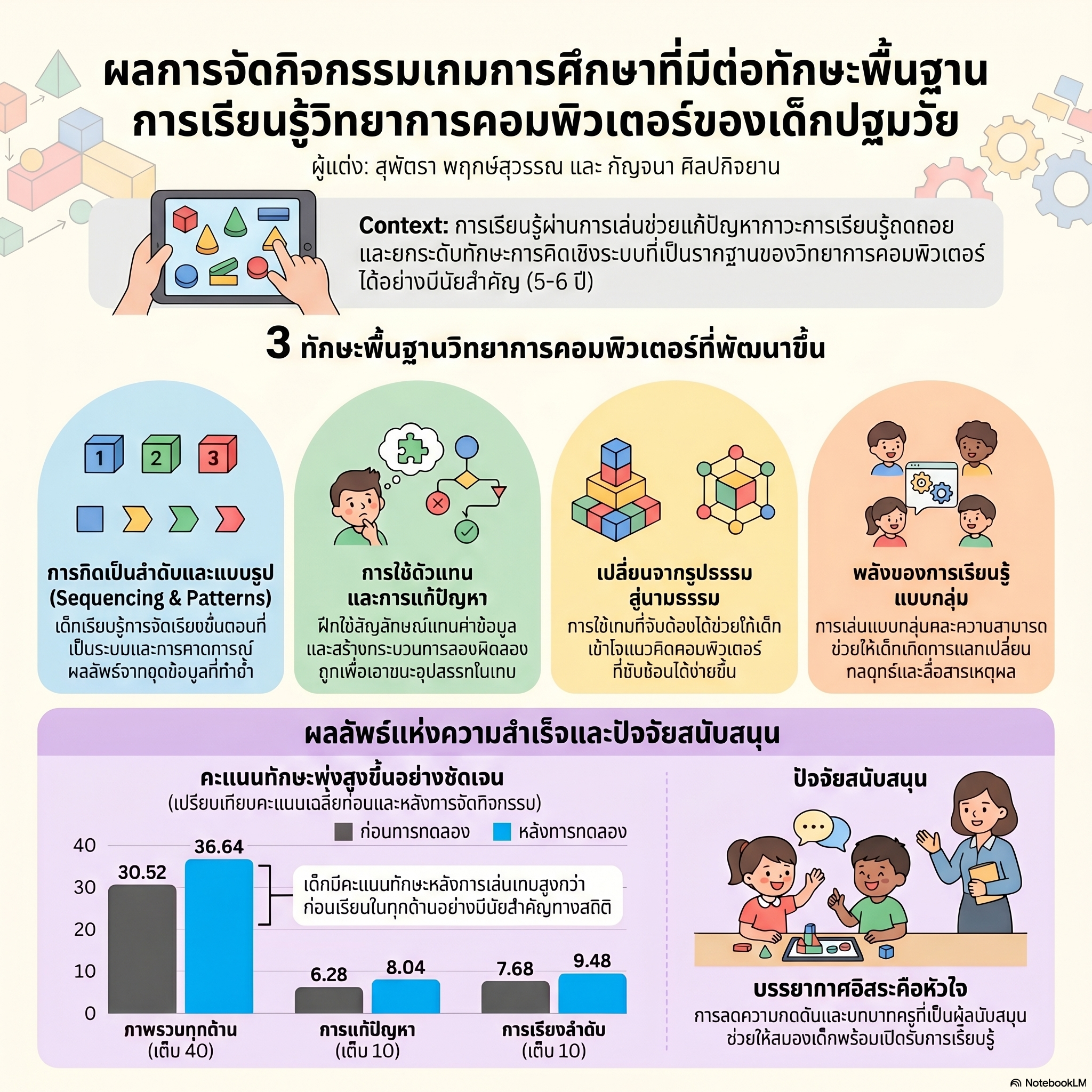
This research aimed to compare the basic computer science learning skills of preschool children before and after educational game activities. The sample consisted of 25 male and female early childhood children aged 5-6 years, who were studying in Kindergarten 3 during the second semester of the 2024 academic year at Chumchon Ban Phop Phra School, Tak Province. Cluster sampling was used to select the sample. The research instruments consisted of 1) a manual for implementing educational game activities, 2) educational games, and 3) a practical assessment form for basic computer science learning skills for preschool children. The statistics used for data analysis were mean, standard deviation, and t-test. The research findings indicated that the early childhood children who participated in the educational game activities had significantly higher basic computer science learning skills when comparing the scores before and after the activities, both overall and in each sub-skill: sequencing, representation, pattern recognition, and problem-solving at the .05 level of statistical significance.
References
กมลวรรณ อังศรีสุรพร. (2561). การจัดกิจกรรมเกมการศึกษา [เอกสารประกอบการอบรม]. เรื่องการจัดประสบการณ์สำหรับเด็กปฐมวัย, มหาวิทยาลัยราชภัฏจันเกษม.
กระทรวงดิจิทัลเพื่อเศรษฐกิจและสังคม. (2562). การส่งเสริมการเรียนรู้เพื่อพัฒนาทักษะด้านโค้ดดิ้งสู่สังคมดิจิทัลในอนาคต. หลักสูตรฝึกอบรมเชิงปฏิบัติการการส่งเสริมการเรียนรู้เพื่อพัฒนาทักษะด้านโค้ดดิ้งสู่สังคมดิจิทัลในอนาคต. ม.ป.ท.
กระทรวงศึกษาธิการ. (2563). การจัดประสบการณ์เรียนรู้วิทยาการคำนวณระดับอนุบาล. หลักสูตรอบรมการจัดประสบการณ์เรียนรู้วิทยาการคำนวณระดับอนุบาล. ม.ป.ท.
ชนิพรรณ จาติเสถียร, กันตวรรณ มีสมสาร และ อภิรดี ไชยกาล. (2560). การพัฒนาเด็กอย่างเป็นองค์รวมวิกฤตปฐมวัยและแนวทางแก้ไข. พลัสเพรส.
ธันวา วัฒนะ, สรวงพร กุศลส่ง และ พิชญาภา ตรีวงษ์. (2565). การพัฒนารูปแบบการจัดกิจกรรมเกมการศึกษาพื้นฐานการบวกเพื่อส่งเสริมทักษะทางคณิตศาสตร์สำหรับเด็กปฐมวัย [วิทยานิพนธ์ปริญญามหาบัณฑิต ไม่ได้ตีพิมพ์]. มหาวิทยาลัยราชภัฏอุดรธานี.
ปิยนันท์ พูลโสภา. (2564). การจัดประสบการณ์เกมการศึกษาแบบมีส่วนร่วมเพื่อส่งเสริมทักษะการแก้ปัญหา ของเด็กปฐมวัยในศูนย์พัฒนาเด็กเล็ก สังกัดกรมส่งเสริมการปกครองท้องถิ่นจังหวัดสุรินทร์. วารสารศึกษาศาสตร์ปริทัศน์, 36(3), 126–136. (หมายเหตุ: เลขหน้าอ้างอิงตามฐานข้อมูลวารสาร)
ปรารถนา หาญเมธี. (2566). ภาวการณ์เรียนรู้ถดถอยในเด็กปฐมวัย. https://ecd-covidrecovery.rlg-ef.com
สถาบันส่งเสริมการสอนวิทยาศาสตร์และเทคโนโลยี. (2561). คู่มือการใช้หลักสูตรรายวิชาพื้นฐานวิทยาศาสตร์ สาระเทคโนโลยี (วิทยาการคำนวณ) ระดับประถมศึกษาและมัธยมศึกษา. กระทรวงศึกษาธิการ.
สถาบันส่งเสริมการสอนวิทยาศาสตร์และเทคโนโลยี. (2563). กรอบการเรียนรู้และแนวทางการจัดประสบการณ์การเรียนรู้บูรณาการวิทยาศาสตร์ เทคโนโลยี และคณิตศาสตร์ ในระดับปฐมวัย ตามหลักสูตรการศึกษาปฐมวัย พุทธศักราช 2560. โกโกพริ้น (ไทยแลนด์).
สำนักงานคณะกรรมการการศึกษาขั้นพื้นฐาน. (2561). คู่มือครูเกมการศึกษาประกอบแผนการจัดประสบการณ์ชั้นอนุบาลปีที่ 3 (5 ขวบ) ภาคเรียนที่ 1 หน่วยที่ 1-8. สำนักบริหารงานการศึกษาภาคบังคับ.
สำนักงานเลขาธิการสภาการศึกษา. (2563ก). รายงานการศึกษาสภาวการณ์การจัดการศึกษาสำหรับเด็กปฐมวัยในประเทศไทย. พริกหวานกราฟฟิค.
สำนักงานเลขาธิการสภาการศึกษา. (2563ข). ถอดบทเรียน กิจกรรมการเรียนการสอน CODING และการสร้างสรรค์นวัตกรรม : การพัฒนาผู้เรียนให้มีคุณลักษณะที่พึงประสงค์ของคนไทย 4.0 ตามมาตรฐานการศึกษาของชาติ. 21 เซ็นจูรี่.
สิรินภา กิจเกื้อกูล. (2565). การจัดการเรียนรู้วิทยาศาสตร์ (พิมพ์ครั้งที่ 2). มหาวิทยาลัยนเรศวร.
หน่วยพัฒนาครูครุศาสตร์ปัญญา. (2564). เอกสารประกอบการอบรมเรื่องสนุกกับเกมการศึกษาเพื่อพัฒนาทักษะการคิดของเด็กปฐมวัย. สถาบันคุรุพัฒนา สำนักงานเลขาธิการคุรุสภา.
Angevine, C. (2017, December 6). Advancing computational thinking across K-12 education. Digital Promise. http://digitalpromise.org/2017/12/06/advancing-computational-thinking-across-k-12-education/
Cojocariu, V. M., & Boghian, I. (2014). Teaching the relevance of game-based learning to preschool and primary teachers. Procedia-Social and Behavioral Sciences, 142, 640–646. https://doi.org/10.1016/j.sbspro.2014.07.679
González-Pérez, L. I., & Ramírez-Montoya, M. S. (2022). Components of Education 4.0 in 21st century skills frameworks: Systematic review. Sustainability, 14(3), Article 1493. https://doi.org/10.3390/su14031493
Loka, N., & Diana, R. R. (2022). Improving cognitive ability through educational games in early childhood. JOYCED: Journal of Early Childhood Education, 2(1), 50–59. https://doi.org/10.14421/joyced.2022.21-05
Lucas, F. M. M. (2017). The game as an early childhood learning resource for intercultural education. Procedia-Social and Behavioral Sciences, 237, 908–913. https://doi.org/10.1016/j.sbspro.2017.02.127
Mohamed, A. M. A., & Shaaban, T. S. K. (2021). The effects of educational games on vocabulary learning of early childhood students with learning disabilities: A systematic review and meta-analysis. International Journal of Linguistics, Literature and Translation, 4(3), 159–167. https://doi.org/10.32996/ijllt.2021.4.3.18
Su, J., & Yang, W. (2023). A systematic review of integrating computational thinking in early childhood education. Computers and Education Open, 4, Article 100122. https://doi.org/10.1016/j.caeo.2023.100122
Downloads
Published
How to Cite
Issue
Section
Categories
License
Copyright (c) 2026 Faculty of Education, Srinakharinwirot university

This work is licensed under a Creative Commons Attribution-NonCommercial-NoDerivatives 4.0 International License.


