
Effects of CUBES Technique Combined with Metacognitive Prompts on Reading, Analytical,and Mathematical Problem-Solving Ability of Grade 6 Students
Keywords:
CUBES Technique, Metacognitive Prompts, Mathematical Problem-Solving Ability, Metacognitive Skills, Fractions, Primary School StudentsAbstract
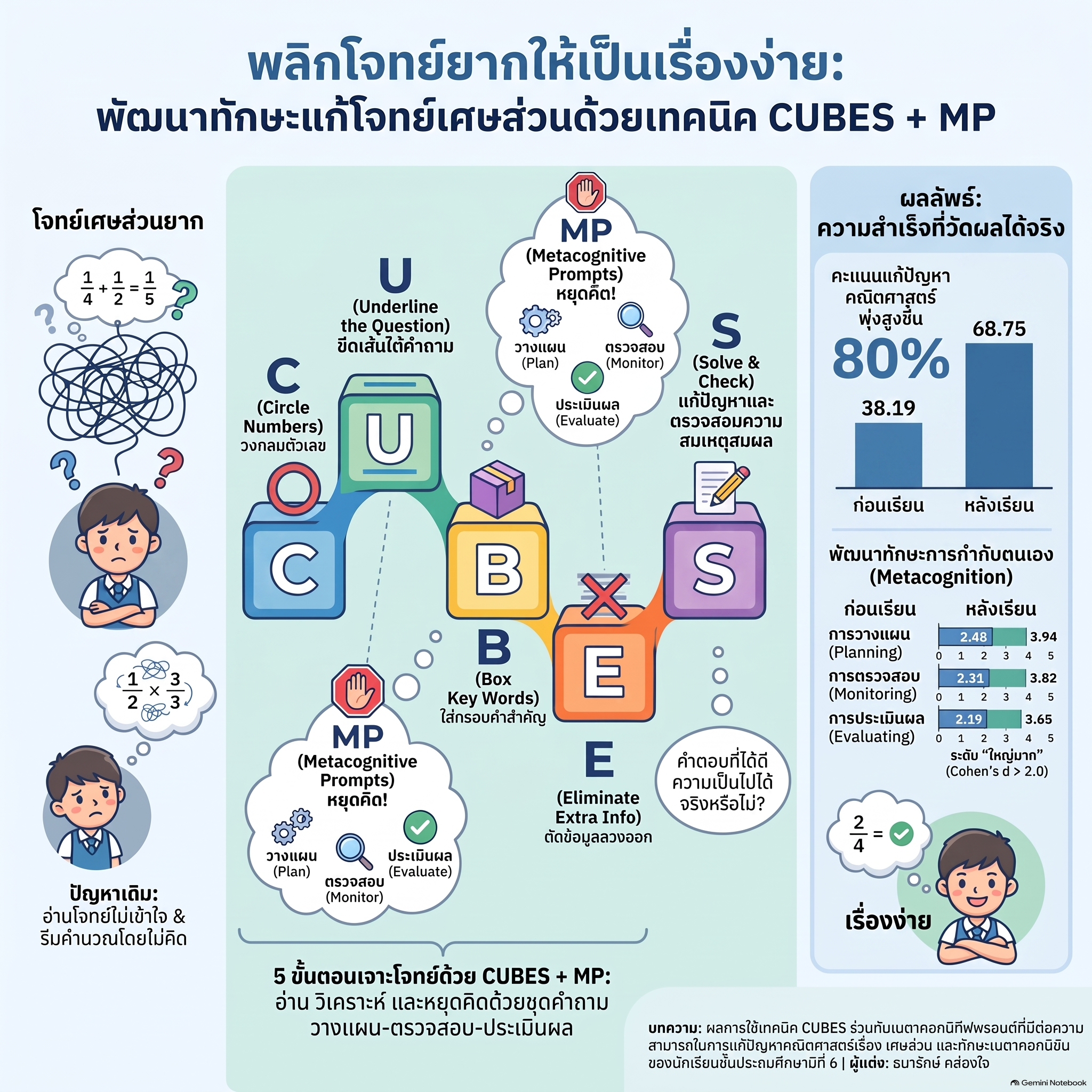
This research aimed to (1) compare the ability to read, analyze, and solve mathematical word problems on fractions of Grade 6 students before and after learning through the CUBES technique combined with Metacognitive Prompts, and (2) compare metacognitive skills in three dimensions: planning, monitoring, and evaluating, before and after instruction. The research employed a quasi-experimental design using a one-group pretest-posttest design. The sample consisted of 16 Grade 6 students in Academic Year 2026 at Ban Han Sai School, Sa Kaeo Primary Educational Service Area Office 2, selected through purposive sampling. The research instruments comprised (1) 12 lesson plans using the CUBES technique combined with Metacognitive Prompts, with a quality mean score of 4.67 and an Index of Item-Objective Congruence (IOC) ranging from 0.67 to 1.00, (2) a mathematical word problem-solving ability test with content validity (IOC) ranging from 0.67 to 1.00, difficulty indices ranging from 0.37 to 0.71, discrimination indices ranging from 0.23 to 0.76, and a reliability coefficient of .84, and (3) a metacognitive skills scale with content validity (IOC) greater than 0.67 for all items, dimensional reliability coefficients ranging from .79 to .84, and an overall reliability coefficient of .81. Data were analyzed using means, standard deviations, and dependent-samples t-tests. The results revealed that: 1) Students' ability to read, analyze, and solve mathematical word problems on fractions after instruction was significantly higher than before instruction at the .05 level. 2) Students' metacognitive skills in all three dimensions—planning, monitoring, and evaluating—after instruction were significantly higher than before instruction at the .05 level.
Keywords: CUBES technique, Metacognitive Prompts
References
กระทรวงศึกษาธิการ. (2560). หลักสูตรแกนกลางการศึกษาขั้นพื้นฐาน พุทธศักราช 2551 (ฉบับปรับปรุง พ.ศ. 2560). โรงพิมพ์ชุมนุมสหกรณ์การเกษตรแห่งประเทศไทย.
สถาบันทดสอบทางการศึกษาแห่งชาติ (องค์การมหาชน). (2568). รายงานผลการทดสอบทางการศึกษาระดับชาติขั้นพื้นฐาน (O-NET) ปีการศึกษา 2568 ชั้นประถมศึกษาปีที่ 6.
สถาบันส่งเสริมการสอนวิทยาศาสตร์และเทคโนโลยี. (2563). คู่มือครูรายวิชาพื้นฐานคณิตศาสตร์ ชั้นประถมศึกษาปีที่ 5-6 (ฉบับปรับปรุง พ.ศ. 2560).
Cohen, J. (1988). Statistical power analysis for the behavioral sciences (2nd ed.). Lawrence Erlbaum Associates.
Education Endowment Foundation. (2018). Metacognition and self-regulated learning: Guidance report. https://educationendowmentfoundation.org.uk/education-evidence/guidance-reports/metacognition
Flavell, J. H. (1979). Metacognition and cognitive monitoring: A new area of cognitive–developmental inquiry. American Psychologist, 34(10), 906–911. https://doi.org/10.1037/0003-066X.34.10.906
Fyfe, E. R., Byers, C., & Nelson, L. J. (2022). The benefits of a metacognitive lesson on children's understanding of mathematical equivalence, arithmetic, and place value. Journal of Educational Psychology, 114(6), 1292–1306. https://doi.org/10.1037/edu0000715
Hardy, A. M., Douglas, G. P., MacLean, K. B., Mason, K. K., & Powell, S. R. (2026). How keywords impact word-problem performance: When 'more' does not mean to add. Learning Disability Quarterly. Advance online publication. https://doi.org/10.1177/07319487251322473
Hattie, J. (2009). Visible learning: A synthesis of over 800 meta-analyses relating to achievement. Routledge.
Hidayat, R., Mohd Saad, M. R. M., & Wewe, M. (2025). A meta-analysis of the effect of metacognitive instruction on mathematics achievement. Cogent Education, 12(1), Article 2517510. https://doi.org/10.1080/2331186X.2025.2517510
Kang, T., Tang, T., Zhang, P., Luo, S., & Qi, H. (2023). Metacognitive prompts and numerical ordinality in solving word problems: An eye-tracking study. British Journal of Educational Psychology, 93(3), 862–877. https://doi.org/10.1111/bjep.12601
Klang, N., Karlsson, N., Kilborn, W., Eriksson, P., & Karlberg, M. (2021). Mathematical problem-solving through cooperative learning—The importance of peer acceptance and friendships. Frontiers in Education, 6, Article 710296. https://doi.org/10.3389/feduc.2021.710296
Mevarech, Z. R., & Kramarski, B. (1997). IMPROVE: A multidimensional method for teaching mathematics in heterogeneous classrooms. American Educational Research Journal, 34(2), 365–394. https://doi.org/10.3102/00028312034002365
Myers, J. A., Witzel, B. S., Powell, S. R., Li, H., Pigott, T. D., Xin, Y. P., & Hughes, E. M. (2022). A meta-analysis of mathematics word-problem solving interventions for elementary students who evidence mathematics difficulties. Review of Educational Research, 92(5), 695–742. https://doi.org/10.3102/00346543211070049
OECD. (2023). PISA 2022 results (Volume I and II): Country notes—Thailand. https://doi.org/10.1787/6138f4af-en
Ozsoy, G. (2011). An investigation of the relationship between metacognition and mathematics achievement. Asia Pacific Education Review, 12(2), 227–235. https://doi.org/10.1007/s12564-010-9129-6
Pearson, P. D., & Gallagher, M. C. (1983). The instruction of reading comprehension. Contemporary Educational Psychology, 8(3), 317–344. https://doi.org/10.1016/0361-476X(83)90019-X
Pólya, G. (1973). How to solve it: A new aspect of mathematical method (2nd ed.). Princeton University Press. (Original work published 1945)
Powell, S. R., Berry, K. A., & Benz, S. A. (2020). Analyzing the word-problem performance and strategies of students experiencing mathematics difficulty. The Journal of Mathematical Behavior, 58, Article 100759. https://doi.org/10.1016/j.jmathb.2020.100759
Powell, S. R., Namkung, J. M., & Lin, X. (2022). An investigation of using keywords to solve word problems. The Elementary School Journal, 122(3), 452–473. https://doi.org/10.1086/717888
Schoenfeld, A. H. (1985). Mathematical problem solving. Academic Press.
Schraw, G., & Dennison, R. S. (1994). Assessing metacognitive awareness. Contemporary Educational Psychology, 19(4), 460–475. https://doi.org/10.1006/ceps.1994.1033
Singh, P., Rahman, A. A., & Hoon, T. S. (2010). The Newman procedure for analyzing Primary Four pupils' errors on written mathematical tasks: A Malaysian perspective. Procedia - Social and Behavioral Sciences, 8, 264–271. https://doi.org/10.1016/j.sbspro.2010.12.036
Teo, L. W. C., & Abdullah, N. A. (2023). Using CUBES strategy in a remote setting for primary mathematics word problems. Jurnal Elemen, 9(1), 132–152. https://doi.org/10.29408/jel.v9i1.6864
Veenman, M. V. J., Wilhelm, P., & Beishuizen, J. J. (2004). The relation between intellectual and metacognitive skills from a developmental perspective. Learning and Instruction, 14(1), 89–109. https://doi.org/10.1016/j.learninstruc.2003.10.004
Xie, Y., Zeng, F., & Yang, Y. (2024). A meta-analysis of the relationship between metacognition and academic achievement in mathematics: From preschool to university. Acta Psychologica, 249, Article 104486. https://doi.org/10.1016/j.actpsy.2024.104486
Zimmerman, B. J. (2002). Becoming a self-regulated learner: An overview. Theory Into Practice, 41(2), 64–70. https://doi.org/10.1207/s15430421tip4102_2
Downloads
Published
How to Cite
Issue
Section
Categories
License
Copyright (c) 2026 Faculty of Education, Srinakharinwirot university

This work is licensed under a Creative Commons Attribution-NonCommercial-NoDerivatives 4.0 International License.


