
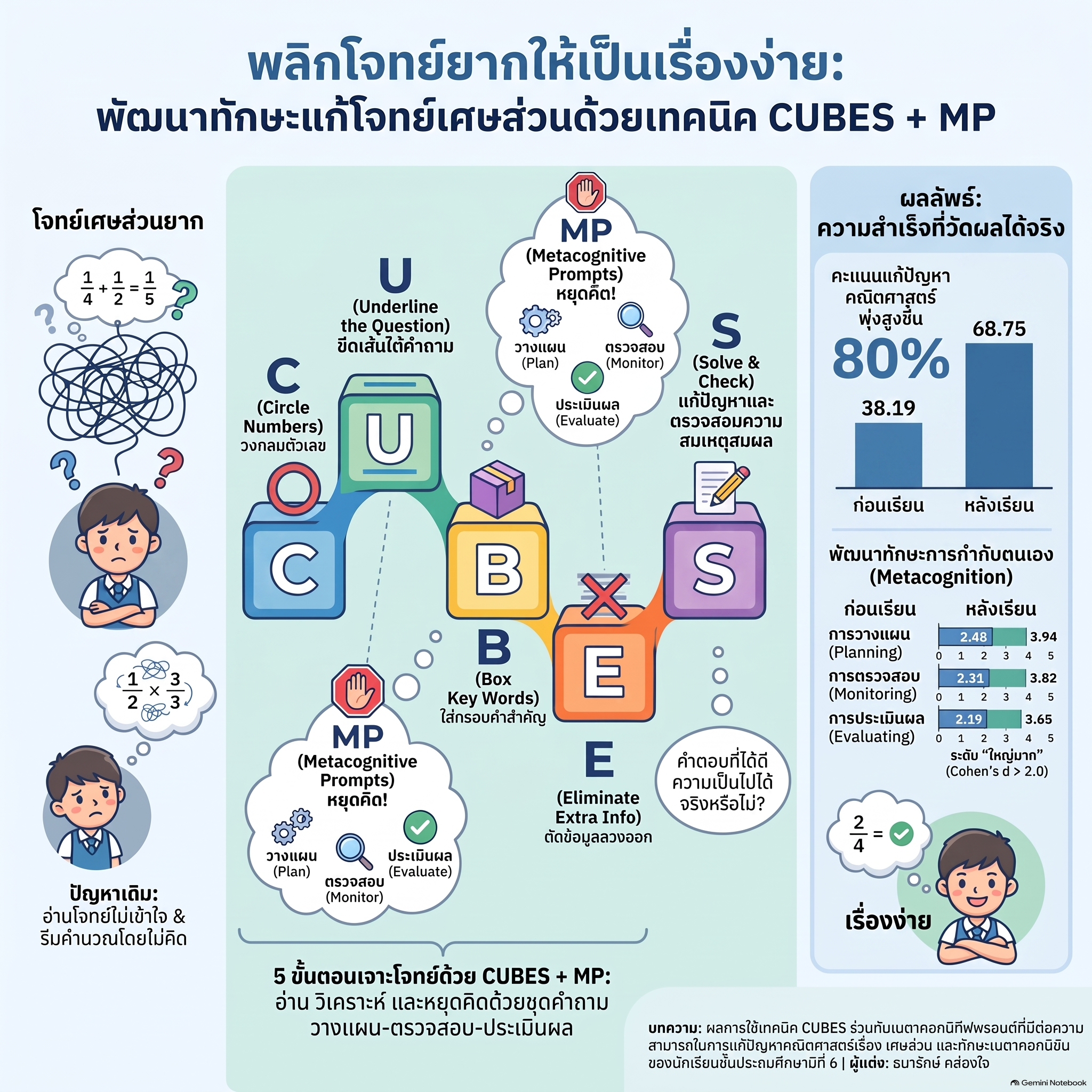
ผลการใช้เทคนิค CUBES ร่วมกับเมตาคอกนิทีฟพรอมต์ ที่มีต่อความสามารถในการอ่าน วิเคราะห์ และแก้โจทย์ปัญหาคณิตศาสตร์ของนักเรียนชั้นประถมศึกษาปีที่ 6
คำสำคัญ:
เทคนิค CUBES, เมตาคอกนิทีฟพรอมต์, ความสามารถในการแก้ปัญหาคณิตศาสตร์, ทักษะเมตาคอกนิชัน, เศษส่วน, นักเรียนประถมศึกษาบทคัดย่อ
การวิจัยครั้งนี้มีวัตถุประสงค์เพื่อ (1) เปรียบเทียบความสามารถในการอ่าน วิเคราะห์ และแก้โจทย์ปัญหาคณิตศาสตร์ เรื่องเศษส่วน ของนักเรียนชั้นประถมศึกษาปีที่ 6 ก่อนและหลังการจัดการเรียนรู้ด้วยเทคนิค CUBES ร่วมกับเมตาคอกนิทีฟพรอมต์ และ (2) เปรียบเทียบทักษะเมตาคอกนิชันทั้ง 3 ด้าน ได้แก่ การวางแผน การตรวจสอบ และการประเมินผล ก่อนและหลังการจัดการเรียนรู้ รูปแบบการวิจัยครั้งนี้เป็นการวิจัยกึ่งทดลอง (Quasi-Experimental Research) ใช้แบบแผนการวิจัยแบบกลุ่มเดียว ทดสอบก่อน-หลังเรียน (One Group Pretest-Posttest Design) กลุ่มตัวอย่างคือนักเรียนชั้นประถมศึกษาปีที่ 6 ปีการศึกษา 2569 โรงเรียนบ้านหันทราย สำนักงานเขตพื้นที่การศึกษาประถมศึกษาสระแก้ว เขต 2 จำนวน 16 คน ได้มาโดยการเลือกแบบเจาะจง เครื่องมือที่ใช้ในการวิจัยประกอบด้วย (1) แผนการจัดการเรียนรู้โดยใช้เทคนิค CUBES ร่วมกับเมตาคอกนิทีฟพรอมต์ จำนวน 12 แผน มีค่าเฉลี่ยคุณภาพความเหมาะสมเท่ากับ 4.67 และ มีค่าดัชนีความสอดคล้อง อยู่ระหว่าง 0.67-1.00 (2) แบบทดสอบวัดความสามารถในการแก้โจทย์ปัญหาคณิตศาสตร์ มีค่าความตรงเชิงเนื้อหา อยู่ระหว่าง 0.67-1.00 ทุกข้อ ค่าความยากง่ายอยู่ระหว่าง 0.37-0.71 ค่าอำนาจจำแนกอยู่ระหว่าง 0.23-0.76 และค่าความเชื่อมั่นทั้งฉบับ เท่ากับ .84 (3) และแบบวัดทักษะเมตาคอกนิทีฟ ค่าความตรงเชิงเนื้อหาโดยมากกว่า 0.67 ทุกข้อ ค่าความเชื่อมั่นรายมิติอยู่ระหว่าง .79-.84 และค่าความเชื่อมั่นภาพรวมทั้งฉบับเท่ากับ .81 วิเคราะห์ข้อมูลด้วยค่าเฉลี่ย ส่วนเบี่ยงเบนมาตรฐาน และการทดสอบค่าที (t-test) แบบ Dependent Samples ผลการวิจัยพบว่า
1) นักเรียนมีความสามารถในการอ่าน วิเคราะห์ และแก้โจทย์ปัญหาคณิตศาสตร์ เรื่องเศษส่วน หลังเรียนสูงกว่าก่อนเรียนอย่างมีนัยสำคัญทางสถิติที่ระดับ .05 2) นักเรียนมีทักษะเมตาคอกนิชันทั้ง 3 ด้าน ได้แก่ การวางแผน การตรวจสอบ และการประเมินผล หลังเรียนสูงกว่าก่อนเรียนอย่างมีนัยสำคัญทางสถิติที่ระดับ .05 ทุกด้าน
คำสำคัญ: เทคนิค CUBES, เมตาคอกนิทีฟพรอมต์
เอกสารอ้างอิง
กระทรวงศึกษาธิการ. (2560). หลักสูตรแกนกลางการศึกษาขั้นพื้นฐาน พุทธศักราช 2551 (ฉบับปรับปรุง พ.ศ. 2560). โรงพิมพ์ชุมนุมสหกรณ์การเกษตรแห่งประเทศไทย.
สถาบันทดสอบทางการศึกษาแห่งชาติ (องค์การมหาชน). (2568). รายงานผลการทดสอบทางการศึกษาระดับชาติขั้นพื้นฐาน (O-NET) ปีการศึกษา 2568 ชั้นประถมศึกษาปีที่ 6.
สถาบันส่งเสริมการสอนวิทยาศาสตร์และเทคโนโลยี. (2563). คู่มือครูรายวิชาพื้นฐานคณิตศาสตร์ ชั้นประถมศึกษาปีที่ 5-6 (ฉบับปรับปรุง พ.ศ. 2560).
Cohen, J. (1988). Statistical power analysis for the behavioral sciences (2nd ed.). Lawrence Erlbaum Associates.
Education Endowment Foundation. (2018). Metacognition and self-regulated learning: Guidance report. https://educationendowmentfoundation.org.uk/education-evidence/guidance-reports/metacognition
Flavell, J. H. (1979). Metacognition and cognitive monitoring: A new area of cognitive–developmental inquiry. American Psychologist, 34(10), 906–911. https://doi.org/10.1037/0003-066X.34.10.906
Fyfe, E. R., Byers, C., & Nelson, L. J. (2022). The benefits of a metacognitive lesson on children's understanding of mathematical equivalence, arithmetic, and place value. Journal of Educational Psychology, 114(6), 1292–1306. https://doi.org/10.1037/edu0000715
Hardy, A. M., Douglas, G. P., MacLean, K. B., Mason, K. K., & Powell, S. R. (2026). How keywords impact word-problem performance: When 'more' does not mean to add. Learning Disability Quarterly. Advance online publication. https://doi.org/10.1177/07319487251322473
Hattie, J. (2009). Visible learning: A synthesis of over 800 meta-analyses relating to achievement. Routledge.
Hidayat, R., Mohd Saad, M. R. M., & Wewe, M. (2025). A meta-analysis of the effect of metacognitive instruction on mathematics achievement. Cogent Education, 12(1), Article 2517510. https://doi.org/10.1080/2331186X.2025.2517510
Kang, T., Tang, T., Zhang, P., Luo, S., & Qi, H. (2023). Metacognitive prompts and numerical ordinality in solving word problems: An eye-tracking study. British Journal of Educational Psychology, 93(3), 862–877. https://doi.org/10.1111/bjep.12601
Klang, N., Karlsson, N., Kilborn, W., Eriksson, P., & Karlberg, M. (2021). Mathematical problem-solving through cooperative learning—The importance of peer acceptance and friendships. Frontiers in Education, 6, Article 710296. https://doi.org/10.3389/feduc.2021.710296
Mevarech, Z. R., & Kramarski, B. (1997). IMPROVE: A multidimensional method for teaching mathematics in heterogeneous classrooms. American Educational Research Journal, 34(2), 365–394. https://doi.org/10.3102/00028312034002365
Myers, J. A., Witzel, B. S., Powell, S. R., Li, H., Pigott, T. D., Xin, Y. P., & Hughes, E. M. (2022). A meta-analysis of mathematics word-problem solving interventions for elementary students who evidence mathematics difficulties. Review of Educational Research, 92(5), 695–742. https://doi.org/10.3102/00346543211070049
OECD. (2023). PISA 2022 results (Volume I and II): Country notes—Thailand. https://doi.org/10.1787/6138f4af-en
Ozsoy, G. (2011). An investigation of the relationship between metacognition and mathematics achievement. Asia Pacific Education Review, 12(2), 227–235. https://doi.org/10.1007/s12564-010-9129-6
Pearson, P. D., & Gallagher, M. C. (1983). The instruction of reading comprehension. Contemporary Educational Psychology, 8(3), 317–344. https://doi.org/10.1016/0361-476X(83)90019-X
Pólya, G. (1973). How to solve it: A new aspect of mathematical method (2nd ed.). Princeton University Press. (Original work published 1945)
Powell, S. R., Berry, K. A., & Benz, S. A. (2020). Analyzing the word-problem performance and strategies of students experiencing mathematics difficulty. The Journal of Mathematical Behavior, 58, Article 100759. https://doi.org/10.1016/j.jmathb.2020.100759
Powell, S. R., Namkung, J. M., & Lin, X. (2022). An investigation of using keywords to solve word problems. The Elementary School Journal, 122(3), 452–473. https://doi.org/10.1086/717888
Schoenfeld, A. H. (1985). Mathematical problem solving. Academic Press.
Schraw, G., & Dennison, R. S. (1994). Assessing metacognitive awareness. Contemporary Educational Psychology, 19(4), 460–475. https://doi.org/10.1006/ceps.1994.1033
Singh, P., Rahman, A. A., & Hoon, T. S. (2010). The Newman procedure for analyzing Primary Four pupils' errors on written mathematical tasks: A Malaysian perspective. Procedia - Social and Behavioral Sciences, 8, 264–271. https://doi.org/10.1016/j.sbspro.2010.12.036
Teo, L. W. C., & Abdullah, N. A. (2023). Using CUBES strategy in a remote setting for primary mathematics word problems. Jurnal Elemen, 9(1), 132–152. https://doi.org/10.29408/jel.v9i1.6864
Veenman, M. V. J., Wilhelm, P., & Beishuizen, J. J. (2004). The relation between intellectual and metacognitive skills from a developmental perspective. Learning and Instruction, 14(1), 89–109. https://doi.org/10.1016/j.learninstruc.2003.10.004
Xie, Y., Zeng, F., & Yang, Y. (2024). A meta-analysis of the relationship between metacognition and academic achievement in mathematics: From preschool to university. Acta Psychologica, 249, Article 104486. https://doi.org/10.1016/j.actpsy.2024.104486
Zimmerman, B. J. (2002). Becoming a self-regulated learner: An overview. Theory Into Practice, 41(2), 64–70. https://doi.org/10.1207/s15430421tip4102_2
ดาวน์โหลด
เผยแพร่แล้ว
รูปแบบการอ้างอิง
ฉบับ
ประเภทบทความ
หมวดหมู่
สัญญาอนุญาต
ลิขสิทธิ์ (c) 2026 คณะศึกษาศาสตร์ มหาวิทยาลัยศรีนครินทรวิโรฒ

อนุญาตภายใต้เงื่อนไข Creative Commons Attribution-NonCommercial-NoDerivatives 4.0 International License.


