THE STUDY OF FACTORS AFFECTING THE ADJUSTMENT OF FIRST YEAR UNDERGRADUATE STUDENTS AT FACULTY EDUCATION SRINAKHARINWIROT UNIVERSITY
Keywords:
Adjustment, Undergraduate Students, Influential FactorsAbstract
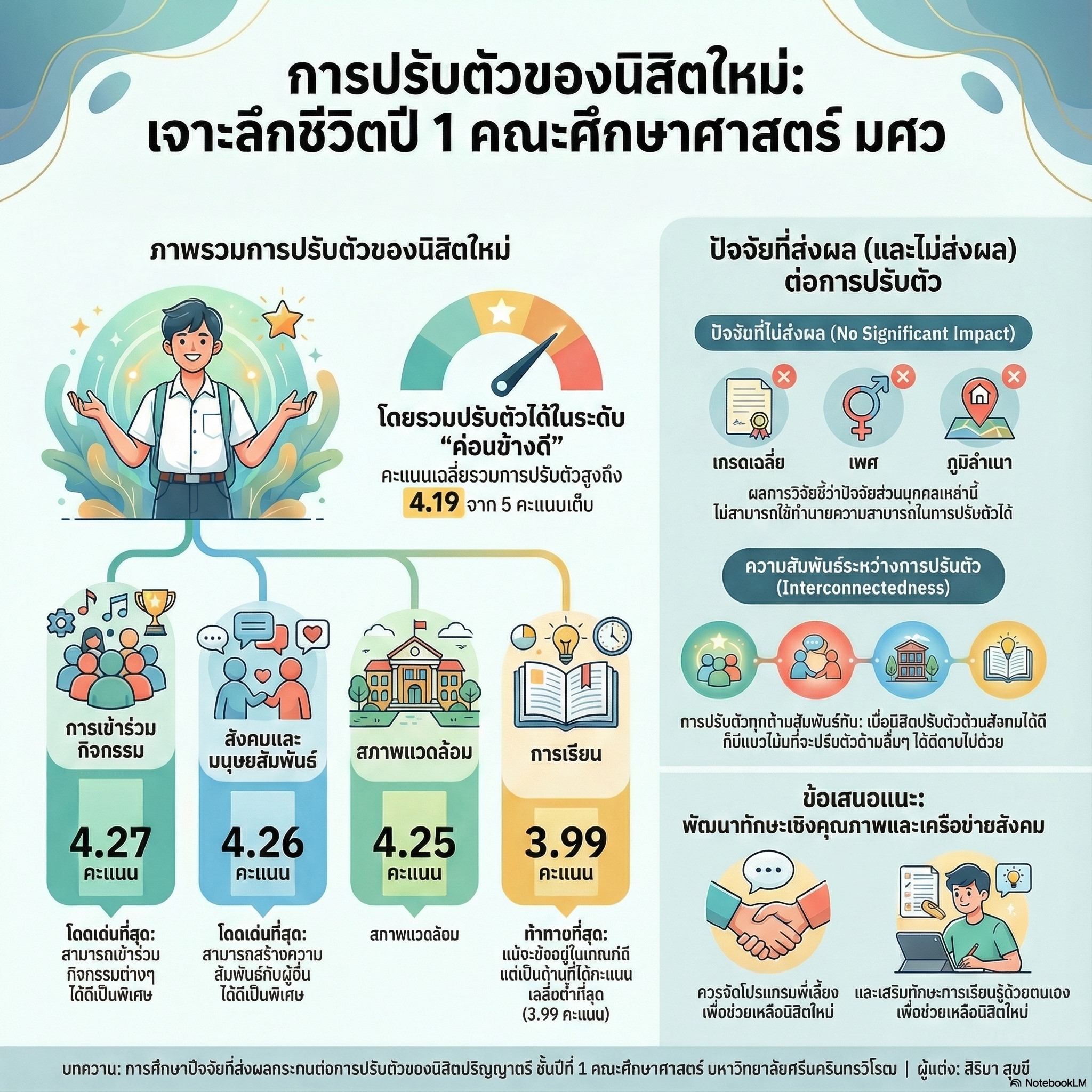
This research aimed to: 1) investigate adjustment problems, and 2) analyze factors influencing the adjustment of first-year undergraduate students. The research instrument was a 5-point Likert scale questionnaire consisting of 40 items, structured into four dimensions: Academic, Social and Human Relations, Environment, and Activity Participation. The sample comprised 181 first-year students from the Faculty of Education, Srinakharinwirot University, representing various majors, including Elementary Education, Industrial Education, Educational Technology, Psychology and Guidance, Educational Measurement, Evaluation and Research, Special Education, Lifelong Education, and Community Development Education. The participants included 41 males and 140 females, selected through voluntary sampling. Data were analyzed using Cronbach’s alpha coefficient, Pearson’s correlation, t-test, and One-way ANOVA. The findings revealed that the overall average score for student adjustment was at a relatively high level (M = 4.198, SD = 0.500), with slight variance across dimensions. The interpersonal relationships dimension showed the highest average score (M = 4.268). All four dimensions demonstrated high internal consistency (Cronbach’s α between .907–.947). Correlation analysis indicated significant positive relationships between all dimensions (r = .626 to .897). Regarding gender differences, the t-test showed no statistically significant difference in adjustment (t = -1.166, p = .249). Furthermore, multiple regression analysis indicated that prior and current grade point averages (GPA), gender, and hometown were not significant predictors of the total adaptation score (p > .05). These results suggest development guidelines, including the enhancement of self-directed learning skills, the establishment of positive social networking programs, and the implementation of holistic support systems for first-year students.
References
จุฑามาศ พงศ์พิทยาภรณ์. (2566). ความฉลาดทางอารมณ์และการสนับสนุนทางสังคมที่มีอิทธิพลต่อการปรับตัวของนิสิตมหาวิทยาลัย. วารสารวิจัยและพัฒนามหาวิทยาลัยราชภัฏนครปฐม, 13(1), 101–115.
ฐิระ ทองเหลือ. (2549). น้องใหม่กับการปรับตัว. วารสารแม่โจ้ปริทัศน์, 7(4), 67–70.
นิรมล สุวรรณโคตร. (2553). การปรับตัวของนิสิตระดับปริญญาตรี ชั้นปีที่ 1 มหาวิทยาลัยนเรศวร (ปริญญานิพนธ์การศึกษามหาบัณฑิต สาขาการอุดมศึกษา). มหาวิทยาลัยศรีนครินทรวิโรฒ.
พรรณี ชูจิตร. (2562). การปรับตัวของนักศึกษามหาวิทยาลัยในช่วงเปลี่ยนผ่านจากระดับมัธยมศึกษา. วารสารครุศาสตร์ มหาวิทยาลัยราชภัฏบ้านสมเด็จเจ้าพระยา, 19(2), 45–59.
ปวีณา ไชยชมพู. (2549). ปัจจัยที่มีผลต่อการปรับตัวของนักศึกษา มหาวิทยาลัยราชธานี วิทยาเขตอุดรธานี (ปริญญานิพนธ์ กศ.ม. สาขาจิตวิทยาการศึกษา). มหาวิทยาลัยขอนแก่น.
ราตรี พงษ์สุวรรณ. (2540). การศึกษาปัญหาการปรับตัวด้านการเรียนของนักศึกษาชั้นปีที่ 1 มหาวิทยาลัยรามคำแหง (ปริญญานิพนธ์ กศ.ม. สาขาจิตวิทยาการแนะแนว). มหาวิทยาลัยศรีนครินทรวิโรฒ.
รุ่ม วิริยะพงษ์. (2542). การศึกษาการปรับตัวของนิสิตระดับปริญญาตรี ชั้นปีที่ 1 จุฬาลงกรณ์มหาวิทยาลัย (วิทยานิพนธ์). จุฬาลงกรณ์มหาวิทยาลัย.
ศิริพร แสงสว่าง. (2564). ปัจจัยที่ส่งผลต่อการปรับตัวของนักศึกษาชั้นปีที่ 1 ในสถาบันอุดมศึกษาไทย. วารสารจิตวิทยาและพฤติกรรมศาสตร์, 11(1), 23–37.
ศุภลักษณ์ เงินบารุง. (2546). ปัจจัยบางประการที่เกี่ยวข้องกับการปรับตัวของนักศึกษาพยาบาลมหาวิทยาลัยศรีนครินทรวิโรฒ องครักษ์ (ปริญญานิพนธ์ กศ.ม. สาขาจิตวิทยาพัฒนาการ). มหาวิทยาลัยศรีนครินทรวิโรฒ.
สุมาลี สุวรรณภักดี. (2541). ปัจจัยที่เกี่ยวข้องกับการปรับตัวของนักศึกษาพยาบาลในเขตภาคใต้สังกัดกระทรวงสาธารณสุข (ปริญญานิพนธ์ กศ.ม. สาขาการอุดมศึกษา). มหาวิทยาลัยศรีนครินทรวิโรฒ.
สำรวย ประโพธิ์ศรี. (2544). ตัวแปรที่เกี่ยวข้องกับการปรับตัวด้านการเรียนในระบบไตรภาคของนักศึกษามหาวิทยาลัยเทคโนโลยีสุรนารี (ปริญญานิพนธ์ กศ.ม. สาขาจิตวิทยาการศึกษา). มหาวิทยาลัยศรีนครินทรวิโรฒ.
วัณยรัตน์ คุณาพันธ์. (2561). การศึกษากระบวนการปรับตัวที่มีประสิทธิผลสำหรับนักศึกษาในสถาบันอุดมศึกษาเอกชน (ดุษฎีนิพนธ์). มหาวิทยาลัยบูรพา.
Astin, A. W. (1999). Student involvement: A developmental theory for higher education. Journal of College Student Development, 40(5), 518–529.
Avcı, D. (2024). A qualitative study to determine the needs of first-year students. EduRe Journal.
Baker, R. W., & Siryk, B. (1999). Student adaptation to college questionnaire (SACQ): Manual. Los Angeles, CA: Western Psychological Services. (Original work published 1989)
Collie, R. J., & Martin, A. J. (2020). Adaptability and the 5Cs of academic resilience and buoyancy: Going beyond genetics. Learning and Individual Differences, 77, 101815. https://doi.org/10.1016/j.lindif.2019.101815
Credé, M., & Niehorster, S. (2012). Academic adjustment to college: A meta-analytic review of its predictors and its association with degree attainment. Educational Psychology Review, 24, 133–165. https://doi.org/10.1007/s10648-011-9184-5
Demirel, C. (2024). The effect of Roy’s adaptation model-based education. PubMed.
Gray, R. (2013a). Examining social adjustment to college in the age of social media. Computers & Education, 68, 193–203.
Gray, R. (2013b). The transition to university: Factors that influence the experience of first-year students. University of Huddersfield.
Homklin, T. (2024). The moderated-mediating roles of motivation on college adaptation. International Journal of Behavioral Science.
Hosseini, S. (2022). Application of Roy’s adaptation model in nursing practice and research: A systematic review. International Journal of Nursing Studies Advances, 4, 100062.
López, M. J. (2023). Academic performance and adjustment of first-generation students. Cogent Social Sciences.
Misra, R., & Castillo, L. G. (2004). Academic stress among college students: Comparison of American and international students. International Journal of Stress Management, 11(2), 132–148.
Pather, S., Norodien-Fataar, N., Cupido, X., & Mkonto, N. (2020). First year students' transition to university: A case study of the orientation program. South African Journal of Higher Education, 34(2), 242–261.
Purnamasari, H. (2022). Systematic review: College adjustment. Buletin Psikologi, Universitas Gadjah Mada.
Quidley-Rodriguez, N. (2022). Creating effective post-pandemic psychiatric nursing education based on Roy’s model. SAGE Journals.
Roy, C. (1976). Adaptation model. In Foundational theories of nursing.
Roy, C., & Andrews, H. A. (1999). The Roy adaptation model (2nd ed.). Stamford, CT: Appleton & Lange.
Salovey, P., & Mayer, J. D. (1990). Emotional intelligence. Imagination, Cognition and Personality, 9(3), 185–211.
Siripongpan, A., Phattaramarut, K., Namvichaisirikul, N., Poochaya, S., & Horkaew, P. (2022). Prevalence of depression and stress among the first year students in Suranaree University of Technology, Thailand. Health Psychology Research, 10(3), 35464. https://doi.org/10.52965/001c.35464
Tinto, V. (1993). Leaving college: Rethinking the causes and cures of student attrition (2nd ed.). Chicago, IL: University of Chicago Press.
Tinto, V. (2012). Completing college: Rethinking institutional action. Chicago, IL: University of Chicago Press.
Wang, K. T., Wei, M., & Chen, H. (2013). Social support and college adjustment: A person-centered approach. The Counseling Psychologist, 41(7), 1013–1040.
Downloads
Published
How to Cite
Issue
Section
Categories
License
Copyright (c) 2025 Faculty of Education, Srinakharinwirot university

This work is licensed under a Creative Commons Attribution-NonCommercial-NoDerivatives 4.0 International License.


