
THE EFFECTS OF USING GAMIFIED DIGITAL CLASSROOM TO ENHANCE PHOTOGRAPHY SKILLS OF PRATHOM SUEKSA SIX STUDENTS
Keywords:
Digital Classroom, Gamification, Photography SkillsAbstract
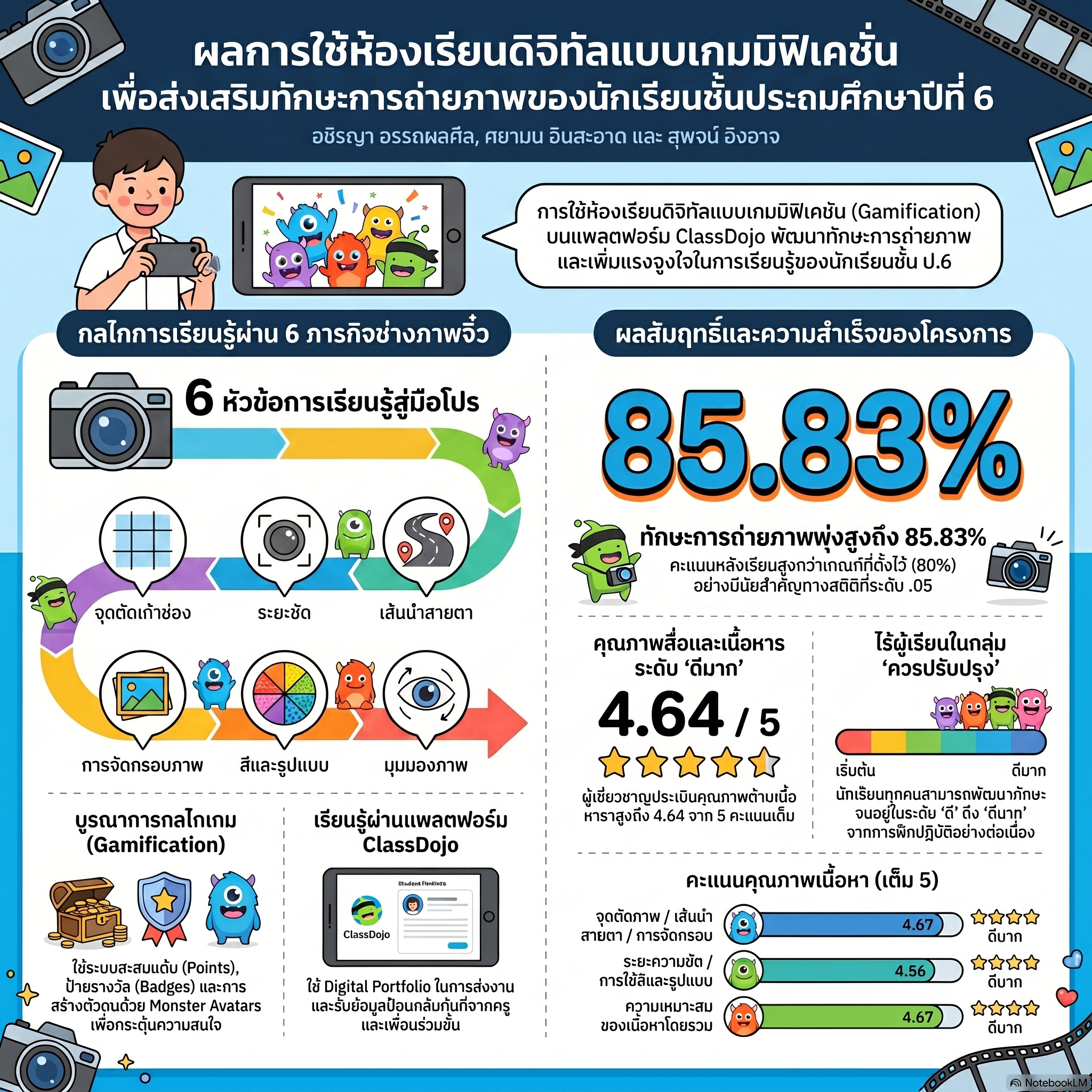
In this thesis, the researcher develops (1) a gamified digital classroom to enhance the photography skills of Prathom Sueksa Six students; and compares (2) the photography skills after the study with the criteria of 80 percent using a gamified digital classroom. The sample population consisted of thirty Prathom Sueksa Six students at Ramkhamhaeng University Demonstration School (Elementary Level) in the second semester of the academic year 2025 using the technique of simple random sampling by drawing lots. The research instruments consisted of the following: (1) a gamified digital classroom; (2) a digital classroom quality assessment; and (3) a photography skill assessment. The statistics used in data analysis were mean (M), standard deviation (S.D.), and one-sample t-test. Findings are as follows. (1) The developed gamified digital classroom exhibited the quality overall at a good level (M = 4.42, S.D. = 0.66) and the photography contents were at a very good level (M = 4.64, S.D. = 0.56). The comparison of the photography skills after the study with a gamified digital classroom found that the photography skills after the study were at 85.83 percent, higher than the criteria of 80 percent at the statistically significant level of .05.
References
กัลยา วงศ์คำจันทร์, ศิริพร ทิพย์คง, และพิมพ์ใจ ศรีสว่าง. (2567). การจัดการเรียนรู้โดยใช้เกมเป็นฐานร่วมกับแนวคิดเกมมิฟิเคชันเพื่อเสริมสร้างแรงจูงใจใฝ่สัมฤทธิ์และยกระดับผลสัมฤทธิ์ทางการเรียนรายวิชาวิทยาศาสตร์ของนักเรียนระดับชั้นประถมศึกษาปีที่ 4. วารสารศึกษาศาสตร์ มหาวิทยาลัยรามคำแหง, 19(2), 45-62.
เกษกานดา สุรรัตน์, และอังคณา อ่อนธานี. (2566). การพัฒนากิจกรรมการเรียนรู้โดยใช้เกมมิฟิเคชันแบบออนไลน์ เพื่อเสริมสร้างความสามารถในการแก้ปัญหาทางคณิตศาสตร์ และแรงจูงใจในการเรียน สำหรับนักเรียนชั้นมัธยมศึกษาปีที่ 4. Journal of Roi Kaensarn Academi, 8(10), 509–533. https://so02.tci-thaijo.org/index.php/JRKSA/article/view/263043
ชนัตถ์ พูนเดช, และธนิตา เลิศพรกุลรัตน์. (2563). การศึกษานวัตกรรมการเรียนรู้ด้วยแนวคิดเกมมิฟิเคชัน. วารสารศึกษาศาสตร์ มหาวิทยาลัยนเรศวร, 22(2), 84-97.
โรงเรียนสาธิตมหาวิทยาลัยรามคำแหง (ฝ่ายประถม). (2561). รายงานประจำปี 2561 โรงเรียนสาธิตมหาวิทยาลัยรามคำแหง (ฝ่ายประถม). โรงเรียนสาธิตมหาวิทยาลัยรามคำแหง (ฝ่ายประถม).
สุรพล บุญลือ. (2560). การใช้ Application ClassDojo สำหรับการบริหารจัดการห้องเรียนในศตวรรษที่ 21. https://apdi.kbu.ac.th/Research%20database/APDI%20km/1Classdojo.pdf
Antin, J., & Churchill, E. F. (2011). Badges in social media: A social psychological perspective. In Proceedings of the CHI 2011 Gamification Workshop (pp. 1–4). ACM.
Ausubel, D. P. (1968). Educational psychology: A cognitive view. Holt, Rinehart and Winston.
Bruner, J. S. (1966). Toward a theory of instruction. Harvard University Press.
Castner, L. (2012). The art of seeing: Visual literacy through photography education. Journal of Visual Literacy, 31(1), 61-78.
Csikszentmihalyi, M. (1990). Flow: The psychology of optimal experience. Harper & Row.
Decker, A., & Bauer, M. (2018). When did we stop worrying and love gamification? The effects of a gamified classroom. Journal of Computing Sciences in Colleges, 33(6), 36-46.
Deterding, S., Dixon, D., Khaled, R., & Nacke, L. (2011). From game design elements to gamefulness: Defining gamification. In Proceedings of the 15th International Academic MindTrek Conference (pp. 9-15). ACM.
Domínguez, A., Saenz-de-Navarrete, J., de-Marcos, L., Fernández-Sanz, L., Pagés, C., & Martínez-Herráiz, J. J. (2013). Gamifying learning experiences: Practical implications and outcomes. Computers & Education, 63, 380-392.
Freeman, M. (2007). The photographer's eye: Composition and design for better digital photos. Focal Press.
Hamari, J., Koivisto, J., & Sarsa, H. (2014). Does gamification work? A literature review of empirical studies on gamification. In Proceedings of the 47th Hawaii International Conference on System Sciences (pp. 3025-3034). IEEE.
Hattie, J., & Timperley, H. (2007). The power of feedback. Review of Educational Research, 77(1), 81-112. https://doi.org/10.3102/003465430298487
Kapp, K. M. (2012). The gamification of learning and instruction: Game-based methods and strategies for training and education. Pfeiffer.
Likert, R. (1932). A technique for the measurement of attitudes. Archives of Psychology, 22(140), 1-55.
Mayer, R. E. (2009). Multimedia learning (2nd ed.). Cambridge University Press.
Nagel, D. (2013). Most students to learn in digital classrooms by 2020. T.H.E. Journal.
Nicholson, S. (2012). A user-centered theoretical framework for meaningful gamification. In Proceedings of Games+Learning+Society 8.0 (pp. 223-230). ETC Press.
Peterson, B. (2015). Understanding composition: The expanded guide. Amphoto Books.
Picciano, A. G. (2017). Theories and frameworks for online education: Seeking an integrated model. Online Learning, 21(3), 166-190.
Piaget, J. (1970). Science of education and the psychology of the child. Orion Press.
Präkel, D. (2010). Basics photography: Composition. AVA Publishing.
Sahin, A., & Arslan, M. (2019). The effects of ClassDojo application on primary school students' academic achievement and attitudes. Cypriot Journal of Educational Sciences, 14(4), 620-631.
Sailer, M., Hense, J. U., Mayr, S. K., & Mandl, H. (2017). How gamification motivates: An experimental study of the effects of specific game design elements on psychological need satisfaction. Computers in Human Behavior, 69, 371-380. https://doi.org/10.1016/j.chb.2016.12.033
Schiller, J. (2000). Taking photos: A meaningful activity for young children. Early Childhood Education Journal, 28(1), 49-55.
Siddiqui, N. (2021). ClassDojo as a classroom management tool: Implications for student behavior and engagement. Journal of Educational Technology Systems, 49(4), 439-455.
Suh, A., Wagner, C., & Liu, L. (2018). Enhancing user engagement through gamification: The role of time constraints. Journal of Computer Information Systems, 58(3), 204-213.
UNESCO. (2011). Global media and information literacy assessment framework: Country readiness and competencies. UNESCO Publishing.
Werbach, K., & Hunter, D. (2012). For the win: How game thinking can revolutionize your business. Wharton Digital Press.
Wright, C. (2011). Photography: A window on the world. Journal of Visual Communication, 10(2), 12-25.
Downloads
Published
How to Cite
Issue
Section
Categories
License
Copyright (c) 2026 Faculty of Education, Srinakharinwirot university

This work is licensed under a Creative Commons Attribution-NonCommercial-NoDerivatives 4.0 International License.


