STUDENTS’ SATISFACTION AND ATTITUDES TOWARD TEACHING AND LEARNING MANAGEMENT IN A FUNDAMENTALS PROFESSIONAL COURSE: A CASE STUDY OF THE BASIC OF THAI MASSAGE COURSE
Keywords:
Satisfaction and attitudes, Teaching and learning management, Fundamentals professional courseAbstract
This quantitative survey study aimed to explore students’ satisfaction and attitudes toward teaching and learning management in a foundational professional course.
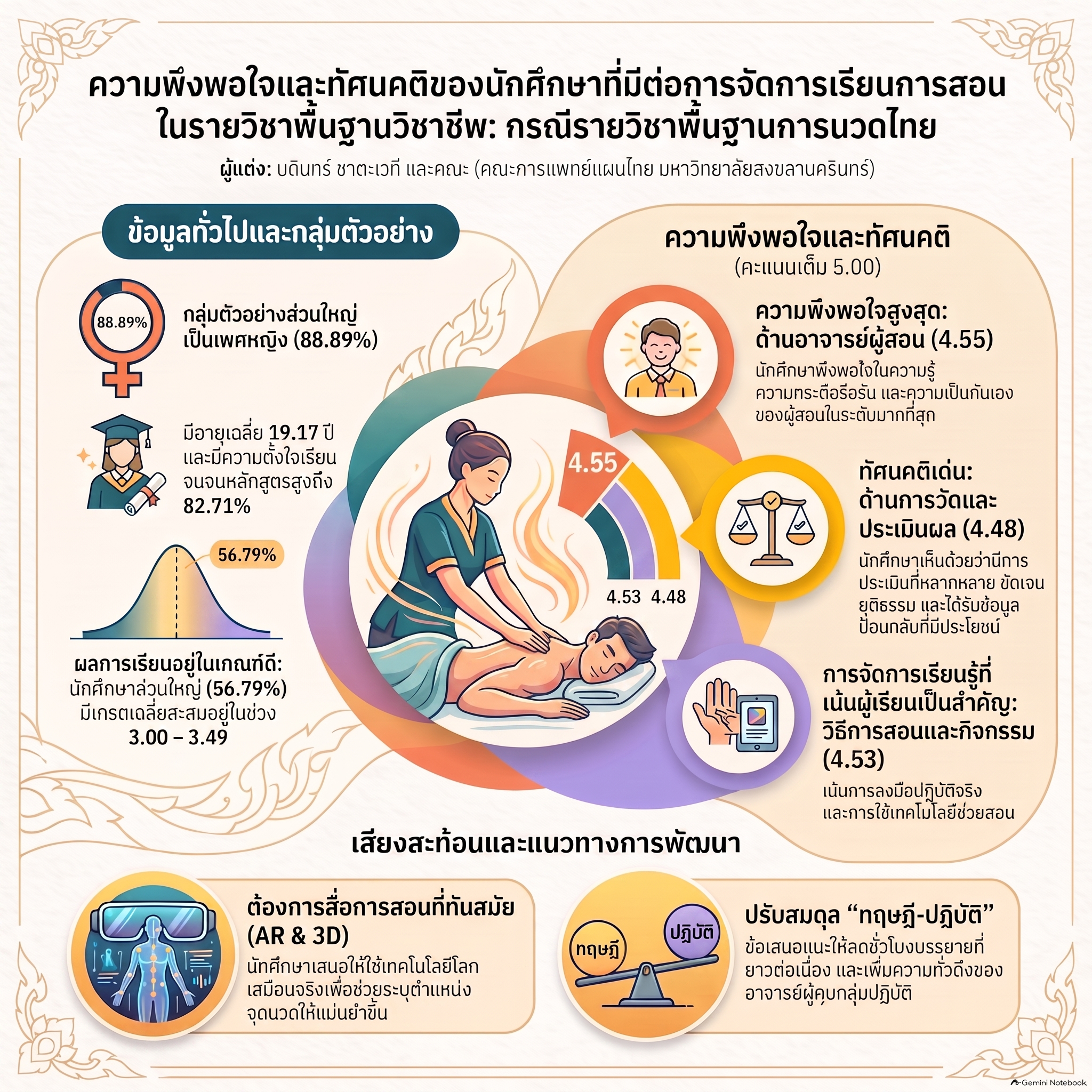
The participants were 81 first-year students enrolled in the Fundamentals of Thai massage course. Data was collected using a structured questionnaire consisting of 4 sections: demographic characteristics, satisfaction, attitudes and recommendations. Descriptive statistics including frequency, percentage, mean and standard deviation were employed for data analysis. The findings showed that most respondents were female (88.89%) with an average age of 19.17 years. The majority expressed an intention to complete the program (82.71%), and most had a GPA ranging from 3.00 to 3.49 (56.79%). Overall satisfaction with teaching and learning management was at the highest level. Among the dimensions, the highest satisfaction was reported for instructors and practical supervisors (𝑥̄ = 4.55±0.61), followed by teaching methods and learning activities (𝑥̄ = 4.53±0.59), assessment and evaluation (𝑥̄ = 4.51±0.63), supporting factors (𝑥̄ = 4.51±0.62), and course content (𝑥̄ = 4.46±0.63). In terms of attitudes, the overall level was positive, at the agree level. The highest mean score was observed in assessment and evaluation (𝑥̄ = 4.48±0.61), followed by teaching methods and learning activities (𝑥̄ = 4.45±0.60), supporting factors (𝑥̄ = 4.43±0.60), course content (𝑥̄ = 4.36±0.60), and instructors and practical supervisors (𝑥̄ = 4.28±0.68). In conclusion, students demonstrated the highest level of satisfaction and positive attitudes toward teaching and learning management, highlighting the effectiveness of the instructional design, particularly in terms of teaching practices and learning activities.
References
กมล โพธิเย็น. (2564). Active Learning: การจัดการเรียนรู้ที่ตอบโจทย์การจัดการศึกษาในศตวรรษที่ 21. วารสารศึกษาศาสตร์ มหาวิทยาลัยศิลปากร, 19(1), 11-28. https://so02.tci-thaijo.org/index.php/suedujournal/article/view/245317
เกวลี ผังดี, และพิมพ์รดา ครองยุติ. (2556). ความพึงพอใจที่มีต่อการจัดการเรียนการสอนในหลักสูตรของภาควิชาสถิติ คณะวิทยาศาสตร์ มหาวิทยาลัยขอนแก่น [ปริญญานิพนธ์ปริญญาบัณฑิต, มหาวิทยาลัยขอนแก่น]. https://sc2.kku.ac.th/stat/statweb/images/project%20stat/p56/017_56.pdf
ชรินธร จินดา. (2568). ทัศนคติของนักศึกษาต่อการจัดการเรียนการสอนในหลักสูตรวิทยาศาสตรบัณฑิต ภาควิชาสถิติประยุกต์ คณะวิทยาศาสตร์ประยุกต์ มหาวิทยาลัยเทคโนโลยีพระจอมเกล้าพระนครเหนือ. วารสารวิชาการ มหาวิทยาลัยราชภัฏบุรีรัมย์ สาขามนุษยศาสตร์และสังคมศาสตร์, 17(1), 1-12. https://so02.tci-thaijo.org/index.php/bruj/article/view/276182
ชัษษพณขิ์ จันวงค์เดือน, และวริญรดา บรรหาร. (2568). ทัศนคติของนักศึกษาต่อการจัดการเรียนรู้ของอาจารย์ในยุคเทคโนโลยีขับเคลื่อนการเรียนรู้: กรณีศึกษา รายวิชา การจัดการเรียนรู้และการบูรณาการ. วารสารสหวิทยาการศึกษาครุศาสตร์, 1(2), 28-37. https://so19.tci-thaijo.org/index.php/JISES/article/view/1803
ฐิตินันท์ ดาวศรี, พรนภา ทิพย์กองลาด, พีรพล เข็มผง, สมเชาว์ ดับโศรก, สุทธิดา เพ่งพิศ, วรวัฒน์ วิศรุตไพศาล, และจันทรัศม์ ภูติอริยวัฒน์. (2563). แนวทางการจัดการเรียนรู้ของสถานศึกษาในศตวรรษที่ 21. วารสารวิชาการมนุษยศาสตร์และสังคมศาสตร์ คณะมนุษยศาสตร์และสังคมศาสตร์ มหาวิทยาลัยราชภัฏนครปฐม, 11(1), 59-74. https://so07.tci-thaijo.org/index.php/HUSO-J/article/view/692/513
นุชจรีย์ หงส์เหลี่ยม, พัชดาพรรณ อุดมเพ็ชร, และพรรณิการ์ พุ่มจันทร์. (2558). การศึกษาทัศนคติของนักศึกษาแพทย์ชั้นปรีคลินิกต่อการจัดการเรียนการสอนหลักสูตรแพทยศาสตรบัณฑิต ของคณะแพทยศาสตร์ศิริราชพยาบาล. วารสารเวชบันทึกศิริราช, 8(1), 10-18. https://he02.tci-thaijo.org/index.php/simedbull/article/view/81493/64817
โภไคย เฮ่าบุญ, โสภณ จันทร์ทิพย์, ธรรมรัตน์ แซ่ตัน, ธงชัย สุธีรศักดิ์, และวัชรวดี ลิ่มสกุล. (2566). การศึกษาความพึงพอใจต่อรูปแบบการจัดการเรียนการสอนระดับปริญญาตรีของคณะเทคโนโลยีและสิ่งแวดล้อม ภายใต้สถานการณ์การแพร่ระบาดของโรคติดเชื้อไวรัสโคโรนา 2019. วารสารสังคมวิจัยและพัฒนา, 5(2), 1-21. https://he02.tci-thaijo.org/index.php/JMARD/article/view/258074/179884
มาลี อินทร์ประเสริฐ. (2563). ทัศนคติของนักศึกษาระดับปริญญาตรีมหาวิทยาลัยธรรมศาสตร์ ที่มีต่อวิชาศึกษาทั่วไปและคุณลักษณะ GREATS [ปริญญานิพนธ์ปริญญามหาบัณฑิต, มหาวิทยาลัยธรรมศาสตร์]. http://ethesisarchive.library.tu.ac.th/thesis/2020/TU_2020_5919030048_13364_15026.pdf
มิตรา เกิดอินทร์, ราชัน เกษดา, และเตือนใจ เจริญบุตร. (2568). ความพึงพอใจต่อการจัดการเรียนการสอนด้วยสถานการณ์จำลองเสมือนจริงในการพยาบาลผู้ป่วยประคับประคองของนักศึกษาพยาบาล มหาวิทยาลัยเอกชนแห่งหนึ่งในกรุงเทพมหานคร. วารสารการพยาบาลและสุขภาพ สสอท., 7(2), 1-16. https://so10.tci-thaijo.org/index.php/rdicpru/article/
วราภรณ์ เลิศขามป้อม. (2566). ความพึงพอใจของนักศึกษาที่มีต่อการจัดการเรียนการสอนของหลักสูตรบริหารธุรกิจบัณฑิต คณะบริหารธุรกิจ มหาวิทยาลัยราชภัฏชัยภูมิ. วารสารสถาบันวิจัยและพัฒนา มหาวิทยาลัยราชภัฏชัยภูมิ, 5(1), 1-13. https://so10.tci-thaijo.org/index.php/rdicpru/article/view/454
สมฤดี พงษ์เสนา, กัญญา บวรโชคชัย, และอรวรรณ ริ้วทอง. (2562). ความพึงพอใจของนักศึกษาที่มีต่อการจัดการเรียนการสอนของมหาวิทยาลัยราชภัฏสวนสุนันทา. วารสารชุมชนวิจัยและพัฒนาสังคม, 13(3), 94-107. https://so04.tci-thaijo.org/index.php/NRRU/article/view/201083
Al-Hashimi, K., Said, U. N., & Khan, T. N. (2023). Formative objective structured clinical examinations (OSCEs) as an assessment tool in UK undergraduate medical education: A review of its utility. Cureus, 15(5), Article e38519. https://doi.org/10.7759/cureus.38519
Best, W. J. (1997). Research in education (8th ed.). Allyn and Bacon.
Blazar, D., & Kraft, M. A. (2017). Teacher and teaching effects on students’ attitudes and behaviors. Educational Evaluation and Policy Analysis, 39(1), 146-170. https://doi.org/10.3102/0162373716670260
Bu, C., Li, S., Yang, H., Wang, L., Zhang, T., & Zhang, S. (2023). Research on the internal mechanism, model, and effectiveness of online deep learning. Frontiers of Education in China, 18(3), 310-331. https://doi.org/10.3868/s110-008-023-0024-9
Guo, Q., Samsudin, S., Yang, X., Gao, J., Ramlan, M. A., Abdullah, B., & Farizan, N. H. (2023). Relationship between perceived teacher support and student engagement in physical education: A systematic review. Sustainability, 15(7), Article 6035. https://doi.org/10.3390/su15076039
Herlinawati, H., Marwa, M., Ismail, N., Liza, L. O., & Situmorang, D. D. B. (2024). The integration of 21st century skills in the curriculum of education. Heliyon, 10(15), Article e35148. https://doi.org/10.1016/j.heliyon.2024.e35148
Pan, X. (2023). Online learning environments, learners' empowerment, and learning behavioral engagement: The mediating role of learning motivation. SAGE Open, 13(4), 1-16. https://doi.org/10.1177/21582440231205098
Rajabalee, Y. B., & Santally, M. I. (2021). Learner satisfaction, engagement and performances in an online module: Implications for institutional e-learning policy. Education and Information Technologies, 26(3), 2623-2656. https://doi.org/10.1007/s10639-020-10375-1
Schunk, D. H., & DiBenedetto, M. K. (2020). Motivation and social cognitive theory. Contemporary Educational Psychology, 60, Article 101832. https://doi.org/10.1016/j.cedpsych.2019.101832
Xiong, X. (2025). Influence of teaching styles of higher education teachers on students’ engagement in learning: The mediating role of learning motivation. Education for Chemical Engineers, 51, 87-102. https://doi.org/10.1016/j.ece.2025.02.005
Yamane, T. (1973). Statistics: An introductory analysis (3rd ed.). Harper & Row.
Yeager, D. S., Hanselman, P., & Walton, G. M. (2019). A national experiment reveals where a growth mindset improves achievement. Nature, 573(7774), 364–369. https://doi.org/10.1038/s41586-019-1466-y
Yu, Z. (2022). Sustaining student roles, digital literacy, learning achievements, and motivation in online learning environments during the COVID-19 pandemic. Sustainability, 14(8), Article 4388. https://doi.org/10.3390/su14084388
Zhang, H., Yang, J., & Liu, Z. (2024). Effect of teachers’ teaching strategies on students’ learning engagement: Moderated mediation model. Frontiers in Psychology, 15, Article 1475048. https://doi.org/10.3389/fpsyg.2024.1475048
Downloads
Published
How to Cite
Issue
Section
Categories
License
Copyright (c) 2026 Faculty of Education, Srinakharinwirot university

This work is licensed under a Creative Commons Attribution-NonCommercial-NoDerivatives 4.0 International License.


