RELATIONSHIP BETWEEN SKILLS OF SCHOOL ADMINISTRATORS IN THE DIGITAL AND INNOVATIVE SCHOOLS UNDER SISAKET PRIMARY EDUCATIONAL SERVICE AREA OFFICE 2
Keywords:
Digital-age school administrators’ skills, Innovative school characteristicsAbstract
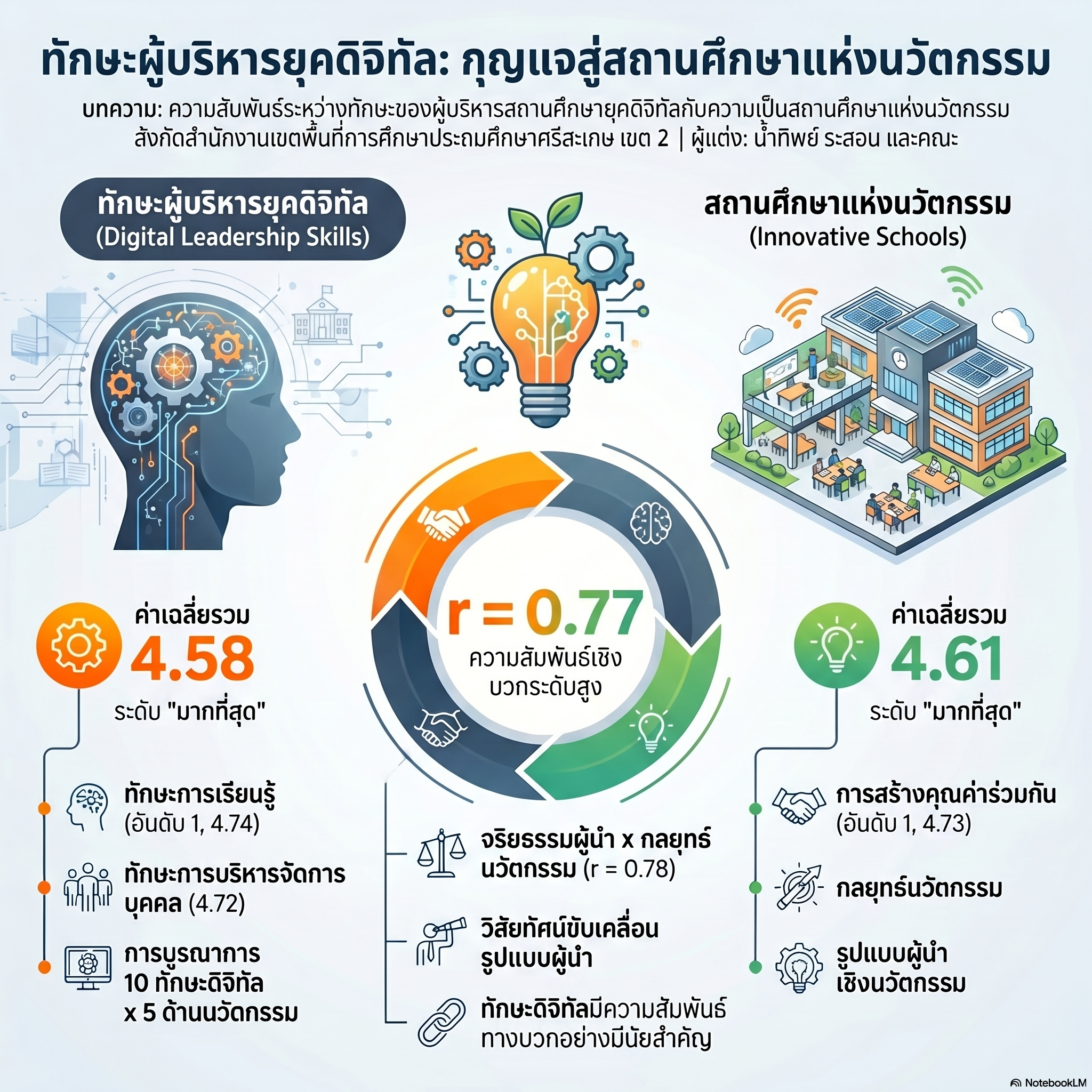
The objectives of this research were 1.To study the digital-age school administrators’ skills 2. To study the characteristics of innovative schools and 3. To study the relationship between digital-age administrators’ skills and innovative school characteristics under the same office The sample group consisted of 321 administrators, teachers, and educational personnel in the academic year 2025, selected through stratified random sampling. The research instrument was a five- rating scale questionnaire with a reliability coefficient of .98. The statistics used for data analysis were percentage, mean, standard deviation, and Pearson’s correlation coefficient. The results revealed that the overall level of digital-age leadership skills of school administrators was at the highest level ( = 4.58, S.D. = 0.25). The overall level of innovative school characteristics was also at the highest level (
= 4.61, S.D. = 0.27). Moreover, there was a high positive relationship between the digital-age leadership skills of school administrators and innovative school characteristics at the .01 level of statistical significance, which supported the research hypothesis. When considering the correlation coefficient, the digital-age management skills of school administrators (X) and innovative school characteristics (Y) had a correlation coefficient (rxy) of .77, indicating a high positive relationship.
References
ขวัญชนก แสงท่านั่ง. (2563). รูปแบบการพัฒนาสถานศึกษาสู่องค์กรแห่งนวัตกรรมสำหรับสถานศึกษาขั้นพื้นฐาน. วารสารสังคมศาสตร์และมานุษยวิทยาเชิงพุทธ, 5(7), 153–168.
นาราภัทร แซ่หว้า และ ณิรดา เวชญาลักษณ์. (2567). การศึกษาความสัมพันธ์ระหว่างภาวะผู้นำยุคดิจิทัลของผู้บริหารสถานศึกษากับการส่งเสริมทักษะการคิดเชิงนวัตกรรมของครู สังกัดสำนักงานเขตพื้นที่การศึกษาประถมศึกษาพิษณุโลก เขต 3. วารสารราชพฤกษ์, 22(2), 98–113.
บุญชม ศรีสะอาด. (2545). การวิจัยเบื้องต้น. สุวีริยาสาส์น.
พิเชษฐ์ ประสานชีพ. (2568). ทักษะของผู้บริหารสถานศึกษาในยุคดิจิทัล สังกัดสำนักงานเขตพื้นที่การศึกษามัธยมศึกษานครพนม. วารสารการบริหารการศึกษาและนวัตกรรมการศึกษา, 5(2), 98–107.
เพ็ญพิมล พลสมบัติ. (2566). แนวทางการพัฒนาความเป็นองค์กรแห่งนวัตกรรมของสถานศึกษา สังกัดสำนักงานเขตพื้นที่การศึกษาประถมศึกษาสุรินทร์ เขต 3. วารสารพุทธปรัชญาวิวัฒน์, 7(2), 658–672.
ลลิดา ไสยสัตย์ และ ศศิรดา แพงไทย. (2568). ภาวะผู้นําดิจิทัลของผู้บริหารสถานศึกษาที่ส่งผลต่อประสิทธิผลของสถานศึกษา สังกัดสำนักงานเขตพื้นที่การศึกษาประถมศึกษาเลย เขต 3. Journal of Integration Social Sciences and Development, 5(1), 63–76.
วิชยานนท์ ทรัพย์ถาวรธานี, ศิกานต์ เพียรธัญญกรณ์ และ บดินทร์ นารถโคษา. (2567). ภาวะผู้นําดิจิทัลของผู้บริหารสถานศึกษาที่ส่งผลต่อการใช้เทคโนโลยีสารสนเทศในการบริหารงานสถานศึกษาในสังกัดสำนักงานเขตพื้นที่การศึกษามัธยมศึกษานครพนม. วารสารการบริหารการศึกษาและภาวะผู้นํา มหาวิทยาลัยราชภัฏสกลนคร, 12(48), 300–310.
สุกัญญา แแช่มช้อย. (2562). การบริหารสถานศึกษาเพื่อสร้างนวัตกรรมรุ่นเยาว์. สำนักพิมพ์แห่งจุฬาลงกรณ์มหาวิทยาลัย.
สุธรรม ธรรมทัศนานนท์. (2564). การบริหารสู่องค์การแห่งนวัตกรรมการศึกษา. ตักสิลาการพิมพ์.
สุภาพร ศรีพรหม และ พิมพ์อร สดเอี่ยม. (2567). ภาวะผู้นำดิจิทัลของผู้บริหารสถานศึกษาที่ส่งผลต่อความเป็นองค์กรแห่งนวัตกรรมของโรงเรียนสังกัดสำนักงานเขตพื้นที่การศึกษามัธยมศึกษาเลย หนองบัวลำภู. วารสารมณีเชษฐาราม, 7(5), 816–832.
อภิชัย คำอาจ และ เจริญวิชญ์ สมพงษ์ธรรม. (2568). ความสัมพันธ์ระหว่างภาวะผู้นำในยุคดิจิทัลของผู้บริหารสถานศึกษากับโรงเรียนแห่งนวัตกรรม สังกัดสำนักงานเขตพื้นที่การศึกษาประถมศึกษายโสธร เขต 1. วารสารมหาจุฬาคชสาร, 16(1), 183–197.
อภิรักษ์ บุปผาชื่น. (2563). ภาวะผู้นำเชิงนวัตกรรม การขับเคลื่อนองค์การสู่ความเป็นเลิศ. วารสารนวัตกรรมการศึกษาและการวิจัย, 4(3), 205–216.
Kertpolsert, Y. (2022). Developing learning skills for digital citizenship. Journal of Digital Communications, 6(1), 353–379.
Kor, H., Erbay, H., & Engin, M. (2016). Technology leadership of education administrators and innovative technologies in education: A case study of Çorum city. Universal Journal of Educational Research, 4(12A), 140–150. https://doi.org/10.13189/ujer.2016.041318
Krejcie, R. V., & Morgan, D. W. (1970). Determining sample size for research activities. Educational and Psychological Measurement, 30(3), 607–610. https://doi.org/10.1177/001316447003000308
Nonaka, I., & Takeuchi, H. (2020). The wise company: How companies create continuous innovation. Oxford University Press. https://doi.org/10.1017/beq.2021.9
Ribble, M., & Park, M. (2022). The digital citizenship handbook for school leaders: Fostering positive interactions online. International Society for Technology in Education.
Weng, C. H., & Tang, Y. (2014). The relationship between technology leadership strategies and effectiveness of school administration: An empirical study. Computers and Education, 76(1), 91–107. https://doi.org/10.1016/j.compedu.2014.03.010
Downloads
Published
How to Cite
Issue
Section
Categories
License
Copyright (c) 2026 Faculty of Education, Srinakharinwirot university

This work is licensed under a Creative Commons Attribution-NonCommercial-NoDerivatives 4.0 International License.


