ผลการใช้ห้องเรียนดิจิทัลแบบเกมมิฟิเคชัน เพื่อส่งเสริมทักษะการถ่ายภาพของนักเรียนชั้นประถมศึกษาปีที่ 6
คำสำคัญ:
ห้องเรียนดิจิทัล, เกมมิฟิเคชัน, ทักษะการถ่ายภาพบทคัดย่อ
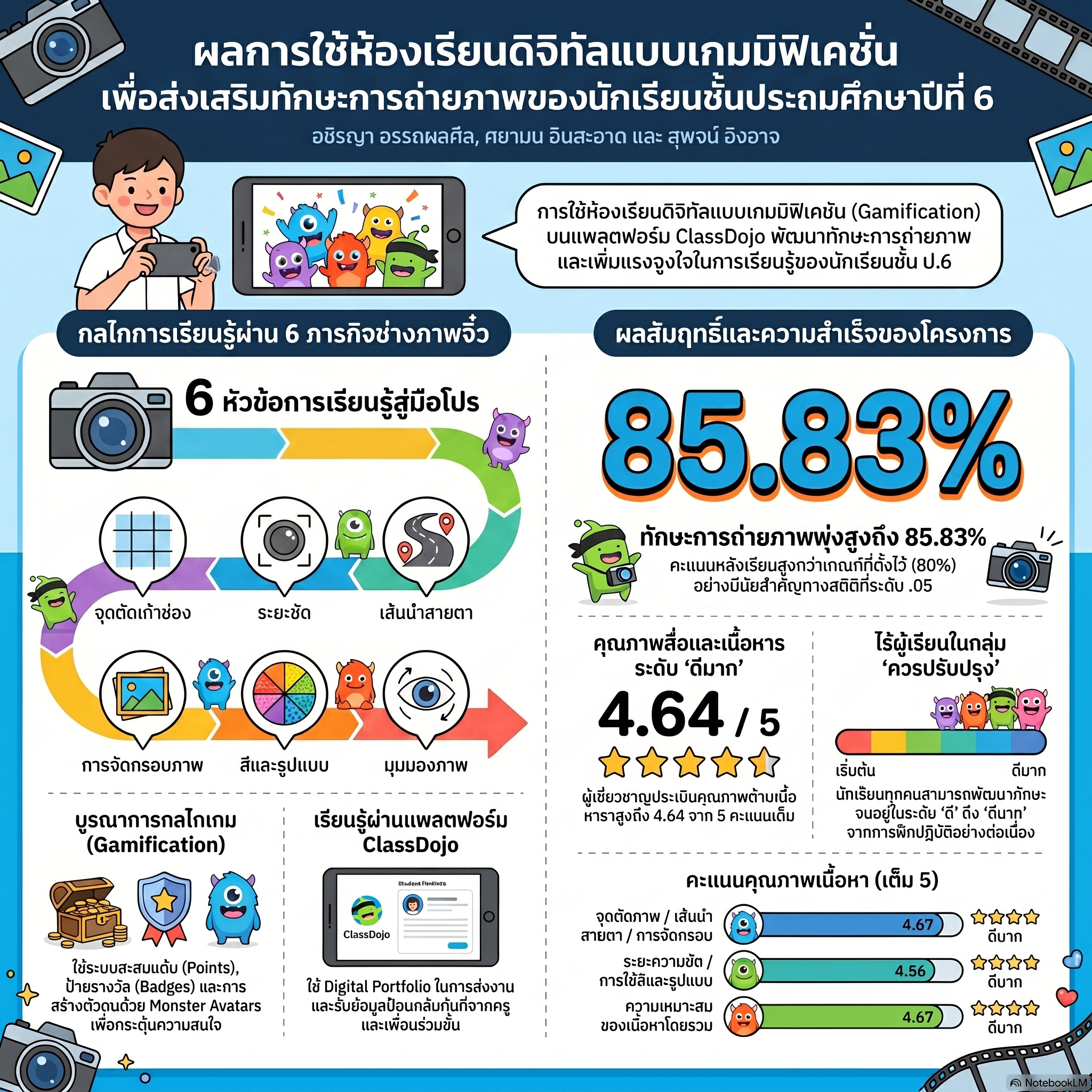
การวิจัยครั้งนี้มีวัตถุประสงค์เพื่อ 1) พัฒนาห้องเรียนดิจิทัลแบบเกมมิฟิเคชันเพื่อส่งเสริมทักษะ การถ่ายภาพสำหรับนักเรียนชั้นประถมศึกษาปีที่ 6 และ 2) เปรียบเทียบทักษะการถ่ายภาพหลังเรียนด้วย ห้องเรียนดิจิทัลแบบเกมมิฟิเคชันกับเกณฑ์ร้อยละ 80 กลุ่มตัวอย่างเป็นนักเรียนชั้นประถมศึกษาปีที่ 6 โรงเรียนสาธิตมหาวิทยาลัยรามคำแหง (ฝ่ายประถม) ภาคเรียนที่ 2 ปีการศึกษา 2568 จำนวน 30 คน ได้มาโดยการสุ่มอย่างง่าย (Simple Random Sampling) เครื่องมือที่ใช้ประกอบด้วย 1) ห้องเรียน ดิจิทัลแบบเกมมิฟิเคชันบนแพลตฟอร์ม ClassDojo 2) แบบประเมินคุณภาพห้องเรียนดิจิทัล และ 3) แบบประเมินทักษะการถ่ายภาพแบบรูบริค โดยสถิติที่ใช้ในการวิเคราะห์ข้อมูล ได้แก่ ค่าเฉลี่ย (M) ส่วนเบี่ยงเบนมาตรฐาน (S.D.) และ One Sample t-test ผลการวิจัยพบว่า 1) ห้องเรียน ดิจิทัลแบบเกมมิฟิเคชันมีคุณภาพโดยรวมด้านสื่ออยู่ในระดับดี (M = 4.42, S.D. = 0.66) และด้านเนื้อหาอยู่ในระดับดีมาก (M = 4.64, S.D. = 0.56) และ 2) ทักษะการถ่ายภาพหลังเรียนเฉลี่ยร้อยละ 85.83 สูงกว่าเกณฑ์ร้อยละ 80 อย่างมีนัยสำคัญทางสถิติที่ระดับ .05
เอกสารอ้างอิง
กัลยา วงศ์คำจันทร์, ศิริพร ทิพย์คง, และพิมพ์ใจ ศรีสว่าง. (2567). การจัดการเรียนรู้โดยใช้เกมเป็นฐานร่วมกับแนวคิดเกมมิฟิเคชันเพื่อเสริมสร้างแรงจูงใจใฝ่สัมฤทธิ์และยกระดับผลสัมฤทธิ์ทางการเรียนรายวิชาวิทยาศาสตร์ของนักเรียนระดับชั้นประถมศึกษาปีที่ 4. วารสารศึกษาศาสตร์ มหาวิทยาลัยรามคำแหง, 19(2), 45-62.
เกษกานดา สุรรัตน์, และอังคณา อ่อนธานี. (2566). การพัฒนากิจกรรมการเรียนรู้โดยใช้เกมมิฟิเคชันแบบออนไลน์ เพื่อเสริมสร้างความสามารถในการแก้ปัญหาทางคณิตศาสตร์ และแรงจูงใจในการเรียน สำหรับนักเรียนชั้นมัธยมศึกษาปีที่ 4. Journal of Roi Kaensarn Academi, 8(10), 509–533. https://so02.tci-thaijo.org/index.php/JRKSA/article/view/263043
ชนัตถ์ พูนเดช, และธนิตา เลิศพรกุลรัตน์. (2563). การศึกษานวัตกรรมการเรียนรู้ด้วยแนวคิดเกมมิฟิเคชัน. วารสารศึกษาศาสตร์ มหาวิทยาลัยนเรศวร, 22(2), 84-97.
โรงเรียนสาธิตมหาวิทยาลัยรามคำแหง (ฝ่ายประถม). (2561). รายงานประจำปี 2561 โรงเรียนสาธิตมหาวิทยาลัยรามคำแหง (ฝ่ายประถม). โรงเรียนสาธิตมหาวิทยาลัยรามคำแหง (ฝ่ายประถม).
สุรพล บุญลือ. (2560). การใช้ Application ClassDojo สำหรับการบริหารจัดการห้องเรียนในศตวรรษที่ 21. https://apdi.kbu.ac.th/Research%20database/APDI%20km/1Classdojo.pdf
Antin, J., & Churchill, E. F. (2011). Badges in social media: A social psychological perspective. In Proceedings of the CHI 2011 Gamification Workshop (pp. 1–4). ACM.
Ausubel, D. P. (1968). Educational psychology: A cognitive view. Holt, Rinehart and Winston.
Bruner, J. S. (1966). Toward a theory of instruction. Harvard University Press.
Castner, L. (2012). The art of seeing: Visual literacy through photography education. Journal of Visual Literacy, 31(1), 61-78.
Csikszentmihalyi, M. (1990). Flow: The psychology of optimal experience. Harper & Row.
Decker, A., & Bauer, M. (2018). When did we stop worrying and love gamification? The effects of a gamified classroom. Journal of Computing Sciences in Colleges, 33(6), 36-46.
Deterding, S., Dixon, D., Khaled, R., & Nacke, L. (2011). From game design elements to gamefulness: Defining gamification. In Proceedings of the 15th International Academic MindTrek Conference (pp. 9-15). ACM.
Domínguez, A., Saenz-de-Navarrete, J., de-Marcos, L., Fernández-Sanz, L., Pagés, C., & Martínez-Herráiz, J. J. (2013). Gamifying learning experiences: Practical implications and outcomes. Computers & Education, 63, 380-392.
Freeman, M. (2007). The photographer's eye: Composition and design for better digital photos. Focal Press.
Hamari, J., Koivisto, J., & Sarsa, H. (2014). Does gamification work? A literature review of empirical studies on gamification. In Proceedings of the 47th Hawaii International Conference on System Sciences (pp. 3025-3034). IEEE.
Hattie, J., & Timperley, H. (2007). The power of feedback. Review of Educational Research, 77(1), 81-112. https://doi.org/10.3102/003465430298487
Kapp, K. M. (2012). The gamification of learning and instruction: Game-based methods and strategies for training and education. Pfeiffer.
Likert, R. (1932). A technique for the measurement of attitudes. Archives of Psychology, 22(140), 1-55.
Mayer, R. E. (2009). Multimedia learning (2nd ed.). Cambridge University Press.
Nagel, D. (2013). Most students to learn in digital classrooms by 2020. T.H.E. Journal.
Nicholson, S. (2012). A user-centered theoretical framework for meaningful gamification. In Proceedings of Games+Learning+Society 8.0 (pp. 223-230). ETC Press.
Peterson, B. (2015). Understanding composition: The expanded guide. Amphoto Books.
Picciano, A. G. (2017). Theories and frameworks for online education: Seeking an integrated model. Online Learning, 21(3), 166-190.
Piaget, J. (1970). Science of education and the psychology of the child. Orion Press.
Präkel, D. (2010). Basics photography: Composition. AVA Publishing.
Sahin, A., & Arslan, M. (2019). The effects of ClassDojo application on primary school students' academic achievement and attitudes. Cypriot Journal of Educational Sciences, 14(4), 620-631.
Sailer, M., Hense, J. U., Mayr, S. K., & Mandl, H. (2017). How gamification motivates: An experimental study of the effects of specific game design elements on psychological need satisfaction. Computers in Human Behavior, 69, 371-380. https://doi.org/10.1016/j.chb.2016.12.033
Schiller, J. (2000). Taking photos: A meaningful activity for young children. Early Childhood Education Journal, 28(1), 49-55.
Siddiqui, N. (2021). ClassDojo as a classroom management tool: Implications for student behavior and engagement. Journal of Educational Technology Systems, 49(4), 439-455.
Suh, A., Wagner, C., & Liu, L. (2018). Enhancing user engagement through gamification: The role of time constraints. Journal of Computer Information Systems, 58(3), 204-213.
UNESCO. (2011). Global media and information literacy assessment framework: Country readiness and competencies. UNESCO Publishing.
Werbach, K., & Hunter, D. (2012). For the win: How game thinking can revolutionize your business. Wharton Digital Press.
Wright, C. (2011). Photography: A window on the world. Journal of Visual Communication, 10(2), 12-25.
ดาวน์โหลด
เผยแพร่แล้ว
รูปแบบการอ้างอิง
ฉบับ
ประเภทบทความ
หมวดหมู่
สัญญาอนุญาต
ลิขสิทธิ์ (c) 2026 คณะศึกษาศาสตร์ มหาวิทยาลัยศรีนครินทรวิโรฒ

อนุญาตภายใต้เงื่อนไข Creative Commons Attribution-NonCommercial-NoDerivatives 4.0 International License.


