การศึกษาพฤติกรรมการเปิดเผยตนเองในสื่อสังคมออนไลน์กับบุคลิกภาพแบบแสดงตัว-เก็บตัวของนักเรียนชั้นมัธยมศึกษาตอนปลาย โรงเรียนเอกชนระดับมัธยมศึกษาแห่งหนึ่งในจังหวัดชัยภูมิ
คำสำคัญ:
บุคลิกภาพแบบแสดงตัว-เก็บตัว, สื่อสังคมออนไลน์, การเปิดเผยตนเองบทคัดย่อ
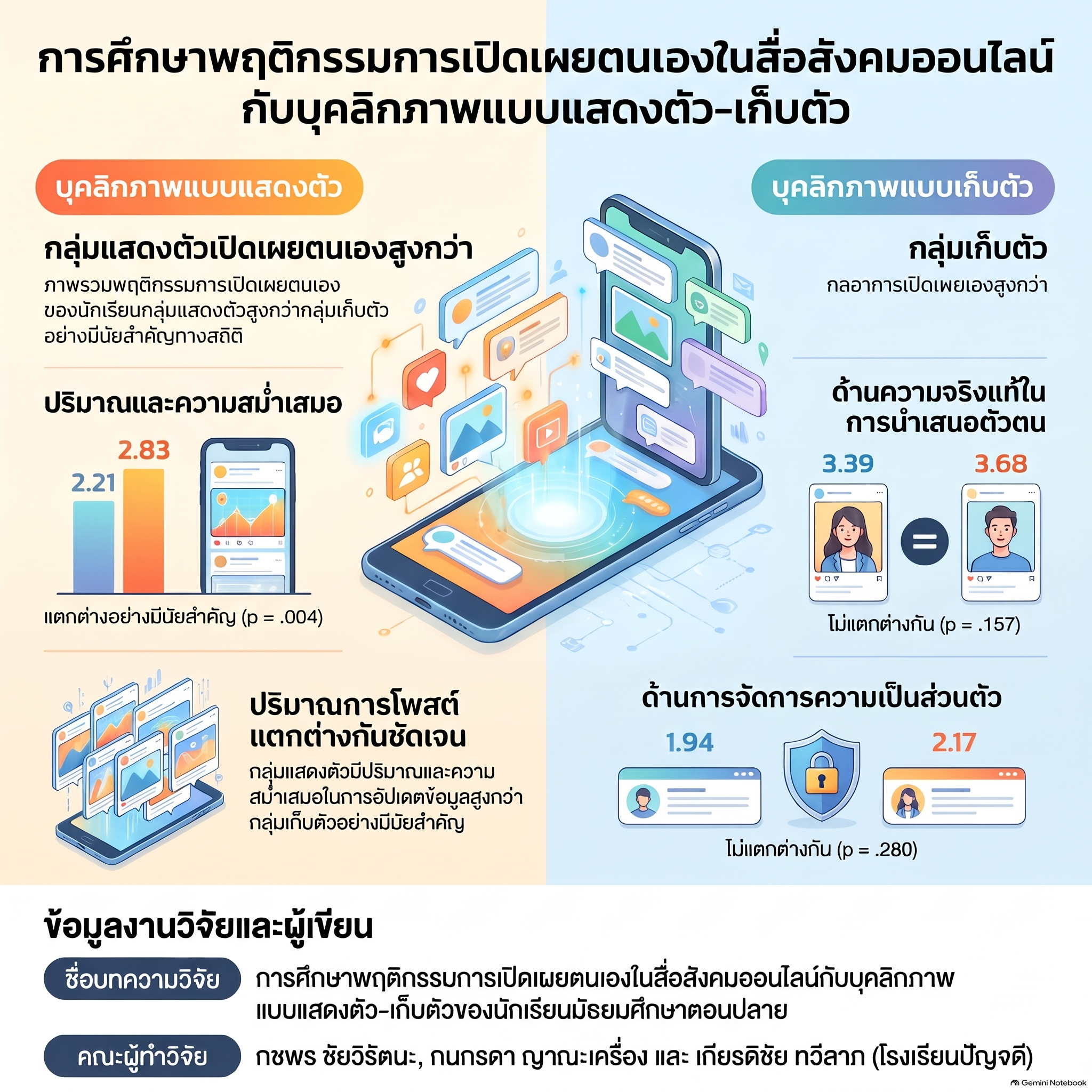
งานวิจัยนี้มีวัตถุประสงค์เพื่อเปรียบเทียบพฤติกรรมการเปิดเผยตนเองในสื่อสังคมออนไลน์ระหว่างบุคลิกภาพแบบแสดงตัว-เก็บตัวของนักเรียนชั้นมัธยมศึกษาตอนปลาย โรงเรียนเอกชนระดับมัธยมศึกษาแห่งหนึ่งในจังหวัดชัยภูมิ กลุ่มตัวอย่างเป็นนักเรียนชั้นมัธยมศึกษาตอนปลาย โรงเรียนเอกชนระดับมัธยมศึกษาแห่งหนึ่งในจังหวัดชัยภูมิ ปีการศึกษา 2568 โดยแบ่งนักเรียนเป็น 2 กลุ่ม คือกลุ่มที่มีบุคลิกภาพแบบแสดงตัว และกลุ่มที่มีบุคลิกภาพแบบเก็บตัว กลุ่มละ 20 คน รวมทั้งสิ้น 40 คน เครื่องมือที่ใช้ในการวิจัยคือแบบสอบถามพฤติกรรมการเปิดเผยตนเองในสื่อสังคมออนไลน์ซึ่งมีค่าความเชื่อมั่นทั้งฉบับตามวิธีสัมประสิทธิ์แอลฟาของครอนบาคเท่ากับ 0.71 สถิติที่ใช้ในการวิเคราะห์ข้อมูลได้แก่ ค่าเฉลี่ย ส่วนเบี่ยงเบนมาตรฐาน และ independent samples t-test ผลการวิจัยพบว่าพฤติกรรมการเปิดเผยตนเองในสื่อสังคมออนไลน์ของนักเรียนที่มีบุคลิกภาพแบบแสดงตัว-เก็บตัวแตกต่างกันอย่างมีนัยสำคัญทางสถิติที่ระดับ .05 (t = 3.676, p = .002) โดยนักเรียนที่มีบุคลิกภาพแบบแสดงตัวมีพฤติกรรมการเปิดเผยตนเองในสื่อสังคมออนไลน์สูงกว่านักเรียนที่มีบุคลิกภาพแบบเก็บตัว ผลการวิจัยนี้สะท้อนให้เห็นว่าลักษณะบุคลิกภาพอาจเป็นปัจจัยสำคัญที่ควรพิจารณาในการทำความเข้าใจและส่งเสริมพฤติกรรมการใช้สื่อสังคมออนไลน์อย่างเหมาะสมของนักเรียน
เอกสารอ้างอิง
ปภาภรณ์ ไชยหาญชาญชัย. (2561). การนำเสนอตนเอง การเปิดเผยตนเอง เเละความเป็นส่วนตัวบนเฟซบุ๊ก. วารสารนิเทศศาสตร์, 36(1), 63–78.
สมนึก ภัททิยธนี. (2565). การวัดผลการศึกษา (พิมพ์ครั้งที่ 13). ประสานการพิมพ์.
ภาษาอังกฤษ:
Altman, I., & Taylor, D. A. (1973). Social penetration: The development of interpersonal relationships. Holt, Rinehart and Winston.
Amichai-Hamburger, Y., & Vinitzky, G. (2010). Social network use and personality. Computers in Human Behavior, 26(6), 1289–1295. https://doi.org/10.1016/j.chb.2010.03.018
Anderson, M., & Jiang, J. (2018, May 31). Teens, social media and technology 2018. Pew Research Center. https://www.pewresearch.org/internet/2018/05/31/teens-social-media-technology-2018/
Christofides, E., Muise, A., & Desmarais, S. (2009). Information disclosure and control on Facebook: Are they two sides of the same coin or two different processes? CyberPsychology & Behavior, 12(3), 341–345. https://doi.org/10.1089/cpb.2008.0226
DeVito, J. A. (2019). The interpersonal communication book (15th ed.). Pearson.
Embalsado, J. V. M. (2021). Emerging adulthood: Identity status and parenting styles. Journal of Educational Health and Community Psychology, 10(4), 704–721. https://doi.org/10.12928/jehcp.v10i4.21879
John, O. P., & Srivastava, S. (1999). The Big Five trait taxonomy: History, measurement, and theoretical perspectives. In L. A. Pervin & O. P. John (Eds.), Handbook of personality: Theory and research (2nd ed., pp. 102–138). Guilford Press.
Jung, C. G. (1971). Psychological types (H. G. Baynes, Trans.; R. F. C. Hull, Rev.). Princeton University Press. (Original work published 1921)
Li, P., Cho, H., Shen, C., & Kong, H. (2024). From context adaptation to context restoration: Strategies, motivations, and decision rules of managing context collapse on WeChat. Journal of Computer-Mediated Communication, 29(1), Article zmad043. https://doi.org/10.1093/jcmc/zmad043
Livingstone, S., & Helsper, E. J. (2008). Parental mediation of children's internet use. Journal of Broadcasting & Electronic Media, 52(4), 581–599. https://doi.org/10.1080/08838150802437396
Madden, M., Lenhart, A., Cortesi, S., Gasser, U., Duggan, M., Smith, A., & Beaton, M. (2013, May 21). Teens, social media, and privacy. Pew Research Center. https://www.pewresearch.org/internet/2013/05/21/teens-social-media-and-privacy/
Myers, I. B., & McCaulley, M. H. (1985). Manual: A guide to the development and use of the Myers-Briggs Type Indicator (2nd ed.). Consulting Psychologists Press.
We Are Social, & Meltwater. (2024). Digital 2024: Global overview report. DataReportal. https://datareportal.com/reports/digital-2024-global-overview-report
Žmuk, B. (2017). Impact of questionnaire length and complexity on survey time: Comparison of two business web questionnaire versions. Metodološki Zvezki, 14(2), 49–74. https://doi.org/10.51936/vdqs5871
ดาวน์โหลด
เผยแพร่แล้ว
รูปแบบการอ้างอิง
ฉบับ
ประเภทบทความ
หมวดหมู่
สัญญาอนุญาต
ลิขสิทธิ์ (c) 2026 คณะศึกษาศาสตร์ มหาวิทยาลัยศรีนครินทรวิโรฒ

อนุญาตภายใต้เงื่อนไข Creative Commons Attribution-NonCommercial-NoDerivatives 4.0 International License.

