A STUDY OF SELF-DISCLOSURE BEHAVIOR ON SOCIAL MEDIA AND EXTROVERT–INTROVERT PERSONALITY AMONG UPPER SECONDARY SCHOOL STUDENTS AT A PRIVATE SECONDARY SCHOOL IN CHAIYAPHUM PROVINCE
Keywords:
Extrovert–Introvert Personality, Social Media, Self-disclosureAbstract
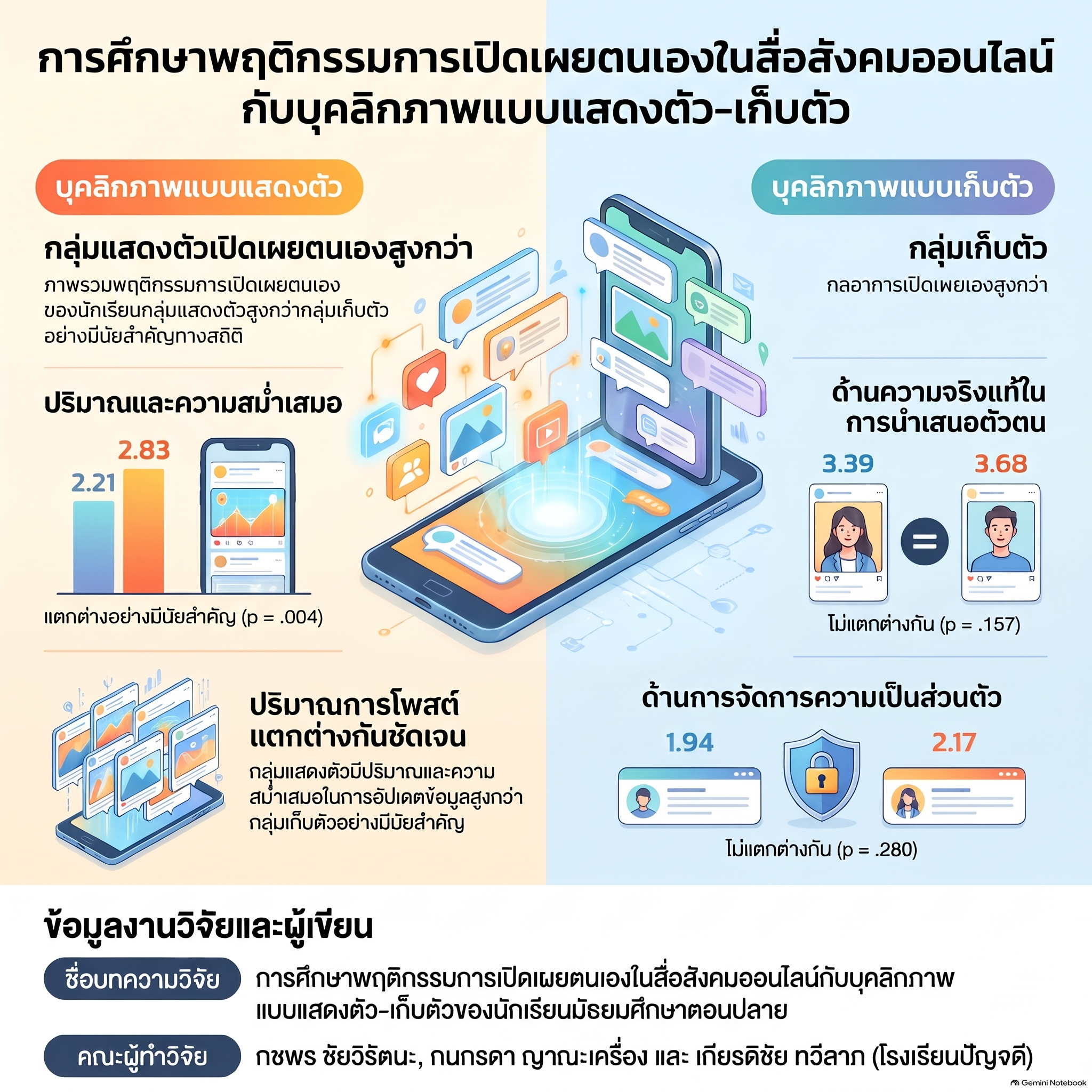
This research aimed to compare self-disclosure behavior on social media between extroverted and introverted upper secondary school students at a private secondary school in Chaiyaphum Province. The sample consisted of upper secondary school students at a private secondary school in Chaiyaphum Province in the academic year 2025. The students were divided into two groups: a group with extroverted personality and a group with introverted personality, with 20 students in each group, totaling 40 students. The research instrument was a questionnaire on self-disclosure behavior on social media, with an overall Cronbach’s alpha coefficient of 0.71. The statistics used for data analysis were mean, standard deviation, and an independent samples t-test. The research findings revealed that the self-disclosure behavior on social media of students with extroverted and introverted personalities was significantly different at the .05 level (t = 3.676, p = .002). Students with extroverted personalities had higher self-disclosure behavior on social media than students with introverted personalities. The findings of this research reflect that personality traits may be an important factor that should be considered in understanding and promoting appropriate social media use behavior among students.
References
ปภาภรณ์ ไชยหาญชาญชัย. (2561). การนำเสนอตนเอง การเปิดเผยตนเอง เเละความเป็นส่วนตัวบนเฟซบุ๊ก. วารสารนิเทศศาสตร์, 36(1), 63–78.
สมนึก ภัททิยธนี. (2565). การวัดผลการศึกษา (พิมพ์ครั้งที่ 13). ประสานการพิมพ์.
ภาษาอังกฤษ:
Altman, I., & Taylor, D. A. (1973). Social penetration: The development of interpersonal relationships. Holt, Rinehart and Winston.
Amichai-Hamburger, Y., & Vinitzky, G. (2010). Social network use and personality. Computers in Human Behavior, 26(6), 1289–1295. https://doi.org/10.1016/j.chb.2010.03.018
Anderson, M., & Jiang, J. (2018, May 31). Teens, social media and technology 2018. Pew Research Center. https://www.pewresearch.org/internet/2018/05/31/teens-social-media-technology-2018/
Christofides, E., Muise, A., & Desmarais, S. (2009). Information disclosure and control on Facebook: Are they two sides of the same coin or two different processes? CyberPsychology & Behavior, 12(3), 341–345. https://doi.org/10.1089/cpb.2008.0226
DeVito, J. A. (2019). The interpersonal communication book (15th ed.). Pearson.
Embalsado, J. V. M. (2021). Emerging adulthood: Identity status and parenting styles. Journal of Educational Health and Community Psychology, 10(4), 704–721. https://doi.org/10.12928/jehcp.v10i4.21879
John, O. P., & Srivastava, S. (1999). The Big Five trait taxonomy: History, measurement, and theoretical perspectives. In L. A. Pervin & O. P. John (Eds.), Handbook of personality: Theory and research (2nd ed., pp. 102–138). Guilford Press.
Jung, C. G. (1971). Psychological types (H. G. Baynes, Trans.; R. F. C. Hull, Rev.). Princeton University Press. (Original work published 1921)
Li, P., Cho, H., Shen, C., & Kong, H. (2024). From context adaptation to context restoration: Strategies, motivations, and decision rules of managing context collapse on WeChat. Journal of Computer-Mediated Communication, 29(1), Article zmad043. https://doi.org/10.1093/jcmc/zmad043
Livingstone, S., & Helsper, E. J. (2008). Parental mediation of children's internet use. Journal of Broadcasting & Electronic Media, 52(4), 581–599. https://doi.org/10.1080/08838150802437396
Madden, M., Lenhart, A., Cortesi, S., Gasser, U., Duggan, M., Smith, A., & Beaton, M. (2013, May 21). Teens, social media, and privacy. Pew Research Center. https://www.pewresearch.org/internet/2013/05/21/teens-social-media-and-privacy/
Myers, I. B., & McCaulley, M. H. (1985). Manual: A guide to the development and use of the Myers-Briggs Type Indicator (2nd ed.). Consulting Psychologists Press.
We Are Social, & Meltwater. (2024). Digital 2024: Global overview report. DataReportal. https://datareportal.com/reports/digital-2024-global-overview-report
Žmuk, B. (2017). Impact of questionnaire length and complexity on survey time: Comparison of two business web questionnaire versions. Metodološki Zvezki, 14(2), 49–74. https://doi.org/10.51936/vdqs5871
Downloads
Published
How to Cite
Issue
Section
Categories
License
Copyright (c) 2026 Faculty of Education, Srinakharinwirot university

This work is licensed under a Creative Commons Attribution-NonCommercial-NoDerivatives 4.0 International License.

