A SURVEY STUDY OF ENGLISH SPEAKING PROBLEMS AND COPING APPROACHES OF EDUCATION FACULTY STUDENTS
Keywords:
English speaking problems, Coping approaches, Development approachesAbstract
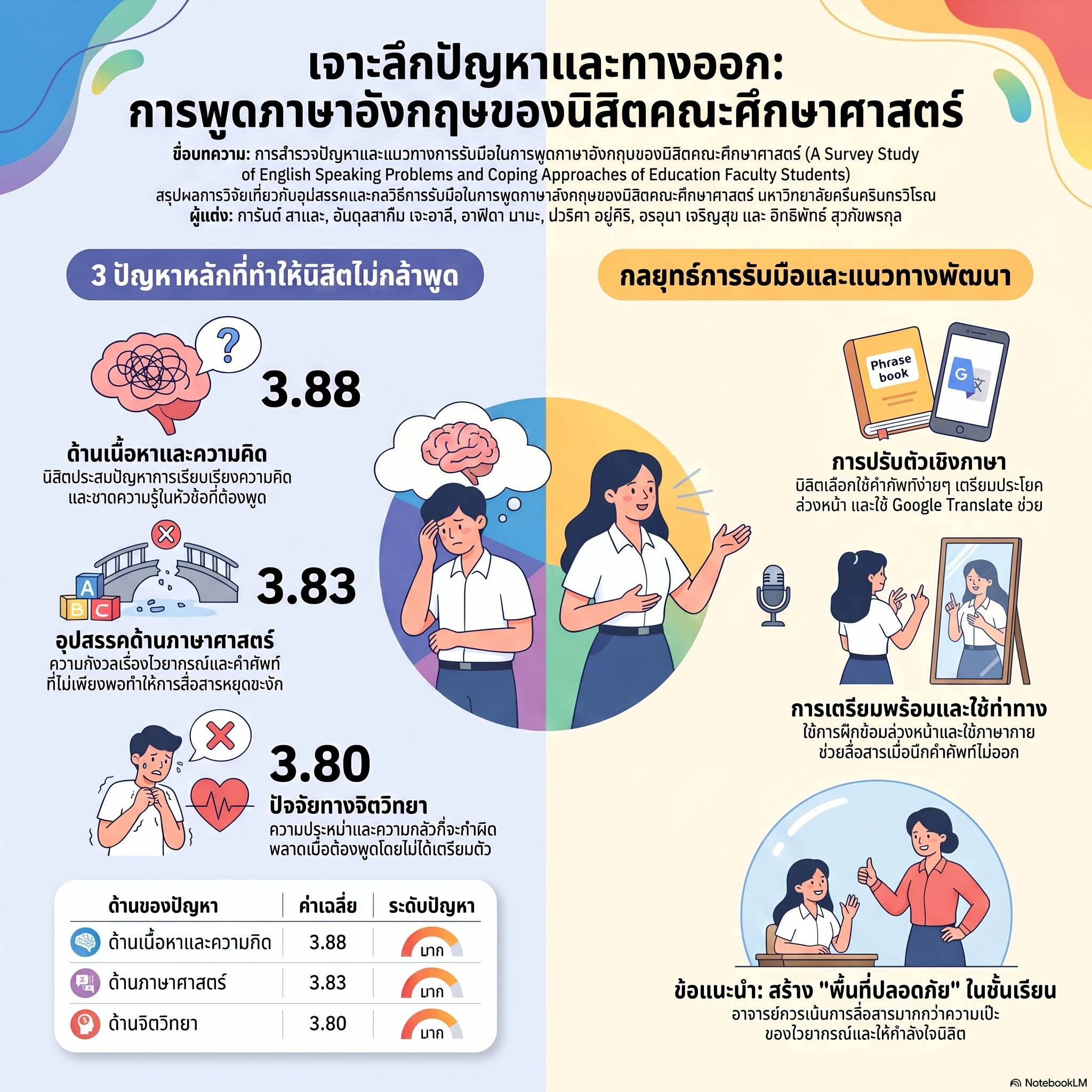
This study aimed to (1) examine English-speaking problems of Education faculty students, (2) investigate coping approaches of Education faculty students, and (3) explore development approaches from English professors to enhance students’ speaking proficiency. The population consisted of 359 students, and the sample comprised 101 second- to fourth-year students (8.3% margin of error) who are Phet Nai Tom scholarship students at the Faculty of Education, Srinakharinwirot University, in the 2026 academic year, selected through convenience sampling. Three English professors were interviewed as key informants. Research instruments included a five-point Likert-scale questionnaire and semi-structured interviews. The questionnaire demonstrated acceptable content validity (IOC = 0.67 - 1.00) and reliability (Cronbach's alpha = 0.89). Data were analyzed using mean, standard deviation, and content analysis. The results indicated that students experienced English-speaking problems at a high level (M = 3.84). Content and ideas posed the greatest challenge (M = 3.88), followed by linguistic (M = 3.83) and psychological aspects (M = 3.80), with grammar, vocabulary, and lack of topical knowledge as key issues. Regarding coping approaches, students reported a high level of self-directed coping strategies (M = 3.72), with linguistic adjustments most frequently employed, particularly the use of simple vocabulary and prior sentence preparation. Additionally, psychological preparation, rehearsal, and the use of gestures and topic preparation were commonly applied. Qualitative findings revealed reliance on technology, repeated practice, and simplified language use. English professors emphasized that effective speaking development requires integrating linguistic competence, psychological readiness, and content knowledge through supportive and communicative classroom practices.
References
Assalihee, M., & Boonsuk, Y. (2022). Factors obstructing English teaching effectiveness: Teacher voices from Thailand's Deep South. IAFOR Journal of Education, 10(1), 155–172. https://doi.org/10.22492/ije.10.1.08
Attahakul, P., Srakaew, P., & Pansa, B. (2024). English speaking problems and models used to solve problems between Thai and foreign students in the Faculty of Education at Mahachulalongkornrajavidyalaya University. Journal of Asian Language Teaching and Learning, 5(3), 259–267. https://journals.mcu.ac.th/jaltl
Choi, W. Y., & Kang, M. K. (2024). The development and validation of English communicative competence model for high school students in Korea. Korea Scholar, 79(1), 3–24. https://doi.org/10.15858/engtea.79.1.202403.3
Dayama, P., Mokmas, N., Onouhn, P., & Manochphinyo, A. (2021). English speaking problem and solutions between employees and customers in workplaces. Jurnal Bahasa Inggris Terapan, 7(1), 1–18. https://pdfs.semanticscholar.org/f85a/5364c890da19061b77b26fb4c5953e822c5a.pdf
Diana, M., Renandya, W. A., & Dahliana, S. (2024). Researching factors and coping strategies of EFL students' speaking anxiety. Englisia: Journal of Language, Education, and Humanities, 12(1), 250–271. https://doi.org/10.22373/ej.v12i1.22733
Farrelly, M. J., & Sinwongsuwat, K. (2021). Strategies used and challenges faced by Thai EFL teachers when eliciting talk during classroom interactions in high school contexts. SAGE Open, 11(4). https://doi.org/10.1177/21582440211050385
Krejcie, R. V., & Morgan, D. W. (1970). Determining sample size for research activities. Educational and Psychological Measurement, 30(3), 607–610. https://doi.org/10.1177/001316447003000308
Pristiyaputri, A. E., Afiqoh, M., Jauhari, M. A., Al Afghani, M. J., & Kurniasih. (2023). The differences of speaking anxiety across academic levels and gender. The Journal of English Literacy Education, 10(1), 63–80. https://doi.org/10.36706/jele.v10i1.20292
Qin, L., & Poopatwiboon, S. (2023). English speaking anxiety of Thai EFL undergraduate students: Dominant type, level, and coping strategies. English Language Teaching, 16(6), 102–115. https://doi.org/10.5539/elt.v16n6p102
Richards, J. C. (2008). Teaching listening and speaking: From theory to practice. Cambridge University Press.
Riensumettharadol, M., & Sujarinpong, P. (2023). English-speaking problems and solutions: A case study of Thai EFL interns in the hospitality and tourism industry. Journal of Studies in the Field of Humanities, 30(1), 217–225. https://so04.tci-thaijo.org/index.php/abc/article/view/247328
Robert, R., & Meenakshi, S. (2022). Rereading oral communication skills in English language acquisition: The unspoken spoken English. Theory and Practice in Language Studies, 12(11), 2429–2435. https://doi.org/10.17507/tpls.1211.25
Sha'ar, M. Y. M. A., & Boonsuk, Y. (2021). What hinders English speaking in Thai EFL learners? Investigating factors that affect the development of their English speaking skills. MEXTESOL Journal, 45(3), 1–16. https://doi.org/10.61871/mj.v45n3-2
Srinakharinwirot University. (2019, January 18). Srinakharinwirot University announcement on the elevation of English language standards for undergraduate students. Educational Services Division.
Thuratham, W., & Namsaeng, P. (2025). Challenges in English communication skills of university-level EFL learners. FWU Journal of Social Sciences, 19(3), 26–40. https://doi.org/10.51709/19951272/Fall2025/3
Tianchai, R., Soranastaporn, S., & Liang-Itsara, A. (2025). Improving English teaching skills: An online course for non-English major teachers in Southern Thailand's rural primary schools. World Journal of English Language, 15(1), 191–204. https://doi.org/10.5430/wjel.v15n1p191
Downloads
Published
How to Cite
Issue
Section
Categories
License
Copyright (c) 2026 Faculty of Education, Srinakharinwirot university

This work is licensed under a Creative Commons Attribution-NonCommercial-NoDerivatives 4.0 International License.


