THE EFFECTS OF LEARNING MANAGEMENT USING HSCE - MONOPOLY BOARD GAME ON HEALTH SCIENCE CAREER KNOWLEDGE AND SATISFACTION OF MATTHAYOMSUKSA 3 STUDENTS TAPHAN HIN SCHOOL
Keywords:
Board Games, Health Science Careers, Career knowledgeAbstract
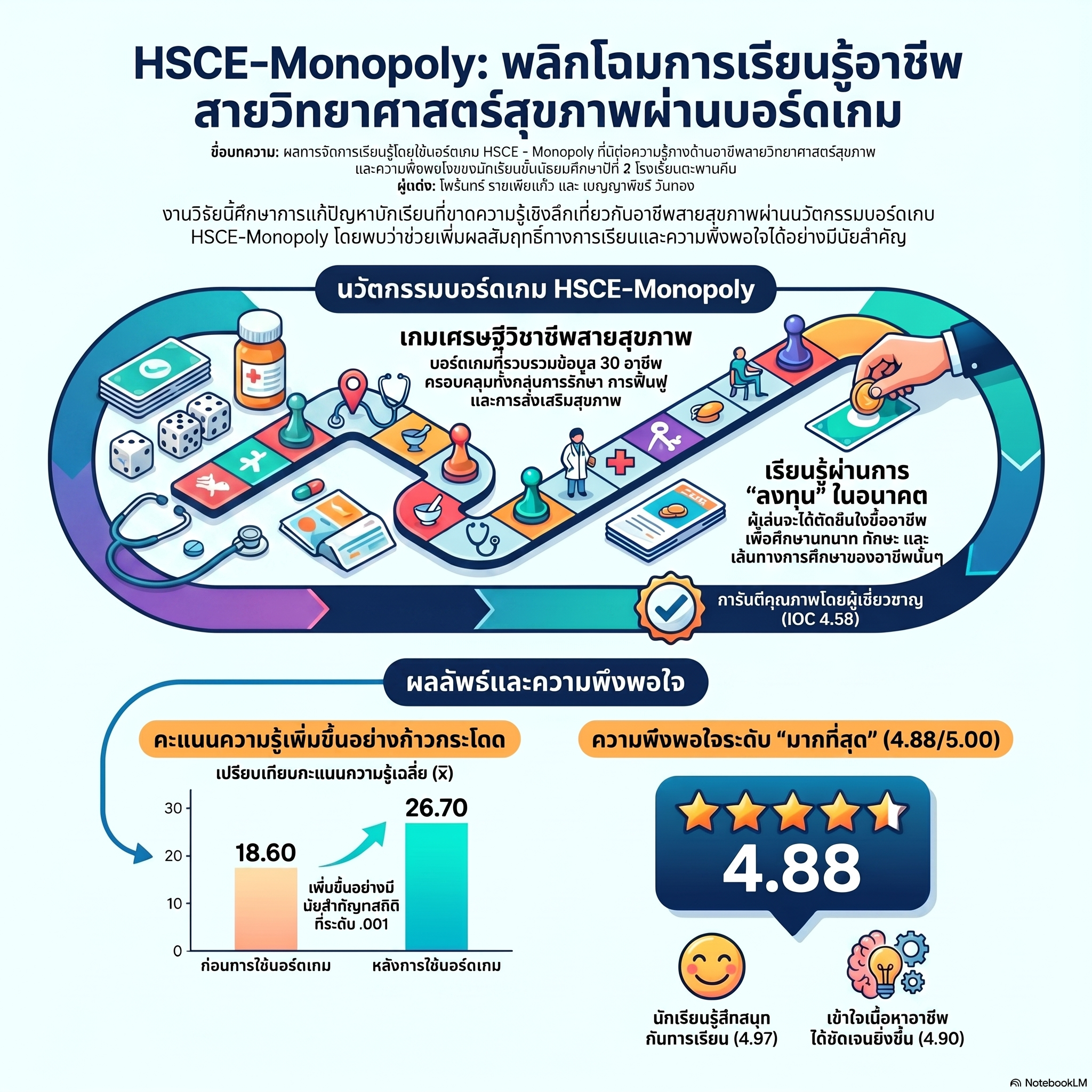
This research aimed to (1) compare health science career knowledge scores of Matthayomsuksa 3 students before and after the implementation of the HSCE–Monopoly board game, and (2) examine the satisfaction of Matthayomsuksa 3 students toward the use of the HSCE–Monopoly board game for enhancing health science career knowledge. The sample consisted of 40 Matthayomsuksa 3/3 students at Taphan Hin School, Phichit Province, enrolled in the first semester of the 2025 academic year, selected through Cluster Random Sampling using classrooms as the sampling unit. The research instruments comprised (1) the HSCE–Monopoly board game, with an IOC value ranging from 0.67 to 1.00 and an appropriateness rating at the highest level (x̄ = 4.58); (2) a health science career knowledge test with a reliability coefficient of 0.85; and (3) a satisfaction questionnaire toward the HSCE–Monopoly board game with a reliability coefficient of 0.92. Data were analyzed using mean, standard deviation, and paired-samples t-test. The findings revealed that (1) students' health science career knowledge scores after using the HSCE–Monopoly board game were significantly higher than before its use at the .001 level of statistical significance, and (2) students' overall satisfaction toward the board game-based learning activities was at the highest level (x̄ = 4.88, S.D. = 0.30).
References
กระทรวงสาธารณสุข. (2565). แผนกำลังคนด้านสุขภาพแห่งชาติ ระยะที่ 1 (พ.ศ. 2565-2574).
จำรัส จันเทศ. (2562). การออกแบบบอร์ดเกมเพื่อส่งเสริมการเรียนรู้คำศัพท์ภาษาอังกฤษเรื่องอาชีพ (JOBS) สำหรับนักเรียนชั้นมัธยมศึกษาตอนต้น [วิทยานิพนธ์ปริญญามหาบัณฑิต, มหาวิทยาลัยธรรมศาสตร์].
ธีรภาพ แซ่เซี่ย. (2560). การใช้บอร์ดเกมประเภทวางแผนเพื่อพัฒนาทักษะการคิดอย่างมีวิจารณญาณในนักเรียนระดับมัธยมศึกษาชั้นปีที่ 3 ในโรงเรียนขนาดใหญ่ สังกัดสำนักงานเขตการศึกษาขั้นพื้นฐาน จังหวัดปทุมธานี [วิทยานิพนธ์ปริญญามหาบัณฑิต, มหาวิทยาลัยธรรมศาสตร์].
ปาริชาต ชิ้นเจริญ. (2564). การพัฒนากิจกรรมการเรียนรู้โดยใช้บอร์ดเกมเป็นฐาน เพื่อส่งเสริมความฉลาดรู้ด้านระบบนิเวศสำหรับนักเรียนชั้นมัธยมศึกษาปีที่ 4 [วิทยานิพนธ์ปริญญามหาบัณฑิต, มหาวิทยาลัยนเรศวร].
ปิยภัส บุตรจันทร์, ปัญญาพล พงษ์ชัยสิทธิ์, และ เบญญาพัชร์ วันทอง. (2568). ผลการพัฒนาเกมการ์ด Career Match เพื่อส่งเสริมความรู้ด้านอาชีพสำหรับนักเรียนชั้นมัธยมศึกษาปีที่ 1 โรงเรียนวัดจันทร์ตะวันออก. วารสารสังคมศึกษาปริทรรศน์, 1(3), 30–43. https://doi.org/10.64186/jsp1557
วชิรวิทย์ เอี่ยมวิลัย. (2563). การพัฒนาบอร์ดเกมตามแนวทางการคิดอย่างมีวิจารณญาณเพื่อส่งเสริมความเป็นพลเมืองดิจิทัลของนักเรียนชั้นมัธยมศึกษาปีที่ 1 [วิทยานิพนธ์ปริญญามหาบัณฑิต, มหาวิทยาลัยศรีนครินทรวิโรฒ].
สถาบันวิจัยระบบสาธารณสุข. (2565). รายงานสถานการณ์กำลังคนด้านสุขภาพของประเทศไทย พ.ศ. 2565.
สำนักงานคณะกรรมการการศึกษาขั้นพื้นฐาน. (2564). รายงานการสำรวจความสนใจในอาชีพของนักเรียนมัธยมศึกษา. สำนักพิมพ์คุรุสภาลาดพร้าว.
สำนักงานเลขาธิการสภาการศึกษา. (2560). แผนการศึกษาแห่งชาติ พ.ศ. 2560-2579. พริกหวานกราฟฟิค.
สำนักงานสภาพัฒนาการเศรษฐกิจและสังคมแห่งชาติ. (2566). รายงานภาวะสังคมไทยไตรมาสสี่และภาพรวมปี 2566.
อรุณลักษณ์ รัตนพันธุ์, บุญญฤทธิ์ รัตนพันธุ์, และ รุ่งรุจี ศรีดาเดช. (2565). การใช้บอร์ดเกมเพื่อพัฒนาทักษะการเรียนรู้ของบรรณารักษ์ สังกัดสำนักงานส่งเสริมการศึกษานอกระบบและการศึกษาตามอัธยาศัย (กศน.) จังหวัดกำแพงเพชร. วารสารพิกุล คณะมนุษยศาสตร์และสังคมศาสตร์ มหาวิทยาลัยราชภัฏกำแพงเพชร, 20(2), 363–385. https://so05.tci-thaijo.org/index.php/Phikun/article/view/258057
Deci, E. L., & Ryan, R. M. (2000). The "what" and "why" of goal pursuits: Human needs and the self-determination of behavior. Psychological Inquiry, 11(4), 227–268. https://doi.org/10.1207/S15327965PLI1104_01
International Labour Organization. (2012). International Standard Classification of Occupations: ISCO-08 (Vol. 1). https://webapps.ilo.org/ilostat-files/ISCO/newdocs-08-2021/ISCO-08/ISCO-08%20EN%20Vol%201.pdf
Khanchai, S., Worragin, P., Ariya, P., Intawong, K., & Puritat, K. (2025). Toward sustainable digital literacy: A comparative study of gamified and non-gamified digital board games in higher education. Education Sciences, 15(8), 966. https://doi.org/10.3390/educsci15080966
Lisana, L., Dinata, H., & Tanudjaja, G. V. (2025). Playing to learn: Game-based approach to financial literacy for generation Z. Entertainment Computing, 52, 100896. https://doi.org/10.1016/j.entcom.2024.100896
Prensky, M. (2001). Digital game-based learning. McGraw-Hill.
Downloads
Published
How to Cite
Issue
Section
Categories
License
Copyright (c) 2026 Faculty of Education, Srinakharinwirot university

This work is licensed under a Creative Commons Attribution-NonCommercial-NoDerivatives 4.0 International License.


