THE NEEDS OF SPORTS ACTIVITIES RECREATIONAL PURSUITS AND DIGITAL TOOLS USING FOR EXERCISE AMONG SPORTS JOURNALISTS
Keywords:
Needs, Sports activities, Recreational activities, Digital tools, Sports journalistsAbstract
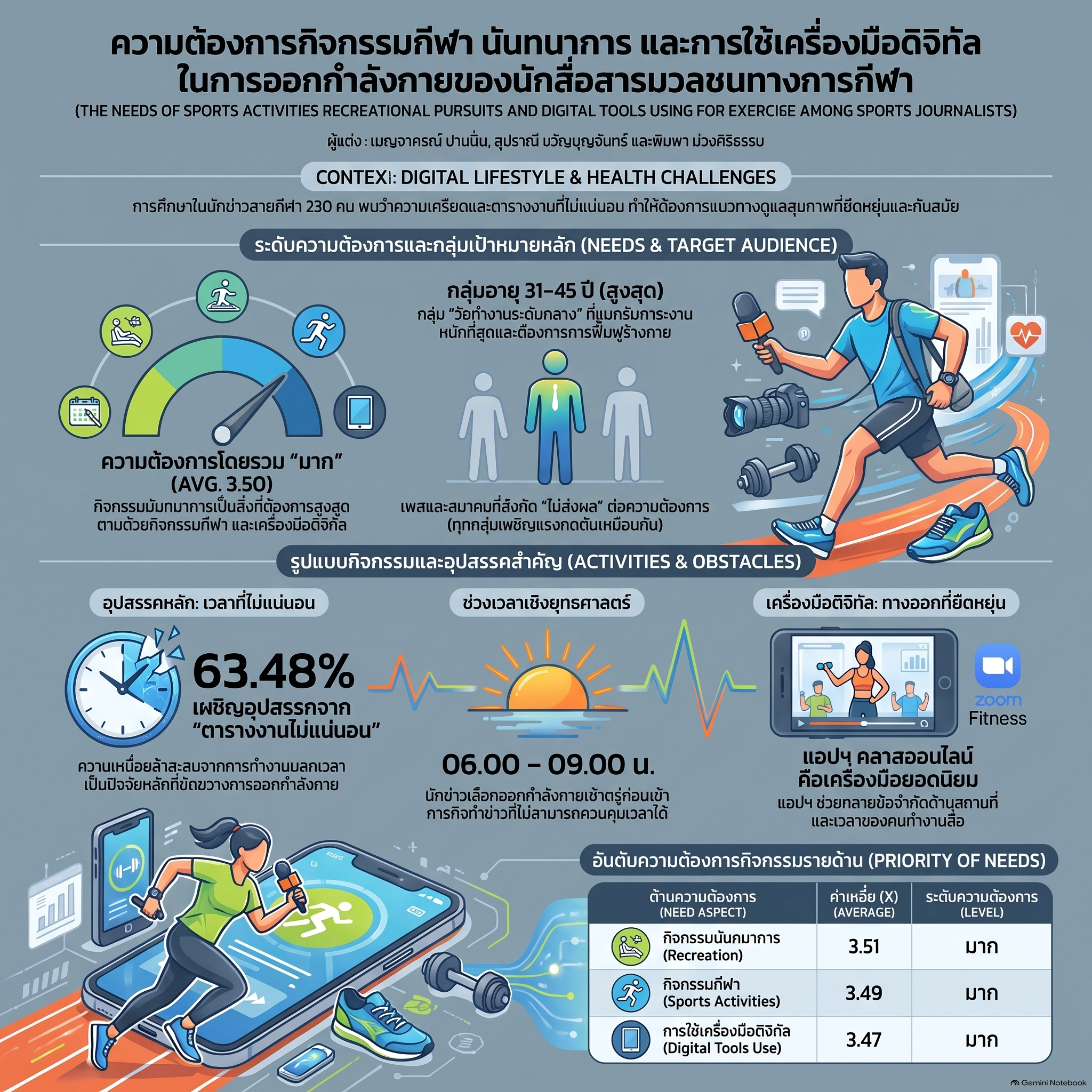
The purposes of this research were: (1) to investigate the needs for sports activities, recreational activities, and the use of digital tools for exercise among sports journalists; and (2) to compare these needs according to gender, age, and professional association membership. The sample consisted of 230 sports journalists who were members of the Sports Journalists Association of Thailand, the Thailand Sports Writers Association, and the Online Sports Journalists Association. The participants were selected through stratified random sampling. The research instrument was a researcher-developed questionnaire consisting of 54 items. The Index of Item-Objective Congruence (IOC) was 1.00, and the reliability coefficient was 0.971. The data were analyzed using frequency, percentage, mean, standard deviation, independent samples t-test, one-way analysis of variance (One-way ANOVA), and Fisher's Least Significant Difference (LSD) test for pairwise comparisons. The results of the study were as follows 1) The overall need for sports activities, recreational activities, and the use of digital tools for exercise among sports journalists was at a high level ( = 3.50, SD = 0.20). 2) Sports journalists with different genders, ages, and professional association memberships showed no significant differences in their overall needs for sports activities, recreational activities, and the use of digital tools for exercise. 3) When each aspect was considered separately, sports journalists of different age groups demonstrated statistically significant differences in their needs for sports activities and recreational activities at the .05 level. Sports journalists aged 31–45 years reported significantly higher needs for sports activities (
= 3.53, SD = 0.28) than those aged 46years and above (
= 3.41, SD = 0.30). Likewise, sports journalists aged 31–45 years exhibited significantly higher needs for recreational activities (
= 3.56, SD = 0.31) than those aged below 31 years (
= 3.42, SD = 0.28).
References
กรมพลศึกษา. (2565). นโยบายการพัฒนากีฬาและนันทนาการ. สำนักงานปลัดกระทรวงการศึกษา.
กระทรวงการท่องเที่ยวและกีฬา. (2566). แผนพัฒนาการกีฬาแห่งชาติ ฉบับที่ 7 (พ.ศ. 2566–2570).
นันทิกา นนทปัทม์. (2562). ความต้องการกิจกรรมนันทนาการและปัจจัยที่ส่งผลต่อการเลือกเข้าร่วมของคนทำงาน. วารสารวิจัยทางสังคม, 45(2), 123–145.
พวงรัตน์ ทวีรัตน์. (2543). วิธีการวิจัยทางพฤติกรรมศาสตร์และสังคมศาสตร์ (พิมพ์ครั้งที่ 8). สำนักทดสอบทางการศึกษาและจิตวิทยา มหาวิทยาลัยศรีนครินทรวิโรฒ ประสานมิตร.
ศุภลักษณ์ เกษมสุข. (2564). ความเครียดในการทำงานของสื่อมวลชนทางกีฬาในยุคดิจิทัล. วารสารศึกษาศาสตร์, 32(3), 78–95.
สำนักงานสภาพัฒนาการเศรษฐกิจและสังคมแห่งชาติ. (2561). ยุทธศาสตร์ชาติ ระยะ 20 ปี (พ.ศ. 2561–2580). สำนักงาน ก.พ.ส.
Beard, J. G., & Ragheb, M. G. (1983). Measuring leisure motivation. Journal of Leisure Research, 15(3), 219–228.
Brickwood, K. J., Watson, G., O’Brien, J., & Williams, A. D. (2019). Consumer-based wearable activity trackers increase physical activity participation: Systematic review and meta-analysis. JMIR mHealth and uHealth, 7(4), Article e11819.
Center for Innovation and Sustainability in Local Media. (2023). Local news burnout report. University of North Carolina at Chapel Hill.
Chtourou, H., Trabelsi, K., H’Mida, C., Boukhris, O., Glenn, J. M., Brach, M., Bentlage, E., Bott, N., Shephard, R. J., Ammar, A., et al. (2020). Staying physically active during the quarantine and self-isolation period for controlling and mitigating the COVID-19 pandemic: A systematic overview of the literature. Frontiers in Psychology, 11, Article 1708.
Cunningham, G. B., & Ahn, N. Y. (2019). Moderation in sport management research: Room for growth. Measurement in Physical Education and Exercise Science, 23(4), 301–313.
Ehrenberg, K., & Alpuim, M. (2024). Mental health, self-care and resilience in journalism (Psychology for Journalists, No. 12). Bonn Institute.
Eime, R. M., Young, J. A., Harvey, J. T., Charity, M. J., & Payne, W. R. (2013). A systematic review of the psychological and social benefits of participation in sport for adults: Informing development of a conceptual model of health through sport. International Journal of Behavioral Nutrition and Physical Activity, 10(1), Article 135.
English, P. (2016). Twitter's diffusion in sports journalism: Role models, laggards and followers of the social media innovation. New Media & Society, 18(3), 484–501.
Fraser-Thomas, J., & Côté, J. (2009). Understanding adolescents’ positive and negative developmental experiences in sport. The Sport Psychologist, 23(1), 3–23.
Gould, D., & Maynard, I. (2009). Psychological preparation for the Olympic Games. Journal of Sports Sciences, 27(13), 1393–1408.
Iso-Ahola, S. E. (1982). Toward a social psychology of recreational travel. Leisure Studies, 1(1), 45–56.
Kenrick, D. T., Griskevicius, V., Neuberg, S. L., & Schaller, M. (2010). Renovating the pyramid of needs: Contemporary extensions built upon ancient foundations. Perspectives on Psychological Science, 5(3), 292–314.
Krejcie, R. V., & Morgan, D. W. (1970). Determining sample size for research activities. Educational and Psychological Measurement, 30(3), 607–610.
Maslow, A. H. (1943). A theory of human motivation. Psychological Review, 50(4), 370–396. https://doi.org/10.1037/h0054346
Maturo, A., & Setiffi, F. (2016). The gamification of risk: How health apps foster self-confidence and why this is not enough. Health, Risk & Society, 17(7–8), 477–494.
McLean, D. D., & Hurd, A. R. (2015). Kraus' recreation and leisure in modern society (10th ed.). Jones & Bartlett Learning.
Newman, D. B., Tay, L., & Diener, E. (2014). Leisure and subjective well-being: A model of psychological mechanisms as mediating factors. Journal of Happiness Studies, 15(3), 555–578.
Reinardy, S. (2011). Newspaper journalism in crisis: Burnout on the rise, eroding young journalists' career commitment. Journalism, 12(1), 33–50.
Robbins, S. P., & Judge, T. A. (2019). Organizational behavior (18th ed.). Pearson.
Rojas-Torrijos, J. L., & Nölleke, D. (2023). Rethinking sports journalism. Journalism and Media, 4(3), 853–860.
Romeo, A., Edney, S., Plotnikoff, R., Curtis, R., Ryan, J., Sanders, I., Crozier, A., & Maher, C. (2019). Can smartphone apps increase physical activity? Systematic review and meta-analysis. Journal of Medical Internet Research, 21(3), Article e12053.
Sonnentag, S., & Fritz, C. (2007). The Recovery Experience Questionnaire: Development and validation of a measure for assessing recuperation and debates from work. Journal of Occupational Health Psychology, 12(3), 204–221.
Stebbins, R. A. (2017). Leisure activities in context: A micro-macro/agency-structure interpretation of leisure. Routledge.
Teixeira, D. S., Silva, M. N., & Palmeira, A. L. (2018). How does frustration make you feel? A motivational analysis in exercise context. Motivation and Emotion, 42(3), 419–428.
Torous, J., Myrick, K. J., Rauseo-Ricupero, N., & Firth, J. (2020). Digital mental health and COVID-19: Using technology today to accelerate the curve on access and quality tomorrow. JMIR Mental Health, 7(3), Article e18848.
Downloads
Published
How to Cite
Issue
Section
Categories
License
Copyright (c) 2026 Faculty of Education, Srinakharinwirot university

This work is licensed under a Creative Commons Attribution-NonCommercial-NoDerivatives 4.0 International License.


