THE INNOVATIVE LEADERSHIP OF SCHOOL ADMINISTRATORS AFFECTING THE QUALITY OF STUDENTS DEVELOPMENT IN THE SECONDARY SCHOOL OF EDUCATIONAL SERVICE AREA OFFICE BANGKOK 1
Keywords:
Innovative leadership, School administrators, Development of student qualityAbstract
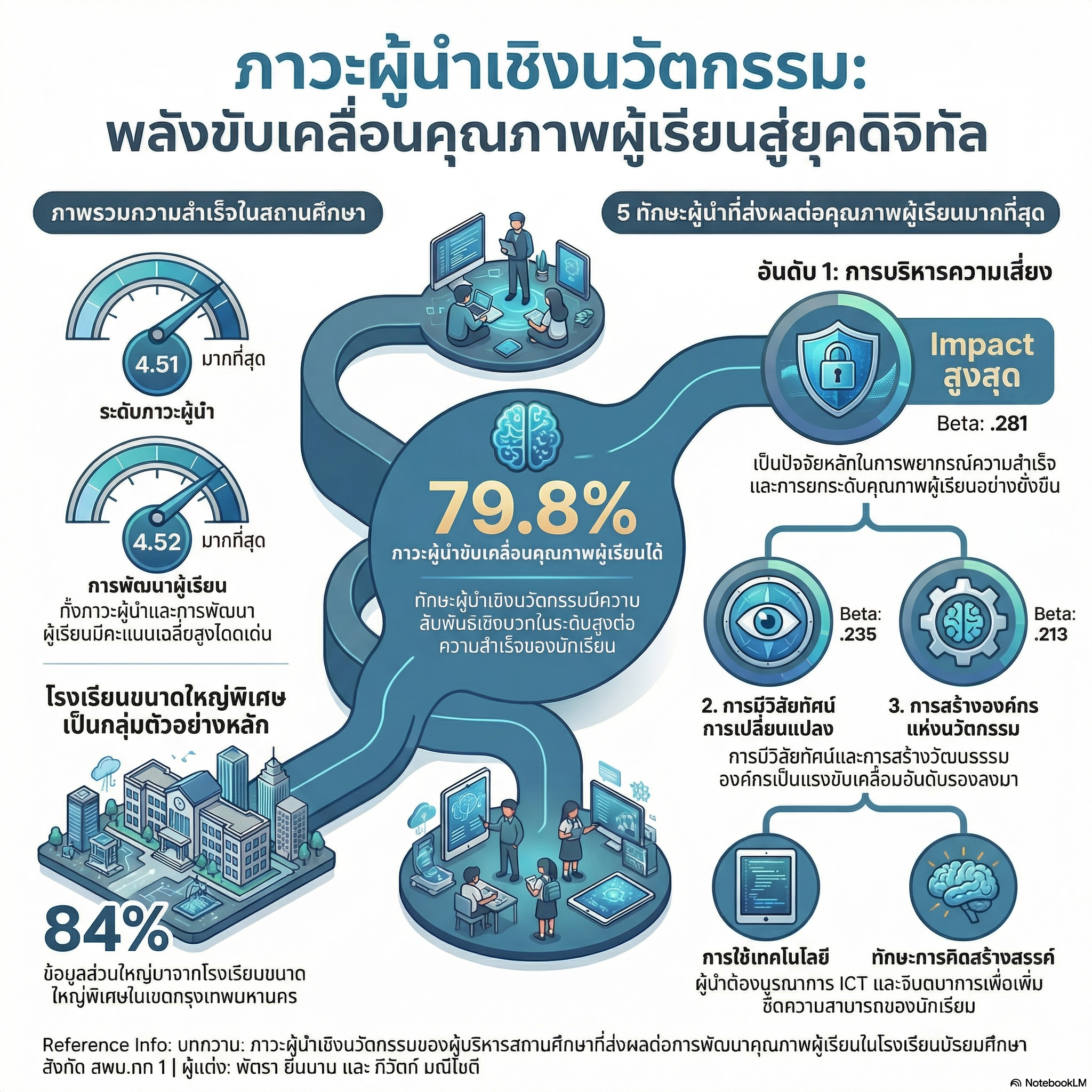
The objectives of this research were to: (1) examine the level of innovative leadership among school administrators; (2) investigate the level of student quality development in secondary schools; and (3) analyze the innovative leadership of school administrators influencing student quality development. The sample consisted of 357 teachers under the Secondary Educational Service Area Office Bangkok 1, selected through stratified random sampling based on school size. The research instrument was a questionnaire with a reliability coefficient
of .993. The statistical techniques employed for data analysis included frequency, percentage, mean, standard deviation, and stepwise multiple regression analysis. The findings revealed that: (1) the level of innovative leadership among school administrators under the Secondary Educational Service Area Office Bangkok 1 was at the highest level; (2) the level of student quality development in secondary schools was also at the highest level; and (3) five dimensions of innovative leadership risk management, transformational vision, building an innovative organization, the use of information and communication technology, and creativity and imagination significantly influenced student quality development at the .01 level
of statistical significance. The standardized regression coefficients (β) were .281, .235, .213, .142, and .105, respectively. Together, these five dimensions explained 79.8% of the variance in student quality development (R² = .798). The findings indicate that innovative leadership, particularly in the dimension of risk management, serves as a crucial driving force for sustainably enhancing student quality. The knowledge generated from this study provides both policy and practical implications for strengthening the capacity of school administrators urban secondary schools.
References
ขวัญชนก โตนาค. (2556). การวิเคราะห์องค์ประกอบภาวะผู้นำเชิงนวัตกรรมสาหรับผู้บริหารสถานศึกษาขั้นพื้นฐาน [วิทยานิพนธ์ปริญญามหาบัณฑิต, มหาวิทยาลัยนเรศวร].
จีราภา ประพันธพัฒน์. (2560). การศึกษาภาวะผู้นำเชิงนวัตกรรมของผู้บริหารสถานศึกษา ตามความคิดเห็นของครูสังกัดสำนักงานเขตพื้นที่การศึกษาประถมศึกษาปทุมธานี [วิทยานิพนธ์ครุศาสตรมหาบัณฑิต, มหาวิทยาลัยเทคโนโลยีราชมงคลธัญบุรี].
จุฑาทิพย์ ชนะเคน. (2559). การศึกษาคุณลักษณะภาวะผู้นำเชิงนวัตกรรมของผู้บริหารสถานศึกษา สังกัด สพป.พิษณุโลก เขต 2 [วิทยานิพนธ์ครุศาสตรมหาบัณฑิต, มหาวิทยาลัยนเรศวร].
ฐิตินันท์ นันทะศรี. (2563). การพัฒนาตัวบ่งชี้ภาวะผู้นำเชิงนวัตกรรมของผู้บริหารสถานศึกษา สังกัดสำนักงานเขตพื้นที่การศึกษาประถมศึกษาในภาคตะวันออกเฉียงเหนือ [วิทยานิพนธ์ปรัชญาดุษฎีบัณฑิต, มหาวิทยาลัยราชภัฏสกลนคร].
บริพัตร สารผล. (2565). ภาวะผู้นำเชิงนวัตกรรมของผู้บริหารสถานศึกษาที่ส่งผลต่อประสิทธิผลของโรงเรียน สังกัดสำนักงานเขตพื้นที่การศึกษามัธยมศึกษาเขต 24 [วิทยานิพนธ์ปริญญามหาบัณฑิต, มหาวิทยาลัยราชภัฏร้อยเอ็ด].
บุษรา ทับทิมศรี และคณะ. (2562). ภาวะผู้นำของผู้บริหารสถานศึกษาที่ส่งผลต่อประสิทธิผลของสถานศึกษาขั้นพื้นฐาน. วารสารการบริหารการศึกษา, 10(2), 85-98.
(หมายเหตุ: ตามหลัก APA 7th ในส่วนของบรรณานุกรมห้ามใช้คำว่า "และคณะ" หรือ "et al." ให้พิมพ์ชื่อผู้แต่งทุกคนลงไปได้เลยสูงสุด 20 คน หากมีข้อมูลผู้แต่งท่านอื่น แนะนำให้เติมชื่อให้ครบครับ)
ปาริฉัตร นวนทอง. (2565). ภาวะผู้นำเชิงนวัตกรรมของผู้บริหารสถานศึกษาที่ส่งผลต่อประสิทธิผลของสถานศึกษา สังกัดสำนักงานเขตพื้นที่การศึกษาประถมศึกษานครราชสีมา เขต 3 [วิทยานิพนธ์ปริญญามหาบัณฑิต, มหาวิทยาลัยราชภัฏนครราชสีมา].
รดาธร สอนเต็ม. (2562). ภาวะผู้นำด้านนวัตกรรมสำหรับการบริหารการพยาบาล. วารสารเครือข่ายวิทยาลัยพยาบาลและสาธารณสุขภาคใต้, 6(1), 260-267.
อนุชิต โฉมศรี. (2564). ภาวะผู้นำเชิงนวัตกรรมของผู้บริหารสถานศึกษาที่ส่งผลต่อประสิทธิภาพการทำงานของครู สังกัดสำนักงานเขตพื้นที่การศึกษามัธยมศึกษา เขต 24 [วิทยานิพนธ์ปริญญามหาบัณฑิต, มหาวิทยาลัยราชภัฏร้อยเอ็ด].
อำภา ไชยทะ. (2563). ภาวะผู้นำเชิงนวัตกรรมของผู้บริหารสถานศึกษาที่ส่งผลต่อความเป็นองค์การนวัตกรรมของสถานศึกษา สังกัดสำนักงานเขตพื้นที่การศึกษาประถมศึกษาร้อยเอ็ด เขต 3 [วิทยานิพนธ์ปริญญามหาบัณฑิต, มหาวิทยาลัยราชภัฏร้อยเอ็ด].
ภาษาต่างประเทศ
Aydın, M. K. (2025). Innovative leadership and school effectiveness: The role of strategic management and organizational learning in educational institutions. Educational Management Administration & Leadership, 53(1), 45-62.
Gliddon, D. G. (2018). Innovation leadership. Routledge.
https://doi.org/10.4324/9781315178219
Hughes, T. P. (1987). The evolution of large technological systems. In W. E. Bijker, T. P. Hughes, & T. Pinch (Eds.), The social construction of technological systems (pp. 51-82). MIT Press.
Maqbool, S., Khan, S., & Ahmad, N. (2024). Transformational leadership and school effectiveness: The mediating role of teachers' innovative practices and organizational learning. International Journal of Educational Management, 38(2), 345-360.
Downloads
Published
How to Cite
Issue
Section
Categories
License
Copyright (c) 2026 Faculty of Education, Srinakharinwirot university

This work is licensed under a Creative Commons Attribution-NonCommercial-NoDerivatives 4.0 International License.


